Why Gamers and Developers Are Rejecting Nvidia’s DLSS 5
▼ Summary
– Nvidia announced DLSS 5, a new version of its AI upscaling technology that uses generative AI to make character faces in games look more realistic and detailed.
– The primary historical use of DLSS has been to improve gaming frame rates by upscaling lower-resolution renders or inserting AI-generated frames, a feature users can toggle on or off.
– The demonstration of DLSS 5 received significant backlash on social media, with critics finding the effect off-putting, comparing it to “yassified” glamour filters and calling it “AI slop.”
– The technology introduces visual changes, like altered facial features and lighting, without developer consent, raising concerns among game artists about devaluing creative intent.
– DLSS 5 also produces technical artifacts, such as visual glitches on objects and inconsistently altered facial features, as seen in its official demo.
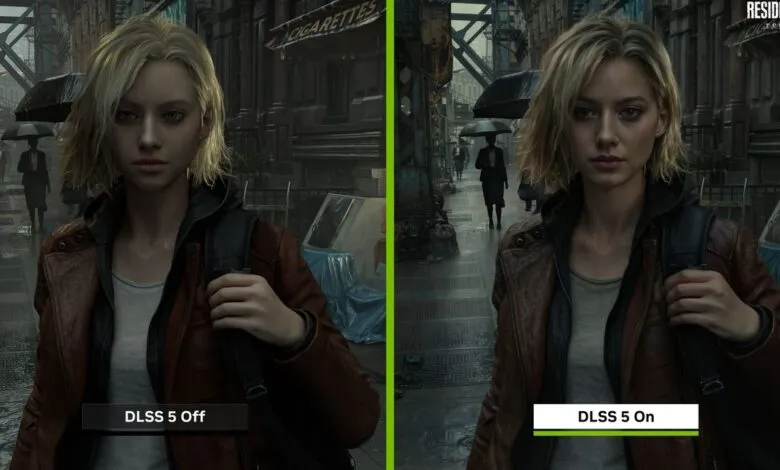
The announcement of Nvidia’s DLSS 5 has ignited a firestorm of criticism from both players and creators, marking a significant departure for the company’s celebrated upscaling technology. While previous iterations focused on boosting frame rates through intelligent rendering, this new version ventures into generative AI to alter character faces in real-time, aiming for heightened realism. The initial demonstration, intended to showcase a technical leap, instead provoked widespread backlash for its unsettling aesthetic and implications for artistic control.
Deep-learning super-sampling, or DLSS, has been a cornerstone of Nvidia’s graphics technology since 2018. Its core function has always been performance-oriented: rendering games at a lower resolution and using AI to intelligently upscale the image, or inserting AI-generated frames between rendered ones. This process conserves computing power, allowing for smoother gameplay on demanding titles without a major hardware upgrade. The feature remains optional, a toggle in a game’s settings menu that users can enable or disable based on their preferences.
From an engineering perspective, the advancement is undeniable. Pushing this level of generative AI processing to a consumer graphics card, rather than relying on cloud servers, represents a formidable technical hurdle. The capability to analyze and modify complex textures like human skin and facial geometry in real time is a substantial computational achievement.
However, DLSS 5 crosses a fundamental line by actively changing artistic content. It is no longer just a tool for rendering efficiency; it becomes an engine for altering visual design. The technology operates by analyzing in-game assets and generating new, “enhanced” details—such as pores, skin texture, and lighting—on the fly. This happens without the direct input or consent of the game’s original artists, leading to a final output that may contradict their creative vision.
The demos shown for popular titles highlighted these concerns. While Nvidia promoted improvements in photorealism and lighting, the results were frequently criticized. Many observers noted an artificial, almost clinical quality to the new lighting, comparing it to the harsh glow of a ring light used in photography. The alterations to character faces proved especially contentious. The AI tended to apply a homogenized standard of beauty, enlarging eyes, plumping lips, and reshaping facial structures in a way that many likened to aggressive social media beauty filters. This led to accusations of the technology unnecessarily sexualizing characters and stripping them of their original, intended personality and design.
Beyond aesthetic disagreements, the demo revealed practical flaws. The real-time generation can introduce visual artifacts—glitches or inconsistencies in the image. In one scene from a sports game, the AI mistakenly rendered part of the soccer net onto the ball before it had even reached the goal. In another, a character’s facial features were noticeably and inconsistently altered from one moment to the next. These errors underscore the technology’s current instability when making complex generative changes on the fly.
For developers and artists, this represents a profound issue of creative integrity. The technology effectively layers a filter over their work, potentially distorting narrative tone, character identity, and visual cohesion. It risks reducing nuanced artistic decisions to a standardized, AI-determined idea of “better,” which many argue devalues the craft and intent behind the original assets. The controversy around DLSS 5 is less about its technical prowess and more about its role: is it an assistive tool, or does it become an uninvited co-artist? The strong negative reaction suggests the gaming community currently views it as the latter.
(Source: Wired)