I Met Olaf, the Robot Shaping Disney’s Future
▼ Summary
– The Olaf robot is a Disney Imagineering creation that uses reinforcement learning in a simulation to achieve screen-accurate, lifelike movement, crossing the uncanny valley.
– It is not AI-powered but is a teleoperated puppet controlled by a human using a Steam Deck to trigger pre-recorded lines and animated movements.
– A key to its believability is its eye movement, as the eyes lead the body’s motion, which makes observers instinctively perceive it as a living being.
– Disney is open-sourcing some of its robotics tools, like the Kamino simulation platform, to advance the field and accelerate the creation of future interactive characters.
– While not fully autonomous yet, such robots represent a future where Disney can quickly populate parks with interactive characters that can perform together.
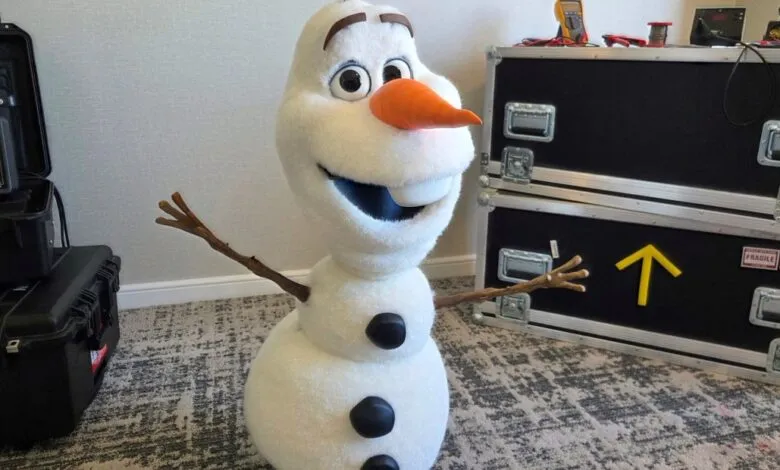
The experience of meeting a beloved animated character brought to life through advanced robotics is both surreal and captivating. Disney Imagineering’s new robotic Olaf, set to debut at Disneyland Paris and Hong Kong Disneyland, represents a significant leap in character animation and interactive entertainment. This isn’t a simple animatronic; it’s a meticulously engineered figure whose movements were perfected in a virtual simulation, training 100,000 digital copies to move with screen-accurate charm. The project leverages cutting-edge reinforcement learning, a technique Disney executives describe as the “true unlock” for rapidly creating interactive robotic characters for its parks.
There’s an undeniable magic when Olaf is in motion. The 35-inch-tall robot waddles with a convincing, lifelike gait that immediately makes you think of him as a “he,” despite knowing he’s a remote-controlled machine. The secret to this illusion lies in a principle explained by Disney researchers: “The eyes go first, and the body follows.” This subtle detail, where the eye movement initiates the action, tricks our brains into perceiving a living being. His sparkling, four-way-stretch costume and magnetic accessories add to the enchanting physical presence.
Technically, Olaf is a complex assembly of 25 actuators, powered by computers including an Nvidia Jetson Orin NX. He is not artificially intelligent; his voice lines are prerecorded by Josh Gad. For now, an operator uses a Steam Deck handheld to control his walking direction, eye gaze, and select from pages of conversational prompts. The groundbreaking work is in how he was trained. Using a custom simulation tool called Kamino and Nvidia hardware, engineers used reinforcement learning to reward virtual Olafs for quiet, cool, and character-perfect movements. This process solved major engineering challenges, like preventing his heavy head from overheating the neck joint and minimizing the noise from his distinctive clomping walk.
Disney is taking an unusually open approach with this technology. The company has contributed its Newton Physics Engine to open source and is now sharing Kamino, the simulation platform that trained Olaf. These tools are designed to work with industry-standard animation software like Maya, allowing animators to focus on crafting emotional performances while the physics simulation determines how the robot can physically achieve them.
While the current version requires a puppeteer, the future roadmap is ambitious. Olaf will first appear in choreographed, time-coded performances, such as on a boat in a lagoon. Imagineers have already tested him on a rocking mock-up, with impressive results. The long-term vision is to create “believable autonomy” and enable interactions between multiple robotic characters from different franchises. This could eventually allow Olaf to share the stage with other robotic figures, creating dynamic, living scenes that were previously impossible.
The illusion may falter when Olaf stands still, and fully autonomous behavior is still on the horizon. Yet, in motion, he is a compelling glimpse into a future where Disney’s animated icons can step off the screen and into the world, inviting guests to believe in the magic in a whole new way.
(Source: The Verge)