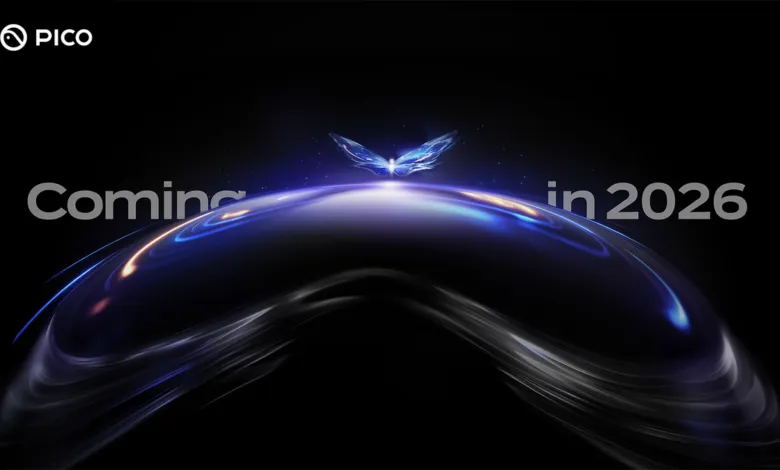
Pico’s Next Headset: 4K OLED, New Chip & Next-Gen OS Revealed
▼ Summary
– ByteDance’s Pico has officially announced the key display and compute specs for its upcoming “Project Swan” headset, which will feature 4000 PPI micro-OLED panels and a dual-chip architecture.
– The headset’s primary processor will offer double the CPU and GPU performance of the current Snapdragon XR2 Gen 2, and its custom coprocessor matches Apple Vision Pro’s R1 chip with approximately 12 milliseconds of latency.
– Project Swan will run on the newly detailed Pico OS 6, an XR operating system with an advanced compositor that allows 2D and 3D apps to run simultaneously in mixed reality, unlike Meta’s or Google’s systems.
– The core of this OS is the Pico Spatial Engine, a unified rendering system built over two years that supports features like environmental lighting, spatial audio, and physics for cohesive app experiences.
– Pico has opened a closed beta application for a global early access program, seeking rigorous feedback from selected XR experts on both the Project Swan hardware and Pico OS 6 software.
ByteDance’s Pico division has officially detailed the core specifications for its upcoming high-end VR headset, codenamed Project Swan, alongside a comprehensive reveal of its next-generation operating system, Pico OS 6. This dual announcement signals a major push into the competitive spatial computing arena, aiming to deliver a significant leap in visual fidelity and system capability. The headset is slated for a broader release later this year, with a closed beta program now accepting applications.
The centerpiece of Project Swan is its display technology. Pico confirms the use of new-generation micro-OLED panels boasting an impressive 4000 pixels per inch (PPI). This hardware is projected to achieve an average angular resolution of 40 pixels per degree (PPD), with peaks reaching 45 PPD. These figures suggest a visual clarity that surpasses devices like the Apple Vision Pro, promising sharp text rendering suitable for virtual monitors and demanding applications. While the exact per-eye resolution depends on the final field of view, a 4K-level experience is strongly indicated.
Powering this visual experience is a dual-chip architecture. The primary processor remains unspecified, but Pico states it will offer double the CPU and GPU performance of the current Snapdragon XR2 Gen 2 found in leading headsets. A custom, self-developed co-processor will handle computer vision and image processing, targeting a latency of approximately 12 milliseconds. This matches the performance claim Apple makes for its dedicated R1 chip, highlighting Pico’s focus on responsive, real-time environmental interaction. Beyond confirming integrated hand and eye tracking, the company has not yet disclosed further hardware details, including the final form factor or whether it will utilize a tethered compute puck.
While the new hardware generates excitement, Pico’s primary emphasis is on the software that will drive it: Pico OS 6. This completely revamped XR operating system introduces the Pico Spatial Engine, a foundational technology developed over two years. Similar in concept to Apple’s visionOS, this engine features an advanced OS-level compositor with a unified rendering architecture. This allows both 2D and 3D applications to run simultaneously in a shared spatial environment, whether against a virtual backdrop or a user’s physical surroundings.
This multitasking capability represents a fundamental departure from competitors like Meta’s Horizon OS, which typically runs only one 3D app at a time. The Pico Spatial Engine manages all rendering and interaction, ensuring system-wide consistency for features like environmental lighting, dynamic occlusion, spatial audio, physics, and scene understanding. The OS features a new design language called Cloud Crystal and provides developers with the Pico Spatial UI system to create adaptive interfaces.
For development, Pico is supporting multiple pathways. Creators can use the new Pico Spatial SDK with Android Studio and Kotlin, or continue using Unreal Engine and Unity with new plugins that unlock the Spatial Engine’s features. The company reaffirms full support for the OpenXR standard, ensuring backward compatibility with existing Pico 4 Ultra applications. Additionally, Pico introduced WebSpatial, an open-source WebXR framework designed to let web developers easily build spatial experiences using familiar HTML, CSS, and JavaScript.
To refine both the Project Swan hardware and Pico OS 6 before launch, Pico has initiated a global early access program. The company is seeking a select group of developers and XR experts with deep platform expertise to participate in a closed beta, emphasizing the desire for rigorous feedback to polish the final product. Interested parties can apply through an official ByteDance form.
(Source: Upload VR)