The AI Automation Trap: Fixing Broken Workflows First
▼ Summary
– The article warns against simply adding AI to existing inefficient workflows, comparing it to paving over meandering cow paths, which creates faster chaos rather than true efficiency.
– It criticizes isolated “random acts of AI,” where tools are used for individual tasks but the underlying slow, siloed processes and approval loops remain unchanged.
– The author advocates for a “dual engine” approach, which requires simultaneously optimizing workflows to remove friction and then integrating AI into the improved processes.
– A practical method involves mapping real-world process friction points and applying an “AI automation inversion” to redesign workflows around what humans should do after AI handles routine work.
– Significant gains come from moving from using AI for simple task augmentation to deploying AI agents that execute entire workflows, but this requires clear, structured processes to succeed.
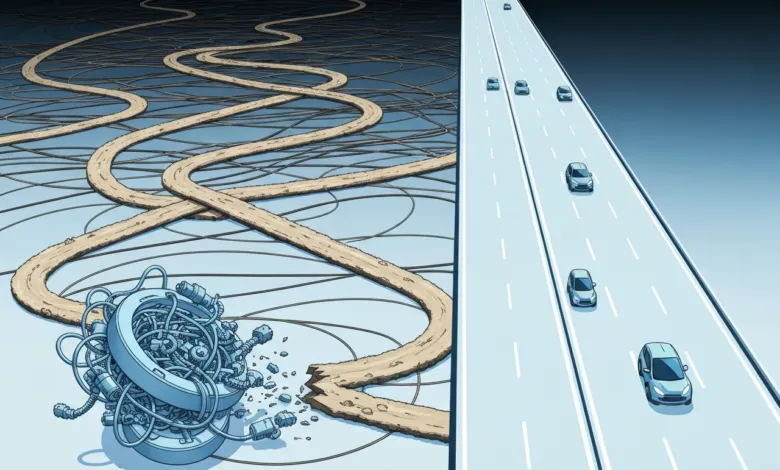
Many marketing teams find themselves at a crossroads, pressured to adopt artificial intelligence but unsure where to begin. The common mistake is to simply layer new technology onto old, inefficient ways of working. This approach, much like paving over a wandering cow path, only makes a bad process happen faster. The key to successful AI implementation is not to automate existing workflows, but to redesign them from the ground up. Before investing in another tool, organizations must audit their processes to remove friction and clarify purpose, ensuring AI amplifies human potential rather than accelerating chaos.
A frequent pitfall in today’s rush to modernize is what can be called random acts of AI. This occurs when individuals or teams adopt tools in isolation, a writer uses a chatbot, a designer employs an image generator, without considering the broader system. While individual tasks may see improvement, the overall workflow often remains broken. Drafts still languish in inboxes, approvals still create bottlenecks, and handoffs still cause strategic intent to get lost. We optimize the tasks but ignore the connections between them, ultimately walking in circles on a newly paved, but still nonsensical, path.
To build a truly adaptive organization, one that can sense and respond in real-time, leaders must stop viewing AI as merely a productivity tool for individuals. Instead, it should be seen as a catalyst for systemic change. This requires running two critical workstreams in parallel: process optimization and AI integration. You cannot have one without the other. Optimizing a process without AI misses exponential gains, while integrating AI into a flawed process only automates waste and inefficiency.
A practical, four-step methodology can guide teams in fixing the workflow before introducing new technology.
First, teams must map the friction points. Gather stakeholders and chart a specific process, like launching a campaign, focusing on what actually happens versus what should happen. Identify two critical issues: organizational friction, where work stops or waits, and fidelity loss, where information becomes distorted through multiple handoffs. AI depends on clean data and clear signals; processes built on informal conversations and vague approvals will cause any AI initiative to fail. Question every step: Is this necessary, or is it merely a legacy habit?
Next, apply the AI automation inversion. Instead of asking which tasks AI can automate, flip the question. If machines handled all routine work, what uniquely human capabilities should your team amplify? For example, one marketing team analyzed their newsletter process and found it involved five handoffs among four people, taking four days due to constant waiting. By inverting the problem, they realized they didn’t need a faster writer; they needed an automated workflow. They redesigned the process so an AI agent could detect a new blog post, draft content, generate graphics, and stage everything for a single human review. The human role shifted from manual execution to strategic oversight, slashing the cycle time from days to a single hour.
Then, decide on the appropriate level of AI intervention. Augmentation uses AI as a tool for individual tasks, like refining a subject line. Automation, or agentic AI, allows AI to execute entire workflows, such as scoring a lead, researching the company, and drafting a personalized email autonomously. The most significant future productivity gains will come from moving from augmentation to agents. However, agents require structure, clear rules and well-defined processes. They need a properly engineered highway, not a meandering dirt trail to follow.
The central irony is that teams are often too buried in busywork to fix the very processes that create it. This AI time paradox means we are too busy bailing water to patch the hole in the boat. Breaking this cycle requires a conscious decision to pause. Leaders must carve out time to map their value streams and critically examine long-standing procedures, willing to declare that some no longer make sense.
When an organization takes the time to fix the workflow first, AI transforms from just another tool to manage into the engine of a fundamentally better way of working. It shifts the focus from merely speeding up tasks to enabling strategic creativity and innovation, building a system designed for the future rather than perpetuating the past.
(Source: MarTech)