Topic: user intent understanding
-

How Google Maps Keyword Fragmentation to User Needs in AI Search
Google's AI search shift allows users to express complex, natural-language queries (e.g., "vegan restaurant for five with kids in NYC") instead of short keywords, fundamentally changing how SEO must approach keyword research and content strategy. Keyword fragmentation and "query fan-out" mean Goo...
Read More » -

Mira Murati’s AI startup reveals its first product
Current AI systems operate with a narrow, single-threaded interaction channel, passively waiting while users input and freezing perception during response generation, which limits collaboration. Thinking Machines, founded by former OpenAI CTO Mira Murati, aims to solve this bandwidth bottleneck b...
Read More » -
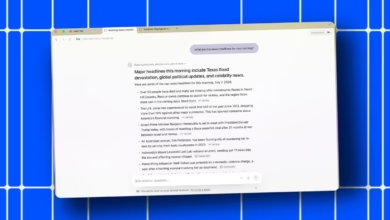
From Skeptic to Fan: How Arc's Dia Replacement Won Me Over
Initially skeptical, the author found Arc's AI-powered browser Dia surprisingly effective, offering a fresh take on web interactions beyond traditional browsing. Dia features a minimalist design with a natural language interface, automating tasks like shopping and news curation while maintaining ...
Read More » -

Microsoft Clarity Launches Citations Dashboard
Microsoft has launched the Citations dashboard in Microsoft Clarity to general availability, providing website owners with data on how their content is cited by AI-powered experiences. The dashboard includes key metrics such as page citations, share of authority, AI referral traffic, queries, cit...
Read More » -
![Google's AI Travel: Uncovering Hidden Gems? [Data Study]](https://digitrendz.blog/z/wp-content/uploads/2025/08/ai-travel-results-919-390x220.png)
Google's AI Travel: Uncovering Hidden Gems? [Data Study]
Google's AI search results are transforming travel discovery by prioritizing unique, firsthand content from smaller sources over traditional authority metrics. While Hidden Gems now appear more frequently, established travel brands still dominate overall visibility due to repetition and user fami...
Read More »