Meta VR Glasses Announced: $1,300 Price, Spring 2027 Release
▼ Summary
– Meta has officially announced the Meta VR Glasses, a lightweight $1300 headset featuring micro-OLED displays and a tethered computing puck.
– The device utilizes a split architecture with a Qualcomm Snapdragon Reality Elite chipset in the puck to achieve high resolution and passively cooled comfort.
– Unlike previous headsets, the glasses lack onboard computing and rely entirely on the external puck for power, data, and processing via a fiber optic cable.
– While offering superior display quality and IMAX Enhanced certification, the glasses sacrifice field of view compared to the Quest 3 and do not include controllers by default.
– The product competes with devices like the Apple Vision Pro and Quest 3, highlighting trade-offs between resolution, weight, and field of view in its specifications.
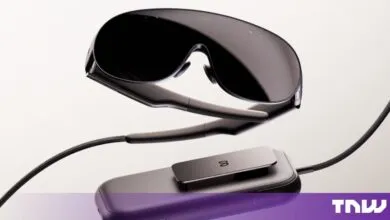
Meta has officially unveiled its latest wearable technology, the Meta VR Glasses, a device that redefines the boundary between augmented reality and virtual immersion. Priced at $1,300 and scheduled for release in Spring 2027, these glasses utilize a unique split-architecture design to achieve a remarkably lightweight form factor. The headset itself weighs approximately 100 grams and features 2.4K micro-OLED displays, but it lacks onboard processing power. Instead, it relies entirely on a tethered puck containing Qualcomm’s Snapdragon Reality Elite chipset.
This external computing unit houses 12GB of RAM and 128GB of storage, with an additional microSD slot for expansion. The puck runs the same operating system as the Quest 3, ensuring broad content compatibility. To maximize visual fidelity, the system employs eye-tracked foveated rendering, allowing the more powerful processor to deliver significantly higher resolutions than previous standalone headsets. The connection between the glasses and the puck is maintained via a thin, flexible hybrid fiber optic cable, which trans both power and data while keeping the user interface unobtrusive.
A Shift in Design Philosophy
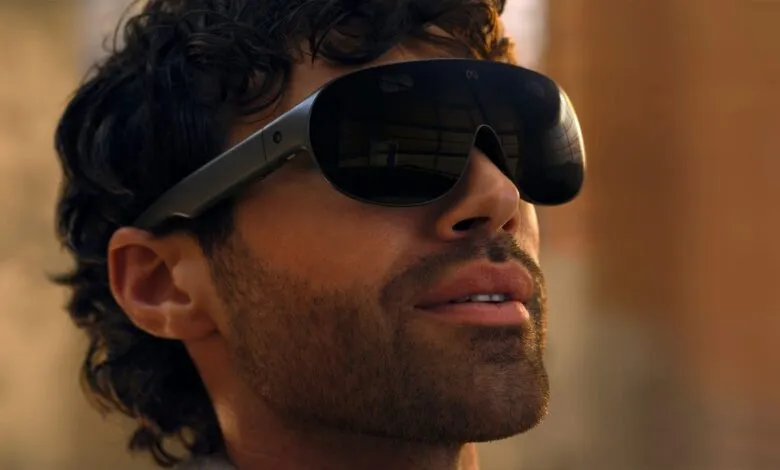
The most striking difference between Meta VR Glasses and traditional all-in-one headsets like the Quest series is the elimination of bulk. By offloading all computational tasks to the 300-gram puck, which is roughly the size of two smartphones stacked together, Meta has created a device that feels more like eyewear than a gaming console. The frame is constructed from magnesium alloy, enabling a fanless, passively cooled design that maintains comfort during extended use.
Visually, the glasses offer an open-periphery design, allowing users to naturally see their surroundings to the sides and below. This contrasts sharply with the enclosed experience of standard VR headsets. The dual 120Hz micro-OLED displays provide a resolution of 2412×2288 per eye, marking Meta’s first non-LCD headset since the original Oculus Quest in 2019. The device supports Dolby Vision HDR and holds the distinction of being the first VR product to receive IMAX Enhanced certification.
However, this sleek design comes with optical trade-offs. The field of view measures 70° horizontal by 66° vertical, equating to roughly 87° diagonal. This is considerably narrower than the Quest 3’s 110° horizontal by 96° vertical range. While this limitation may reduce immersion when using optional light blockers for fully opaque experiences, it allows the glasses to excel in mixed reality scenarios where maintaining awareness of the physical environment is beneficial.
Content Ecosystem and Compatibility
Because the glasses do not include controllers by default, users must purchase them separately or pair existing ones. Meta will sell Touch Plus controllers in a new all-black color, and owners can also connect controllers from their Quest 3 or Quest 3S devices. Bundles including controllers will be available through select retail channels. For those who prefer not to use physical controllers, Meta announced several new hand-tracking games, including a mode called Flux for Beat Saber.
Connectivity options have also been expanded. Users can now plug any USB-C DisplayPort device, such as a smartphone, laptop, or gaming handheld, directly into the puck to project a virtual screen. This eliminates the need for external capture cards, streamlining the process of viewing external content within the headset.
Advanced Avatar Technology
Meta VR Glasses will introduce the first implementation of Hologram, a realistic avatar technology similar to Apple Vision Pro’s Personas. This feature allows users to join flatscreen WhatsApp video calls as photorealistic, face-tracked avatars. In mixed reality environments with other Meta VR Glasses or Quest 3 owners, these avatars appear at true scale. At launch, however, the Hologram will function as a stereoscopic video stream rather than a volumetric 3D model. It will display a front-angle view regardless of the user’s perspective, akin to billboarded assets in video games. Meta intends to evolve this technology post-launch into a full 6DoF 3D system, eventually replacing the cartoonish Meta Avatars as the platform’s default avatar experience.
Marketing the device as “a private cinema, multiple monitor workspace, and game console in one device that fits in your bag,” Meta aims to position the VR Glasses as a versatile tool for productivity and entertainment. While competitors like Xreal offer similar portable displays, Meta’s solution distinguishes itself with a larger field of view, higher resolution, and integrated eye tracking. As the industry moves toward lighter, more socially acceptable AR/VR hybrids, the success of this tethered approach will likely influence future developments in wearable computing.
(Source: UploadVR)