Meta’s Muse AI Gets a Tamagotchi-Inspired Wearable

▼ Summary
– Meta has introduced the Muse Charm, a new AI wearable device designed to house its personal AI agent, Muse.
– CEO Mark Zuckerberg announced the product during the company’s annual Connect event as part of a special reveal segment.
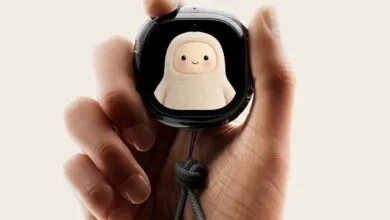
– The palm-sized gadget features a small screen displaying an avatar named Jolly and uses a fingerprint sensor for activation.
– Users can interact with the device via voice commands without needing to unlock a phone or open a specific application.
– The device is scheduled to ship in December, aiming to provide a convenient way to stay connected to Meta’s AI services.
Meta has unveiled a new physical interface for its AI ambitions, introducing the Muse Charm to bridge the gap between digital assistants and tangible hardware. While the tech sector has grown weary of gimmicky “AI amulets” that often feel more like novelties than functional tools, Meta is betting on this palm-sized wearable to deepen engagement with its popular personal AI agent. The device was announced by CEO Mark Zuckerberg as a surprise addition during the company’s Connect conference, marking a strategic push to make artificial intelligence more accessible through dedicated hardware rather than relying solely on smartphones or smart glasses.
The Muse Charm is scheduled to begin shipping in December, positioning it as a holiday gift option. Although the product is not yet ready for immediate distribution, Zuckerberg assured attendees that his engineering team is finalizing the internal components to ensure quality before release. The charm itself acts as a portable home for Muse, Meta’s conversational AI, which is visually represented by a cheerful digital avatar internally known as Jolly. This small totem can be clipped onto keychains or kept in pockets, featuring a miniature screen that brings the avatar to life. Users interact with the device primarily through voice commands, allowing the AI to handle tasks and provide information without requiring them to pull out their phones.
To facilitate seamless interaction, the device incorporates a fingerprint sensor located in the corner of the unit. This design choice eliminates the need to unlock a phone or launch a specific application to start a conversation. By placing the sensor there, Meta aims to create an intuitive, always-on experience where users can initiate dialogue instantly. The integration of real-time voice processing and the animated avatar stack into such a compact form factor represents a significant engineering effort, aiming to provide a constant companion for daily interactions.
Zuckerberg highlighted the utility of the device for users who do not wear Meta’s AR glasses, describing it as the most efficient method to communicate with the assistant while staying aware of one’s surroundings. He stated: “We packed the whole Muse experience, including the whole real-time voice and avatar stack, into something that fits on a keychain and is always available to talk to.” He further emphasized the convenience of the hardware, noting: “You just go ahead and tap here in the fingerprint sensor in the corner, and you can start talking without having to unlock a phone or open an app.” For those outside the ecosystem of head-mounted displays, he added: “So if you’re not wearing glasses, this is going to be by far the fastest way to talk to your Muse and to show what’s going on around you.”
The aesthetic and functional design of the Muse Charm draws clear inspiration from the Tamagotchi, evoking a sense of playful attachment and continuous care. Much like the classic virtual pets, the device relies on personality and responsiveness to maintain user interest, serving as a low-stakes entry point for Meta to experiment with wearable technology. This approach allows the social media giant to distribute its AI capabilities to a broader audience while gathering valuable data on how people interact with persistent, physical AI agents. By moving beyond screens and into everyday accessories, Meta is attempting to normalize the presence of AI in physical spaces, transforming abstract code into a tangible, pocket-sized companion.
(Source: TechCrunch)