Toyota Trains Workers on Humanoid Robots, Rules Out Job Replacements
▼ Summary
– Toyota plans to invest $6.42 billion annually starting in 2028 to deploy 400,000 factory robots across its facilities.
– The automaker is currently training ELEY humanoid robots by having workers teach them precise hand movements using finger-based jigs.
– Executive Hiroki Nakajima stated the goal is for robots to coexist with humans rather than directly replace the existing workforce.
– Toyota employs 18,000 veteran workers globally, including at 11 US manufacturing plants, amid this technological shift.
– Global industrial robot deployment reached 2 million units in China in 2024, highlighting the industry’s rapid automation trends.
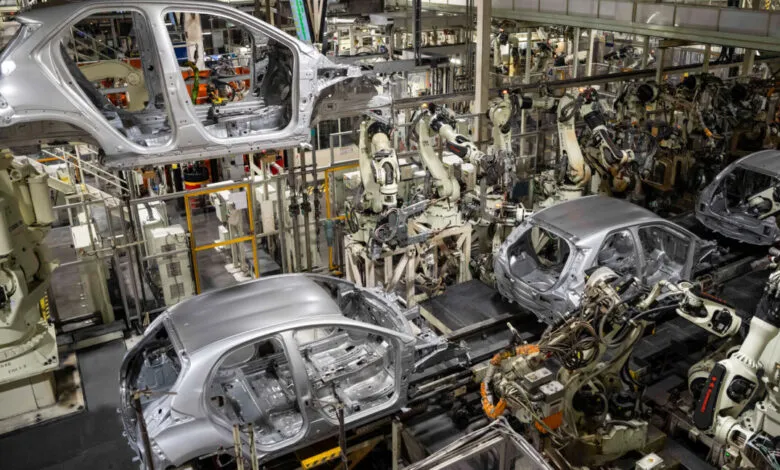
Toyota is actively training humanoid robots to assist in its manufacturing processes, a strategic move aimed at deploying 400,000 factory robots by the end of the decade. Despite this aggressive expansion into automation, company leadership has firmly stated that the initiative is not designed to eliminate human roles within the workforce.
Financial commitments for this technological overhaul are substantial. Beginning in 2028, the Toyota Motor Group plans to allocate $6.42 billion annually to integrate these advanced machines into its production facilities. The goal involves placing 150,000 robots directly within its own automotive assembly plants and an additional 250,000 units across group companies responsible for producing components and raw materials.
To achieve this level of integration, Toyota has already initiated pilot programs on its assembly lines. Workers are currently teaching ELEY humanoid robots, which operate on wheels, how to execute tasks that require dexterous hand movements. This training process involves employees wearing specialized “jigs” modeled after the robots’ fingers, allowing them to guide the machines through precise operations. This hands-on approach highlights the collaborative nature of the current deployment phase.
The rapid introduction of such technology naturally sparks concerns regarding the stability of the human workforce. Toyota employs 18,000 veteran workers across 60 factories globally, including eleven facilities located in the United States. Addressing these concerns, Hiroki Nakajima, a Toyota executive vice president, clarified the company’s philosophy to Nikkei Asia. He emphasized that the objective is “a world where robots coexist with humans, rather than replacing them.”
While specific figures on the total number of robots currently in operation or the exact proportion of humanoid units remain undisclosed, the broader automotive sector has long been a pioneer in industrial automation. For decades, manufacturers have relied on stationary robotic arms for specific tasks and mobile robots for material handling. Toyota’s shift toward humanoid forms represents an evolution in how these tools interact with human operators.
The global context for this automation surge is significant. According to data from the International Federation of Robotics, China led the world in industrial robot deployments in 2024 with 2 million units. Japan followed as the second-largest market with 450,500 robots. The United States and South Korea rounded out the top four, installing 34,200 and 30,600 robots respectively, underscoring the widespread adoption of robotics across major manufacturing economies.
(Source: Ars Technica)


