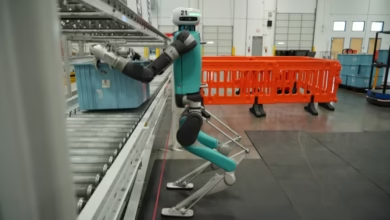
Humanoid robotics firm goes public, CEO downplays home robot timeline

▼ Summary
– Agility Robotics plans to go public via a SPAC merger with Churchill Capital Corp XI, valuing the company at around $2.5 billion and expected to raise over $620 million, making it the first pure-play humanoid robotics company on public markets.
– Agility’s bipedal robot Digit, designed for warehouses and factories, features reverse-bend knees and specialized hands for moving heavy totes, with a focus on task-specific functionality over biomimicry.
– The company has over $300 million in booked, multi-year revenue from a robots-as-a-service model, with customers including GXO Logistics, Amazon, and Toyota, and plans to use SPAC proceeds to ramp production at its Oregon facility.
– CEO Peggy Johnson emphasizes Agility’s decade-long real-world deployment data and industrial safety certifications as key advantages over competitors, noting that safety must be built in from the start, not added later.
– Johnson estimates humanoid robots for home use are 10-plus years away, as warehouses offer more predictable environments, while Agility remains focused on filling over a million unfilled U.S. warehouse jobs.
The humanoid robotics sector is currently experiencing an extraordinary influx of capital. Just last week, AI2 Robotics, a Shenzhen-based startup specializing in wheeled humanoid designs, secured approximately $735 million at a valuation nearing $3 billion. Earlier this year, Apptronik, an Austin-based competitor focused on manufacturing and logistics, closed a $935 million funding round that pushed its valuation past $5.5 billion. And last fall, Figure AI, a San Jose-based firm pursuing general-purpose humanoids, reported a $1 billion Series C round at a staggering $39 billion valuation.
Against this backdrop of eye-popping numbers, Peggy Johnson, CEO of Agility Robotics, offers a surprisingly grounded perspective. We connected by phone just after the company announced plans to go public via a merger with Michael Klein’s Churchill Capital Corp XI, a special purpose acquisition company, or SPAC. The deal values Agility at roughly $2.5 billion and is expected to generate over $620 million in gross proceeds, marking the largest capital raise in humanoid robotics history. The merger is still pending shareholder approval and SEC review, with completion anticipated later this year.
Founded in 2015 as a spinoff from Oregon State University and based in Salem, Oregon, Agility builds bipedal humanoid robots for warehouse and factory environments. This SPAC maneuver is significant for several reasons. It would make Agility the first pure-play humanoid robotics company on public markets, offering retail investors direct access to a sector typically reserved for deep-pocketed venture capital funds. It also provides a rare glimpse into the financials of a business in an industry where most competitors closely guard their numbers and technological progress.
Johnson, a former executive vice president at Microsoft who helped orchestrate the $26 billion LinkedIn acquisition and later led Magic Leap, was measured throughout our conversation. She declined to offer forward-looking financial guidance, refused to disclose the bill of materials for Agility’s flagship robot Digit, and gently pushed back when questions drifted into speculation.
When asked why Agility chose a SPAC over another private fundraising round, Johnson explained it comes down to first-mover advantage. For investors eager to buy into a buzzy robotics company, Agility represents “an acceleration story and a timing story.” The proceeds will also help ramp up production at Agility’s 70,000-square-foot facility in Salem and fulfill an existing pipeline of customer orders.
As for the troubled reputation of SPACs, many of which fizzled after the 2021 boom, Johnson remained unfazed. “If we just keep our head down, keep delivering customer by customer, robot by robot, we hopefully won’t experience the same volatility,” she said. “Our biggest competitor right now is just us. How quickly we can execute, how quickly we can continue to add new skills.”
The pipeline extends well beyond pilot programs, Johnson told TechCrunch, pointing to over $300 million in booked, multi-year revenue representing roughly 1,000 robots under a robots-as-a-service model. Customers pay monthly fees rather than purchasing the machines outright. “Everybody on our list right now is already vetted, and they have deployment plans behind their proof of concepts,” Johnson said. Customers include GXO Logistics, Amazon, Toyota Motor Manufacturing Canada, Schaeffler, and Mercado Libre.
Digit itself is a deliberately simple piece of hardware. Standing about 5’9″ and weighing around 160 pounds, it is designed to do one thing exceptionally well: move heavy objects in human-built spaces. Its most distinctive feature is a set of reverse-bend knees, sometimes called “bird legs,” which allow it to reach from floor level to overhead shelving without colliding with warehouse racking. Agility’s founders, Johnson explained, were not interested in biomimicry for its own sake. The robot’s hands, with two thumbs and two fingers, are similarly task-specific, optimized for gripping heavy plastic totes even as their contents shift.
Johnson said Agility is “LLM-agnostic,” drawing on models including Claude and Gemini to handle what she calls the semantic layer, translating high-level instructions into robot behavior. She described a recent test where engineers scattered different types of trash on the floor and told Digit simply to “clean up this mess.” The robot assessed, sorted, and binned everything correctly, including identifying bubble wrap as non-recyclable.
But it is the physical layer, the mechanics of balance, locomotion, and manipulation, that Agility considers its core proprietary advantage, built over more than a decade of real-world deployment. “The LLMs had the entire internet to train on,” Johnson said. “When you think about the physical AI of humanoids, that doesn’t quite exist yet.” She believes Agility is the exception: “We may have the largest data lake of actual operating robotics data in real-world environments.”
Beyond raw data, Johnson emphasized that safety is where the gulf between Agility and its competitors is widest and most consequential. While rival companies showcase robots in lab demos and choreographed videos, Agility has had to meet actual industrial safety certification requirements to operate inside customer facilities. “You can’t build your robot and then make it safe,” she said. “That’s a redesign. You have to have all of the safety certified, the electrical system, all of the parts, and the software to support all of that.” This is not a trivial concern given that humans are often nearby. In November, Figure AI’s former head of product safety sued the company, alleging he was fired after raising concerns that its robots were powerful enough to fracture a human skull. Figure has disputed the claims.
As for the home, Johnson thinks humanoids will eventually make it there, but not anytime soon. It will be “10-plus years” before they deliver breakfast in bed, she said. Warehouses and factories, for all their complexity, have fixed aisles and predictable equipment and workflows. Homes, by contrast, are chaotic, with dogs, babies, visitors, and objects left in unexpected places.
“At least roads have some discipline to them,” Johnson added, comparing the challenge to autonomous vehicles. “Most of the areas that humanoids will be operating in don’t.”
Agility isn’t ruling out the home market. Johnson said the company will enter it when it makes sense. For now, though, it is laser-focused on the warehouse market, given the growing number of retiring workers and younger workers unwilling to take physically demanding roles. “There’s something like over a million jobs in the US today in these areas that are unfilled,” she said. “They’re just very, very hard to hire for.”
(Source: TechCrunch)