ChatGPT Images 2.0 Preview: Impressive with One Flaw
▼ Summary
– OpenAI released ChatGPT Images 2.0, a new image model focused on precision and complex visual tasks.
– The model reframes image generation as a visual language, combining text and images to build detailed pages or infographics.
– It features enhanced “thinking” capabilities that allow it to interpret vague prompts, gather relevant data, and produce context-aware outputs.
– The model offers improved design control, supporting a wide range of aspect ratios and higher-fidelity text and object rendering.
– Early testing shows the model still struggles with brand fidelity, as it repeatedly failed to accurately reproduce the ZDNET logo.
OpenAI has unveiled a significant upgrade to its visual AI with the launch of ChatGPT Images 2.0. This next-generation model moves beyond simple picture creation, positioning itself as a tool for complex visual tasks and precision design. The company frames this evolution as a shift from generating decorative images to mastering a new visual language, where an image functions like a well-crafted sentence to explain, argue, or reveal ideas.
A core advancement is the model’s enhanced thinking capability. This allows it to interpret vague, high-level instructions and execute multi-step workflows. For instance, asking for an infographic about activities suited to tomorrow’s weather in San Francisco triggers the AI to research local forecasts, identify appropriate pursuits, and then design a coherent visual layout presenting that information. This positions the tool as a visual thought partner capable of carrying a project from a rough concept to a polished asset.
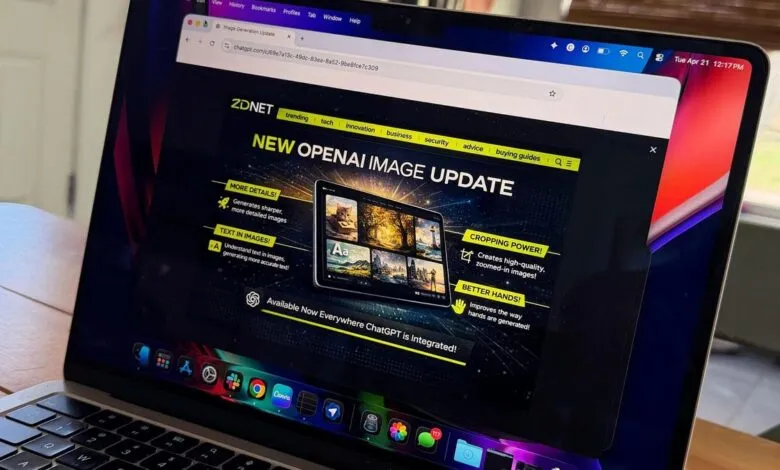
Precision and design control see major improvements, addressing long-standing user frustrations. The model now supports a wide range of aspect ratios, from a panoramic 3:1 to a tall 1:3, giving creators more flexibility. It also promises higher fidelity in outputs, with better object placement, detailed text rendering, and the ability to handle small UI elements and stylistic constraints at resolutions up to 2K.
Early testing of a preview build reveals both impressive power and a persistent flaw. When tasked with creating a brand-accurate infographic for ZDNET using a provided homepage and press release, the model excelled at synthesizing content into a clean, informative graphic. However, it consistently failed to accurately reproduce the ZDNET logo. Attempts yielded a drooping “Z,” an outdated logo from before a 2022 redesign, and even a distorted “D” with an added rudder shape. Despite explicit instructions and new sessions, the AI could not achieve brand fidelity, a critical shortfall for professional use.
The new model is available now to all ChatGPT and Codex users on desktop, with a mobile version promised soon. The more advanced thinking capabilities are reserved for ChatGPT Plus, Pro, Business, and Enterprise subscribers, who must select the “Thinking” mode from a dropdown menu. The technology is also accessible via an API, with pricing that scales based on output quality, resolution, and the complexity of the reasoning required.
While this iteration demonstrates a leap in visual reasoning and compositional skill, its struggle with precise brand replication highlights an area needing refinement. As these tools begin to handle integrated layout and content creation, they promise to reshape design workflows, provided they can master the nuances of consistent visual identity.
(Source: ZDNet)