AI Doc Director Slams AI Firms for IP Theft

▼ Summary
– AI companies are training models on copyrighted artistic work without permission, using it as essential data fuel in a competitive industry race.
– Several lawsuits from creators and major companies are challenging this practice, arguing it violates copyright law and is not fair use.
– AI companies defend the practice with arguments about cost, international competition, and the legal doctrine of fair use.
– Some AI firms are now making licensing deals with large rights holders, which critics say creates an unfair two-tier system that disadvantages individual creators.
– The legal outcome remains uncertain, with early court rulings favoring AI companies but significant cases still pending.
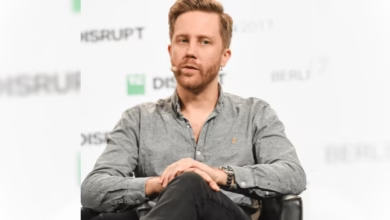
The fundamental training data for today’s most advanced AI models is often sourced from the internet’s vast expanse, including countless works of copyright-protected creative material. This practice, central to the competitive strategies of firms like OpenAI, Google, and Meta, has ignited a fierce legal and ethical debate. Oscar-winning filmmaker Daniel Roher, co-director of The AI Doc: Or How I Became an Apocaloptimist, offers a characteristically direct critique of the industry’s stance. His message to tech executives who justify using protected work without consent is unequivocal.
Roher’s frustration crystallized during a discussion about an AI video company CEO who asserted that training is fair use, period. To Roher, this argument from a financially interested party holds no moral weight. He compares it to a tobacco executive insisting cigarettes are healthy, dismissing any opposition with contempt. For Roher, the appropriate response to such corporate overreach is clear and forceful.
AI corporations typically present a trio of justifications for this approach. First is the sheer cost argument, claiming it’s prohibitively expensive to license the billions of data points needed. Second is a competitive necessity claim, suggesting that because Chinese AI firms operate without such constraints, Western companies must follow suit to keep pace. The third, and most legally pivotal, is the fair use doctrine, which they argue legally shields the act of model training. This interpretation is now being tested in dozens of lawsuits filed by authors, musicians, journalists, and major entities like Disney, all arguing that copyright law must apply equally in the digital age.
While early court rulings have sometimes sided with AI developers, the legal landscape is far from settled. Last year, the U. S. Copyright Office issued a report suggesting training likely falls outside fair use protections, though its opinion is not binding. Roher rejects any notion that the battle is already lost, framing it instead as a profound clash of timelines. He describes it as 25th-century technology colliding with 21st-century society, all regulated by legal frameworks established centuries ago. The final chapter on intellectual property rights in the AI era, he insists, remains unwritten.
The response from the creative community is growing more organized. Following the documentary’s production, co-producer Ted Tremper helped establish the Creators Coalition on AI with figures like Daniel Kwan and Joseph Gordon-Levitt to advocate for artists’ rights. Tremper views recent licensing deals between AI companies and giants like Disney or Universal Music Group with skepticism. He argues this creates a two-tiered system where only entities with formidable legal resources can protect their work, while the personal data and creative output of ordinary individuals are considered fair game.
Tremper challenges the core fair use argument when applied to modern AI. He questions how a system with perfect recall, capable of absorbing more data than a human could in hundreds of lifetimes, and built with the explicit goal of displacing human labor, can be reconciled with traditional concepts of reasonable use. The outcome of this escalating conflict is uncertain, but both sides are preparing for a protracted legal struggle that will undoubtedly define the future of AI development and the value of human creativity within it.
(Source: Mashable)