Besxar Builds Orbital Semiconductor Factory With SpaceX Rockets
▼ Summary
– Startup Besxar has partnered with SpaceX to prototype an orbital semiconductor factory using Falcon 9 boosters.
– Founded by former OpenAI staffer Ashley Pilipiszyn, Besxar aims to manufacture advanced semiconductor precursors in the vacuum of space to avoid Earth-based contamination issues.
– The company raised nearly $14 million in seed funding led by Dauntless Ventures and Overture VC to support its space manufacturing efforts.
– Initial tests on a Starlink mission demonstrated that space-exposed wafers had less particulate matter than terrestrial samples, validating the approach despite minor flight data system malfunctions.
– Besxar plans to scale operations by eventually flying larger fabs on SpaceX’s Starship to supply chipmakers with high-quality materials for power regulation in data centers and electric vehicles.
Orbital manufacturing is rapidly shifting from theoretical concept to operational reality, driven by the increasing reliability of reusable launch systems. While producing goods in space and returning them to Earth has historically been constrained by limited access, the SpaceX Falcon 9 rocket booster has emerged as the dominant workhorse for these missions. With 163 round-trip flights recorded last year and over 100 already completed this year, the booster offers a frequency of service unmatched by other vehicles. Leveraging this infrastructure, Besxar, a startup founded by former OpenAI employee Ashley Pilipiszyn, has secured an agreement with SpaceX to prototype an orbital semiconductor factory across a series of twelve flights using the booster’s payload capacity.
The core thesis behind Besxar’s approach is that the vacuum of space provides a superior environment for fabricating advanced materials compared to terrestrial facilities. Traditional chip fabrication requires massive, energy-intensive clean rooms designed to exclude microscopic dust and contaminants. Pilipiszyn argues that bypassing these earthbound constraints allows for more efficient production methods. To support this vision, the company has raised nearly $14 million, including a $9 million seed round led by Dauntless Ventures and Overture VC.
“We’re at a time where it’s actually more cost-effective to go where the physics already works,” she told TechCrunch. “Don’t do it on Earth where you’re fighting physics.”
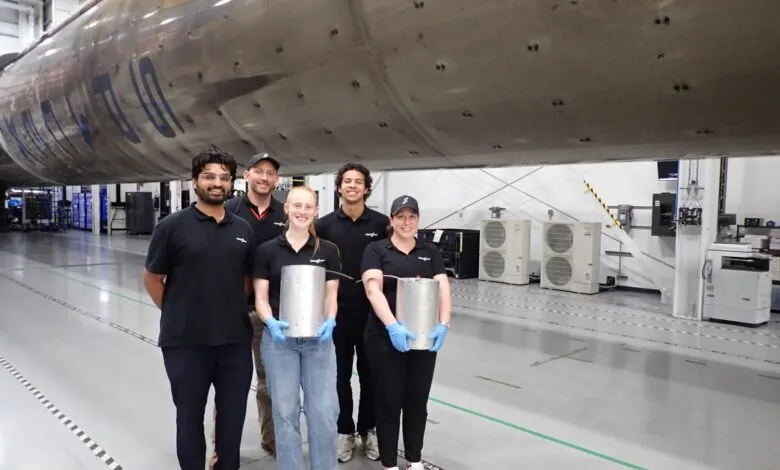
To validate this strategy, Besxar launched its initial two “fabships” aboard a Starlink mission in July. These compact canisters were engineered to transport and test semiconductor materials while exposed to the orbital environment. The primary objectives were to demonstrate survival through launch vibrations, ensure protection against contamination, and successfully expose wafer samples to the vacuum of space. Although one canister experienced a flight data system malfunction, which the team is currently analyzing, the mission was deemed a success.
“The flown samples were the cleanest and had the least amount of particulate matter compared to … non-flown terrestrial wafers, which is fantastic for us as we scale up,” Pilipiszyn told TechCrunch.
Looking ahead, Besxar plans to refine its technology over the next two years before transitioning to larger-scale operations on SpaceX’s Starship. Pilipiszyn initially approached SpaceX three years ago to discuss purchasing flights on the next-generation vehicle but opted for the current booster deal to de-risk her technology in the interim. Future iterations will involve heating wafers and sequentially depositing multiple materials within the controlled space environment. Once qualification samples are produced, the company aims to supply leading chipmakers with wafers essential for power regulation in data centers, robotics, and electric vehicles.
While other firms such as United Semiconductors and Space Forge are also exploring space-based manufacturing, they all face the critical challenge of volume. Scaling production to hundreds or thousands of wafers per fab depends heavily on affordable and frequent launch services. This scalability hinges on the successful deployment of Starship or the emergence of competitive next-generation rockets from companies like Rocket Lab and Stoke Space.
“We believe that there is a solid transport layer now, so we can focus on the application layer,” she told TechCrunch. “We can just focus on our core manufacturing and getting our products back down to earth to market as quickly as possible.”
(Source: TechCrunch)