Poseidon Aerospace Secures $60M Before Pilotless Test
▼ Summary
– Poseidon Aerospace secured $60 million in Series A funding to develop uncrewed cargo planes, building on a previous $11 million seed round.
– Co-founders David Zagaynov and Parker Tenney focus on cost-effective aerologistics rather than flashy new technologies like electric powertrains or vertical takeoff capabilities.
– The company’s aircraft, Egret and Heron, use traditional combustion engines to maximize energy density and minimize operational costs for regional cargo transport.
– Initially targeting defense and commercial sectors, Poseidon aims to serve remote communities with degraded infrastructure to enhance logistics resilience against adversaries.
– Unlike competitors who sell aircraft, Poseidon plans to operate its own regional air cargo business to directly compete with major carriers like UPS and FedEx.
Silicon Valley startup Poseidon Aerospace has raised $60 million in Series A funding, a significant capital injection that positions the company for its upcoming pilotless cargo flight. The round, which closes ahead of the first test of its Egret aircraft later this year, was led by TQ Ventures. New investors including Hanwha Asset Management, G Squared, and JAWS joined existing backers such as Starship Ventures and Draper Associates in supporting the venture. This follows an $11 million seed round secured last year, signaling strong investor confidence in the firm’s unconventional approach to aerologistics.
Rejecting Industry Trends for Practical Efficiency
While many aviation startups chase complex technologies like vertical takeoff and landing (VTOL) or electric powertrains, Poseidon Aerospace is taking a different path. Co-founder and CEO David Zagaynov argues that the industry often gets distracted by flashy innovations at the expense of practical utility. He emphasizes a focus on tangible logistics improvements rather than technological novelty. “Philosophically, we want to build the future of aerologistics,” Zagaynov said. “Not to be a hater, but I think a lot of people who start aerospace companies get nerd-sniped by very cool technology and then want to implement it into market. For us, we want to improve cargo.”
To achieve lower costs, Poseidon utilizes standard combustion engines in fixed-wing designs for both the Egret and its seaplane variant, the Heron. Zagaynov believes that current carbon-based fuels offer superior energy density compared to emerging alternatives. His strategy centers on creating highly efficient, unmanned transport systems that operate on a significantly lower cost curve. “It’s really hard to beat the energy density of fuels of anything carbon-related,” Zagaynov said. “Can I make a really good box with wings to move things for super cheap? If you do that, then abstracting the tech away, we’re left with unmanned cargo like planes that are able to operate on a much lower cost curve, and have much higher utilization.”
Strategic Focus on Defense and Regional Logistics
Poseidon is initially targeting two primary markets: defense operations and regional commercial cargo. In the defense sector, the company aims to serve remote communities and underserved routes where traditional infrastructure is degraded or nonexistent. By enabling logistics in these challenging environments, Poseidon seeks to enhance national resilience against adversary disruptions. The startup has previously highlighted that competitors, including China, are already advancing their own cargo drone capabilities.
On the commercial front, Poseidon does not intend to sell its aircraft. Instead, the company plans to operate its own regional air cargo network, competing directly with major carriers like UPS and FedEx. Removing pilots from the equation allows for greater operational flexibility and reduced expenses. “What’s very nice is, logistics is a commodity, and so if you sell a commodity and do it better, faster, cheaper, the demand is all yours,” he said. This model also allows the company to bypass the traditional hub-and-spoke system, potentially offering more direct point-to-point services similar to low-cost passenger airlines.
Operational Flexibility and Design Advantages
The absence of human crew members offers distinct advantages beyond simple labor cost savings. Without the need to manage pilot schedules, rest periods, and fatigue regulations, Poseidon can optimize aircraft utilization more effectively. Zagaynov notes that manned flights often result in expensive assets sitting idle while waiting for crews or requiring overnight stops. “When you have a pilot, they have a maximum amount of hours that they can fly. So if they fly a five-hour leg in one direction, they’re not able to come back home. And unless you have a relief [pilot], then you have to pay for them to spend the night somewhere,” he said. “The plane is like a very expensive asset that spends most of its life just waiting.”
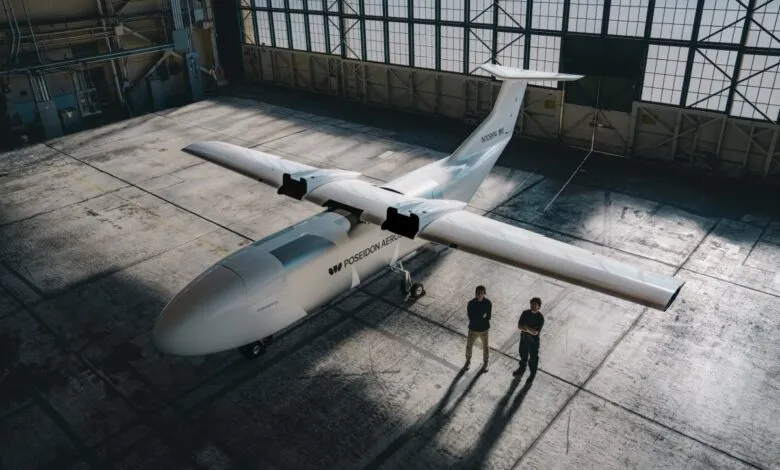
Furthermore, eliminating cockpits and life support systems allows for substantial weight reduction in the airframe. This structural efficiency improves the payload-to-empty-weight ratio, enabling lighter and more efficient engines. The resulting virtuous cycle makes the aircraft cheaper to build and operate. To support the development of its full-size aircraft with a 50-foot wingspan, Poseidon has moved into a large hangar in Alameda, California. The company recently flew a quarter-scale prototype named Seagull and is now ramping up hiring to prepare for the first full-scale flight.
Navigating a Favorable Regulatory Landscape
Poseidon is benefiting from a shifting regulatory environment that is becoming more receptive to new aviation concepts. Although the Federal Aviation Administration’s recent pilot program primarily targets electric vertical takeoff and landing aircraft, the broader framework supports innovation across the sector. Zagaynov suggests that this openness provides a clearer route to market than was available in previous decades. He stated that there is a “path to commercialization that I don’t think existed like five to ten years ago.” As Poseidon prepares for its inaugural test flight, this supportive backdrop could accelerate its entry into both military and commercial logistics markets.
(Source: TechCrunch)