Xiaomi Wide Foldable: More Power Than Samsung
▼ Summary
– Xiaomi has released the 18 Fold, a new short and wide book-style foldable phone that distinguishes itself with a unique aspect ratio resembling international paper sizes.
– The device features superior specifications compared to competitors like Samsung’s Galaxy Z Fold 8, including Xiaomi’s proprietary Xring O3 chipset and advanced GPU support.
– While the form factor is compact and pocketable when closed, it offers an ideal screen experience for media consumption but may present challenges for multitasking workflows.
– Build quality comparisons suggest the 18 Fold is slightly thicker and heavier than rivals, with a more visible crease and no announced IP rating for water resistance.
– The phone is available in multiple colors including a limited pink ceramic edition, though its camera specs lag behind Xiaomi’s standard slab flagships.
Xiaomi has entered the race for short, wide foldable phones, releasing a device that challenges Samsung’s dominance just as Apple is rumored to unveil its own entry into the market. I spent time with the Xiaomi 18 Fold behind closed doors at IFA last week. While its physical design mirrors Samsung’s Galaxy Z Fold 8, superior internal specifications make it feel like the premium handset many users have been waiting for from the South Korean giant.
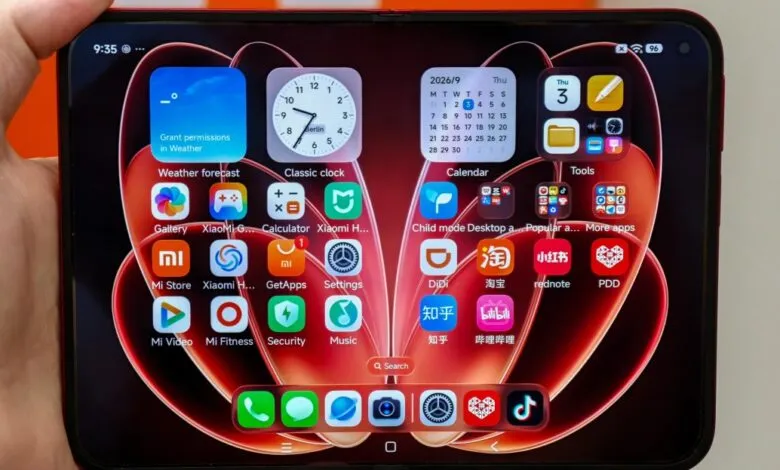
The 18 Fold marks Xiaomi’s return to the book-style form factor following the Mix Fold 4 in 2024. However, the company has adopted a more compact, squat silhouette similar to Huawei and Samsung, while pushing the dimensions further. With an aspect ratio of roughly 1.4:1 on both the 7.58-inch inner display and the 5.38-inch outer screen, the device aligns closely with international paper sizes and IMAX formats. This geometry suggests the phone could be uniquely suited for media consumption without the letterboxing issues common on taller screens. The cover screen features generously rounded corners, creating a visual balance that makes competitors look slender by comparison.
In daily use, the form factor feels familiar yet distinct. When folded, the device remains compact enough for pockets, and the cover screen allows for comfortable one-handed operation, despite potential app compatibility quirks. Unfolded, it offers an ideal canvas for watching movies or reading e-books. While multitasking may not be its strongest suit compared to traditional productivity tools, Xiaomi supports split-screen applications and floating windows to facilitate workflow.
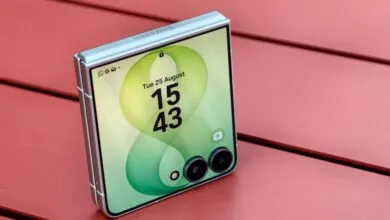
Build quality presents a mixed bag. The 18 Fold is available in black, white, and a striking red, alongside a limited-edition pink ceramic model restricted to 1,500 units. However, it is slightly heavier and thicker than the Z Fold 8. Crucially, Xiaomi has not announced an IP rating for water and dust resistance. Additionally, the hinge crease appears more pronounced than on this year’s Samsung models. Oppo currently holds the crown for minimizing this defect with its Find N6, and observers will be watching Apple’s upcoming reveal to see if they can achieve a similarly seamless finish.
While the design draws comparisons, the technical specifications are where the 18 Fold truly distinguishes itself. It is the first device powered by Xiaomi’s proprietary Xring O3 chipset, which delivers performance comparable to the Snapdragon 8 Elite. This chip also debuts Arm’s Mali G2-Ultra NX GPU, introducing mobile-first support for DLSS-style graphics acceleration on Android.
Powering the device is a massive 6,000mAh silicon-carbon battery, significantly larger than the 4,800mAh unit found in the Samsung counterpart. It supports 67W wired charging and 50W wireless charging. Both OLED displays reach a peak brightness of 4,000 nits. The camera system represents a major leap forward, leveraging Xiaomi’s long-standing partnership with Leica. The setup includes a 200-megapixel main sensor (1/1.56-inch type), a 50-megapixel 3.5x periscope telephoto lens, and a 50-megapixel ultrawide camera.
During my review of the Galaxy Z Fold 8, I was impressed by how quickly I adapted to the new design, but the lack of a triple-camera system was a notable omission for a device approaching $2,000. By addressing this gap while enhancing battery life and display brightness, Xiaomi has created a contender that could easily become my top choice among current foldables. The absence of an IP rating remains a concern, however.
It remains unclear if the 18 Fold will launch outside of China. If Apple announces its expected foldable iPhone tomorrow, the market dynamics could shift dramatically. Regardless, Xiaomi has firmly established its position in the Chinese market. Preorders for the 18 Fold began at ¥10,999 (approximately $1,600), with official sales commencing on September 10th. An international release has not yet been confirmed.
(Source: The Verge)