Google’s New AI Weather Model: Don’t Forget Your Umbrella
▼ Summary
– Google DeepMind and Google Research have released WeatherNext 3, a new AI weather forecasting model that offers higher accuracy and resolution than previous versions.
– The model outperforms both traditional supercomputer-based forecasts and other deep-learning models from competitors like Microsoft and Nvidia on key metrics such as temperature and wind speed.
– WeatherNext 3 addresses previous AI limitations by predicting down to a 5 km resolution, improving rain forecasting by 60%, and providing hourly updates instead of every six hours.
– This technology will integrate into Google products including Search, Maps, and Gemini, while also being available to researchers via Google Cloud platforms.
– The shift toward deep learning allows for faster, more efficient predictions by learning patterns from vast datasets rather than relying solely on complex mathematical physics equations.
High-Resolution Forecasting Meets Real-Time Data
Scientists at Google DeepMind and Google Research have unveiled WeatherNext 3, a new artificial intelligence model designed to interpret atmospheric changes with greater clarity and frequency. This release marks a significant shift in meteorology, driven by deep learning advancements that allow for faster and more precise predictions than traditional methods. Google plans to integrate this technology into consumer-facing tools such as Google Search, Google Maps, and Gemini, while also making it accessible to researchers and developers via its cloud platforms.
“This is going to be the first time that some of the core variables feed and power a lot of the Google products,” Samier Merchant, a senior staff engineer at Google, told TechCrunch. The integration aims to bring high-fidelity weather data directly to users who rely on these daily utilities for planning and navigation.
Surpassing Traditional Supercomputers
In independent testing on Operational WeatherBench, an evaluation utility developed by the startup Brightband, WeatherNext 3 demonstrated superior accuracy compared to other leading contenders. The model outperformed deep-learning systems from Microsoft, Nvidia, and the European Center for Medium-Range Weather Forecasting (ECMWF), as well as traditional forecasts generated by the U. S. National Weather Service and ECMWF. It excels across key metrics including temperature, wind speed, and humidity.
Historically, government-owned supercomputers have dominated weather forecasting by solving complex mathematical equations describing atmospheric physics. While highly accurate, these systems are costly and slow. The landscape changed in 2018 when the ECMWF released over half a century of historical weather data, enabling researchers to train AI models that could replicate this accuracy at a fraction of the computational cost.
“Weather is chaotic, and so small differences really start to perturb massively…Machine learning targets the problem we are really solving, which is approximate noisy physics from incomplete information and finite compute, and so it learns patterns from a lot of data,” said Ferran Alet, a staff research scientist manager at DeepMind.
Solving Granularity and Rain Prediction Challenges
Previous AI weather models faced three primary limitations: coarse resolution, poor rain prediction, and reliance on pre-formatted government datasets. WeatherNext 3 addresses each of these issues. The new model achieves a resolution of 5 km, a significant improvement over the 15 to 25 square km typical of earlier iterations. Additionally, its ability to predict rainfall has improved by 60% compared to its predecessor, WeatherNext 2.
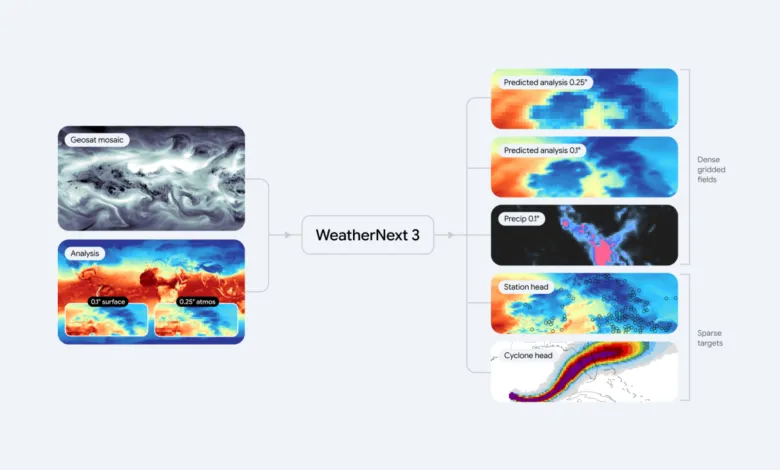
The architecture behind these gains includes a model with 2.4 times more parameters than the previous version. Designers tailored the decoder heads to provide more useful outputs, moving beyond standard 3D grid averages to visualize specific phenomena like cyclone paths. Crucially, the model is now trained to target specific weather stations, allowing for granular, hourly forecasts rather than the traditional six-hour intervals.
“The idea, with a lot of AI applications, is to try to run tasks as end-to-end as possible,” explained Daniel Rothenberg, an atmospheric scientist at Brightband. “Adding a capability where this model is now also predicting, say, what Denver’s airport’s weather station is going to measure on an hourly basis, just connects that forecasting task closer to the core.”
Integrating Raw Satellite Observations
A key differentiator for WeatherNext 3 is its ability to ingest real-time satellite data on an hourly basis. By feeding raw empirical observations directly into the model, rather than relying solely on analyzed data from supercomputers, Google aims to enhance forecast accuracy. Although integrating unformatted data remains technically challenging, this approach represents a step toward true direct data assimilation.
Google claims WeatherNext 3 is the first AI model to incorporate raw observations for high-resolution global forecasting. However, competitors like WindBorne argue their WeatherMesh 6 model has utilized similar raw data from weather balloons since late 2025. Google maintains that its advantage lies in the higher global resolution of its forecasts. Both models still utilize national weather datasets, indicating that full independence from traditional data sources is not yet achieved.
Economic and Environmental Impact
Beyond consumer convenience, AI-driven meteorology holds substantial economic potential. Transformer-based models are already being adopted by European and U. S. weather agencies, offering a low-cost alternative to expensive sensor networks and supercomputers. This accessibility could significantly benefit developing regions where accurate forecasts were previously out of reach.
Bill Gates has highlighted AI-powered weather forecasting as a critical tool for improving crop yields in developing nations. Furthermore, Ferran Alet noted that higher-resolution predictions for wind, rain, and cloud cover will help make renewable energy projects more reliable.
“At the end of the day, I think Google is about providing useful information to the user, and a lot of what users are looking for has to do with the weather in some way or another,” Alet said.
(Source: TechCrunch)