Fish Audio raises $52M to offer free voice AI, charge businesses
▼ Summary
– Fish Audio raised $52 million in a seed round and has $21 million in annual recurring revenue, with over 8 million users.
– The startup gives away its best models for free to attract developers, charging enterprises for latency and uptime guarantees.
– Its newest model, S2.1 Pro, offers free API access until August 31, cloning voices from five-second clips in 83 languages with 70-millisecond response time.
– Voice is becoming a primary interface for AI, and Fish Audio claims its inference stack is far cheaper than rivals like ElevenLabs.
– The company’s user-supplied voice library of over two million voices is both its main asset and a liability, as creators have reported unauthorized uploads and slow removals.
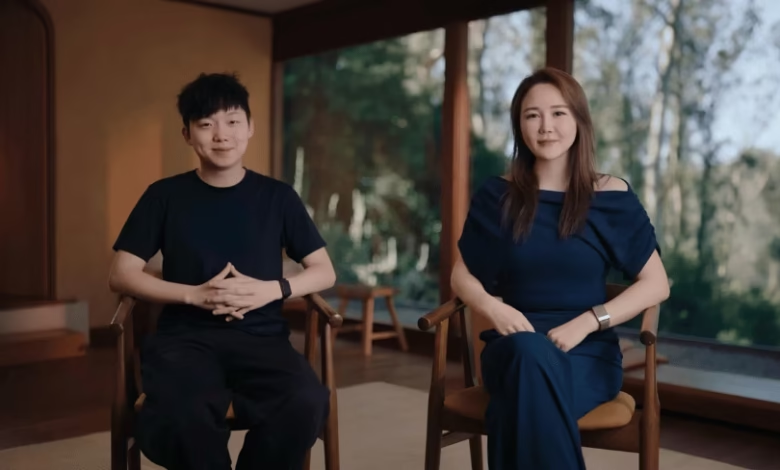
Fish Audio, a Palo Alto-based voice AI startup, has secured $52 million in what it still classifies as a seed round, as first reported by TechCrunch. The company operates with an unusual structure: it gives away its best models for free while charging for the infrastructure that supports them.
Now one year old, Fish Audio reports that more than 8 million users are leveraging its models, either through open-weight releases or its hosted platform. The business currently generates $21 million in annual recurring revenue.
Give the model away, charge for the latency
Fish Audio’s strategy follows the open-source playbook applied to voice technology. In the past year, it has shipped five models and open-sourced three of them. By offering free weights and a free frontier model, the company attracts developer adoption; revenue comes from enterprises requiring contracts and guarantees.
Even its newest model, S2.1 Pro, which remains proprietary, is free over the API until August 31. It can clone a voice from a five-second clip, supports 83 languages, and delivers first audio in roughly 70 milliseconds. The paid plans provide latency and uptime guarantees. Fish Audio asks any company with revenue above $1 million to negotiate before using the free tier, according to Unite. AI.
That succinctly captures the business model: open weights attract developers, while enterprises pay for reliability. Companies like HeyGen, LiveKit, Retell, Sanas, and OpenArt already run on its APIs. A $52 million “seed” round on $21 million in revenue illustrates how rapidly voice has evolved from a feature into an infrastructure line item.
Voice is becoming the interface
Timing works in Fish Audio’s favor. Voice is becoming the default way people interact with AI, from Claude’s voice mode to agents handling sales and support calls. CEO Rissa Cao notes that demand splits by use case: avatar firms seek realism, game studios want expressive characters, and voice-agent companies prioritize low latency that still sounds human.
However, this is a crowded, well-funded space. ElevenLabs carries a valuation around $22 billion, and competitors like Bland continue attracting capital. Fish Audio’s pitch is that its proprietary inference stack is far cheaper; it claims S2.1 Pro runs at a fraction of ElevenLabs’ cost.
The library is the moat, and the risk
The asset investors are really buying is the community. Fish Audio’s voice library is user-supplied: individuals submit their own voices and get paid when someone uses them. The library now holds more than two million voices.
That same library is also the liability. Earlier this year, creators reported that others had uploaded their voices without consent, and that takedown requests moved slowly. Fish Audio has since built a dedicated dispute process, and says removals now complete in under three minutes. But the fix only helps after the fact; nothing prevents someone from uploading your voice, and it remains in use until you notice and file a complaint.
Fish Audio’s lead investor identified the problem directly. “A community-centric approach can only become a durable advantage if creators trust the platform,” said Osuke Honda of Coreline Ventures, who co-led the round. Consent, transparency, and attribution, he added, “must be built into the product rather than treated as afterthoughts.”
The raise funds a bet where the moat and the risk are the same thing, and this open-consent tension echoes through the wider debate about open-weight models.
(Source: The Next Web)