How 90,000 Flock cameras track your city – and how to check yours
▼ Summary
– Flock Safety’s AI-powered cameras track vehicles by capturing license plates and vehicle details, storing data in a shared cloud network accessible to police and other authorized users.
– The network of cameras across multiple towns can be used to reconstruct a person’s movements over time, raising privacy concerns about mass surveillance without public consent.
– Risks include AI-driven searches for suspicious activity unrelated to crimes, cloud security vulnerabilities, unauthorized data access by insiders, and false alerts that can lead to wrongful police encounters.
– Many communities install Flock cameras without public discussion or awareness, as seen in upstate New York where residents only learned about them after installation.
– Residents can locate cameras using volunteer-run maps like DeFlock.org, then push for public debate by requesting contracts and raising concerns at meetings or with officials.
In upstate New York, I discovered that towns surrounding me had quietly installed Flock “Falcon” cameras to track every passing vehicle, including mine. There was no public debate, no warning. The first I learned of it was when nearby Saranac Lake erupted in protest last spring, forcing officials to cancel their contract and remove the cameras. But across the United States, thousands of communities have adopted these AI-powered surveillance tools without clear consent from residents.
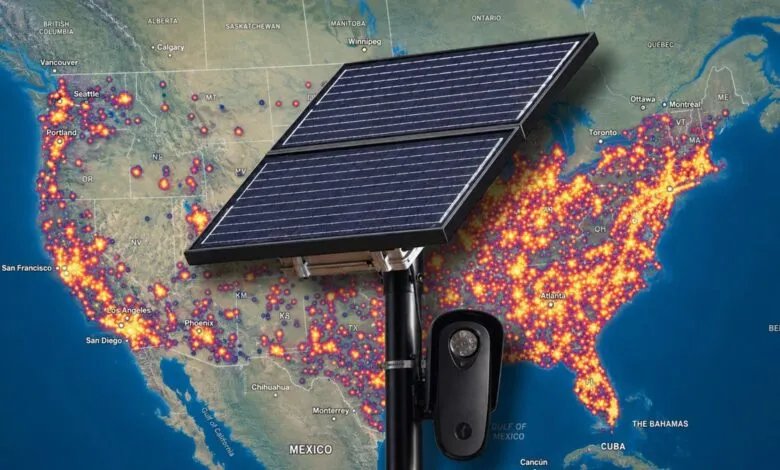
Flock cameras are deceptively unassuming. I’ve spotted several in my small town of roughly 11,000 people, mounted on utility poles along roads I drive daily. They look like small black boxes, often powered by batteries or solar panels, and they connect via cellular service, not Wi-Fi. It’s easy to mistake them for ordinary traffic cameras. According to Flock Safety, more than 12,000 customers use its products, and public estimates suggest about 90,000 Flock-branded cameras may be operating nationwide. Police aren’t the only ones using them; businesses, schools, and homeowners associations can install them too. The system also integrates with partner cameras, such as Motorola’s, through platforms like CommandCentral Aware and shared APIs, allowing law enforcement to view data from both networks.
These Falcon cameras don’t measure speed. Instead, they capture six to twelve still images every time a vehicle passes. Automated license plate recognition (ALPR) software and machine learning analyze those images, extracting the plate number, make, model, color, body type, direction of travel, damage, aftermarket wheels, bumper stickers, and other details. “The software analyzes images of vehicles and extracts characteristics such as license plates…and other distinguishing features,” Trevor Horwitz, co-founder and chief information security officer of TrustNet, told ZDNET. “Those become searchable, allowing investigators to look for a vehicle even if they don’t have a complete license plate number.”
The data isn’t stored on the cameras themselves. According to Flock, images and vehicle details are sent over a cellular network to its cloud system, where authorized users can search them through the Flock Safety dashboard. Police can receive alerts when a camera detects a plate tied to a stolen vehicle, a missing person, an arrest warrant, or another database entry. One camera might help identify a vehicle connected to a crime, but the real power,and risk,comes from the network. When cameras across different towns and states feed into the same searchable database, they can trace the movements of almost anyone.
“A single plate hit reveals nothing more than what an ordinary person could see unaided, that a car is at a particular place at a particular time,” said Catherine Crump, a clinical professor of technology law and director of the Samuelson Law, Technology, and Public Policy Clinic at UC Berkeley. “A network is different, particularly when it involves lots of cameras, because over time it will become a comprehensive record of someone’s movements.” In my case, I might pass one camera near a store, another near my daughter’s school, and another on the road home. Each image shows a single moment, but together they reveal where I go, when I’m there, and which routes I prefer. “Together a person’s movements can tell you a lot about them,where they work, live, worship, what they do in their spare time, who they associate with,” Crump added. “And unlike traditional surveillance that has to be done in real time, it can be used to reconstruct someone’s past movements.”
Flock also sells a pan-tilt-zoom camera called Condor, which detects and follows humans. While Flock maintains that none of its cameras use facial recognition, InvestigateTV shared a video showing a Condor panning to keep a reporter in frame. The company describes this as an object-detection feature called Guardian Mode, which can be set up to detect people, follow their movements, zoom in, and capture high-resolution video.
Beyond the network itself, there are risks tied to AI, cloud storage, and access. The AI makes searching records far easier,operators can search across multiple cameras for a plate, partial plate, vehicle description, or broader pattern. But that also opens the door to misuse. “When ALPR data had to be searched by an individual officer for a particular investigation, that limited its use and generally funneled it towards legitimate law enforcement investigations,” Crump explained. “But when AI can be used to, for example, proactively look for suspicious activities untied to a known criminal act, that raises a whole host of risks, particularly of profiling and drawing inaccurate conclusions.” Police could ask the AI to flag vehicles near a protest, even when no crime has been reported.
Cloud storage also raises concerns. Flock says images and vehicle details are hosted by Amazon Web Services, encrypted, and generally deleted after 30 days. But placing large amounts of location data in one searchable system makes strong security and oversight critical. The system could become a target for hackers and insiders with authorized access. “Organizations need strong controls around who can access that data, how long it’s retained, how it’s monitored, and how it’s protected from unauthorized access,” Horwitz said. “The quieter danger is access,” added Noam Birnbaum, founder and CEO of Ignition. “The scariest part of the risk is often those who are already in the system.”
Access to Flock data can extend beyond the agency that installed the cameras. Other authorized users may search or download records if an administrator grants them access. Once data is shared, local rules may no longer apply. “It undermines rules some cities have made to protect this sensitive information,” Crump said. “A local ordinance saying data can only be used for a particular purpose or kept for a particular length of time if people elsewhere download it and use it for whatever.”
False alerts are another serious concern. Joel Feder, director of content and product at The Drive, recently experienced this while driving a Range Rover with a manufacturer plate. Flock’s cameras tracked his SUV because its plate looked similar to one reported missing in California, but it wasn’t the same. Police still surrounded Feder and his wife in a Minnesota parking lot. “Initially the officers were prepared and had their hands on their holsters,” Feder told ZDNET. “My immediate thought…was ‘I wasn’t even speeding.'” The problem was that police had entered part of a stolen vehicle’s plate into their database, and the AI incorrectly connected it to Feder’s partial reading. He suggested that the system should alert officers when there are extra characters on a plate, indicating they need to “dig deeper and see what the situation is before moving forward.” He added, “We need regulations and guardrails beyond what’s happening today.
Flock itself and the other companies that sell/operate automatic license plate readers need to take responsibility for their LLMs and the internal guardrails that are in place enabling situations like this.” Horwitz agreed, saying the system should “support human decision-making rather than replace it.”
Former Rhode Island police officer Noel Pichardo recently drew attention after claiming his career ended because he raised concerns about Flock cameras and testified before state lawmakers. He said he was suspended, passed over for a promotion, and pressured to resign. The Rhode Island Police Chiefs’ Association disputed his account, arguing he was disciplined for insubordination and allegedly false statements. Pichardo said he hoped “to have these cameras taken down or have an intelligent conversation about them at the very least…I just want you, the public, to know these cameras exist, and that they were put up without your consent.”
To find Flock cameras near you, I’ve been using DeFlock.org, a volunteer-run map. You can search by town or address, view reported locations, and often see a photo, camera model, and direction it’s facing. Its route tool estimates how many license plate readers you may pass on a trip. Because volunteers maintain the map, some entries may be missing or outdated. After finding a camera, residents can ask their local police department, town or village office, nearby business, or homeowners association about who owns and operates it. Once identified, residents can request the contract, retention rules, data-sharing agreements, audit records, false-alert procedures, and a list of outside agencies allowed to search the system. They can then raise concerns at a public meeting, contact elected officials, file a public records request, or demand a hearing before more cameras are installed.
“There should be at minimum robust public discussion and debate to determine Flock policies as it relates to the sharing of the information they gather and who has access to that data,” civil rights attorney Adanté Pointer told ZDNET. Saranac Lake shows what can happen when residents are given a chance to weigh in. Three Flock Falcon cameras had already been installed before the public pushed back, and the village canceled its contract. People deserve to learn about plans for Flock cameras early enough to ask questions, demand answers, and have a say before they go up. I didn’t know Flock Safety was operating near me until its cameras were already installed and tracking my movements. I contacted Flock Safety before writing this story. A spokesperson asked about my deadline and indicated the company would respond, but I hadn’t received a statement or answers to my questions by the time of publication.
(Source: ZDNet)