Evotrex raises $30M for an RV that charges itself
▼ Summary
– Evotrex has secured $30 million in Series A funding to develop and produce its first hybrid RV travel trailer, targeting 1,000 units annually.
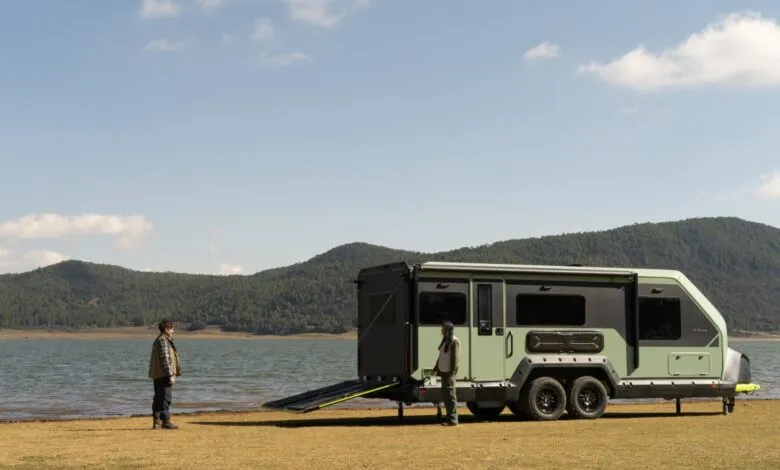
– The startup is building a hybrid RV with a battery pack rechargeable by an onboard gas engine, designed for extended off-grid living.
– Evotrex faces competition from startups like Lightship and Pebble, but legacy manufacturers like Thor and Winnebago have been slow to release electric RVs.
– 90% of Evotrex’s existing orders are for the $160,000 Premium trim PG5 model, indicating strong demand for the high-end version.
– The company plans to manufacture RVs in China, complete final assembly in California, and is prioritizing service over sales by hiring a service employee before a sales employee.
Evotrex may be only two years old, but the startup is already gearing up to manufacture and sell its first hybrid RV travel trailers next year, with a target of roughly 1,000 units annually. To reach that milestone, the company has secured a $30 million Series A funding round, pushing its total capital raised to $46 million.
The bulk of this investment comes from a consortium of Chinese and Hong Kong-based firms, including GSR United Capital, Forebright Concerto Capital, TTGG Ventures, and Pegasus Capital. Consumer electronics giant Anker is among its seed investors. The Los Angeles-based startup will use the fresh capital to finish building and testing its RV, which it debuted at this year’s Consumer Electronics Show after stepping out of stealth mode in 2025.
But the funding will also help Evotrex hold its own in an increasingly crowded startup arena. Legacy manufacturers have been slow to pivot. Thor is funneling its first electric vehicle into rental fleets instead of dealerships, while Winnebago’s eRV2 has been in field testing since 2023 with no consumer release yet. That lag has created an opening for newcomers, and Evotrex is racing to be the first to fill it.
Co-founder Alex Xiao, who previously worked as a product manager at Anker, told TechCrunch he welcomes the competition. “We are not afraid of competition, competition is a good thing. We educate the market together, we grow the market together,” he said. “In the long term the strongest companies will have many things , you must be very good at product definition, R&D, and supply chain. You also need to be very good at distribution and service. Many things together. It’s a very complicated business.”
While some RV startups like Lightship and Pebble are pushing all-electric travel trailers, Evotrex is one of the few pursuing a hybrid system. Specifically, its RV runs on a battery pack that can be recharged by an onboard gas engine , a setup often called an EREV, or extended range electric vehicle. Xiao’s goal is to create an RV that allows people to live off-grid for extended periods, something that’s difficult with a fully electric powertrain or a gas engine that still requires an electric hookup.
The strategy appears to be resonating. Evotrex reports that 90% of its current order book is for the fully loaded Premium trim of its PG5 model, which carries a price tag of around $160,000.
Xiao confirmed that Evotrex has completed validation of a functional version of its first RV, but the next 10 to 12 months will be dedicated to rigorous durability testing. That’s a known weak spot in the industry. RVs contain so many moving parts that mechanical reliability is never guaranteed, and Xiao says Evotrex is taking the issue seriously. He noted that the company hired its first service employee six months ago, while its first sales employee only started this past month , a clear signal that Evotrex is prioritizing customer support over sales volume.
Evotrex still plans to manufacture its RVs in China and handle final assembly in California. Xiao is actively securing locations for both operations. He believes a Los Angeles base gives the company access to its target market and a variety of nearby climates ideal for testing.
Drawing on another lesson from Anker’s rise, Xiao emphasizes the importance of focusing on the right customers and turning them into brand evangelists. “The first thing is you need to find the real customer demand,” he said. “The second is you need to deliver a really good product, and third is: the customer will say the story for you.”
(Source: TechCrunch)