Google Simplifies Creating Your Own Deepfake
▼ Summary
– Omni Flash, the new video-generation model in Flow, produces richer detail and more consistent characters than past versions.
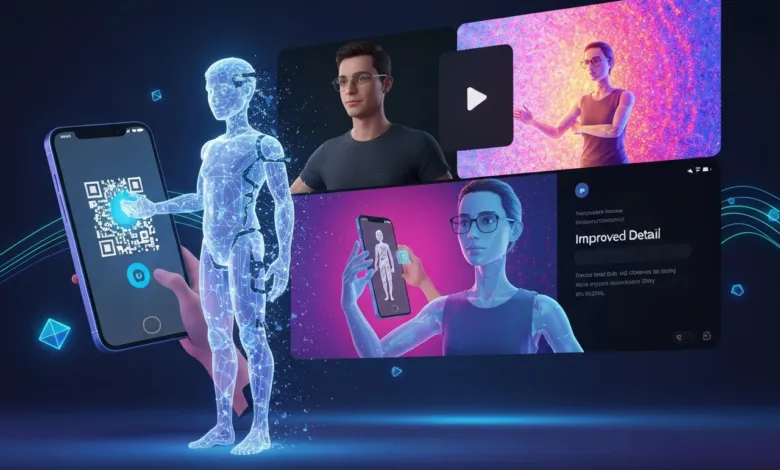
– Users can create an AI avatar of themselves by scanning a QR code, recording their voice, and capturing their face from multiple angles.
– Google’s avatars are initially limited to generating videos of the user themselves, not other people, and include a SynthID watermark.
– The Omni Flash model can adjust generated clips—such as changing the background or shirt color—while preserving the avatar’s details.
– Generative AI tools like these are polarizing audiences, who may view the videos as inauthentic if they recognize them as AI.
One of the most striking upgrades to Google’s Flow platform is the arrival of Omni Flash, a new video-generation model that replaces the earlier Veo system. Much like how the Nano Banana model enriched AI image creation with deeper contextual understanding, Omni Flash brings significantly more detail and consistency to video clips.
With Omni Flash, Flow users can now generate characters in AI-generated videos with far greater stability. Roman, a Google executive, highlights this as a major fix for a persistent flaw in earlier versions of Flow, where characters would warp or distort across successive video generations. But perhaps the most compelling new feature is the ability to insert yourself into these AI scenes. Users can create a personalized avatar by navigating to their Flow account settings, scanning a QR code with their phone, and recording themselves reciting a string of numbers while turning their head to capture every angle. This selfie-capture process will feel familiar to anyone who used the Sora app, OpenAI’s short-lived AI-first social media platform that let people generate and share clips of themselves. OpenAI surprisingly shut down Sora after less than seven months.
Unlike Sora, where users could generate videos of others depending on privacy settings, Google is initially restricting avatar use to the account holder. Every video generated with the Omni model, including those featuring your avatar, carries Google’s SynthID watermark for traceability.
“You can capture your voice and your visual identity from multiple angles and have that show up with pretty high levels of fidelity,” Roman explains. To demonstrate, he generated a playful video of himself teasing the Flow team in front of a dumpster fire. The AI version of himself looked lifelike and sounded authentic. He then used Flow to request changes, such as a new background and a different-colored shirt, and Omni Flash adjusted the clips while preserving the avatar’s details.
This isn’t Google’s first foray into self-controlled deepfake video tools. Last month, YouTube Shorts added a limited option for users to create similar AI avatars for their clips. Other Silicon Valley companies are also exploring how generative AI can transform creator workflows. For instance, Meta rolled out an AI feature last year that seamlessly translates Instagram Reels into different languages, even adjusting creators’ lip movements to match the new voiceovers.
While these tools can streamline content production,eliminating the need to even get out of bed to produce sassy vertical videos,generative AI remains a polarizing force. Audiences increasingly view such videos as inauthentic or misaligned with their values, provided they even recognize the content as AI-generated in the first place.
(Source: Wired)