Nscale’s €695M Portugal bet with Microsoft as AI neocloud hits $14.6B
▼ Summary
– Nscale, a former crypto miner now valued at $14.6 billion, is investing €695 million in Portugal to supply 66,000 Nvidia Rubin GPUs to Microsoft’s Start Campus site in Sines.
– The investment includes €230 million in shared infrastructure and €465 million for a second 200-megawatt building at the 1.2-gigawatt Sines campus.
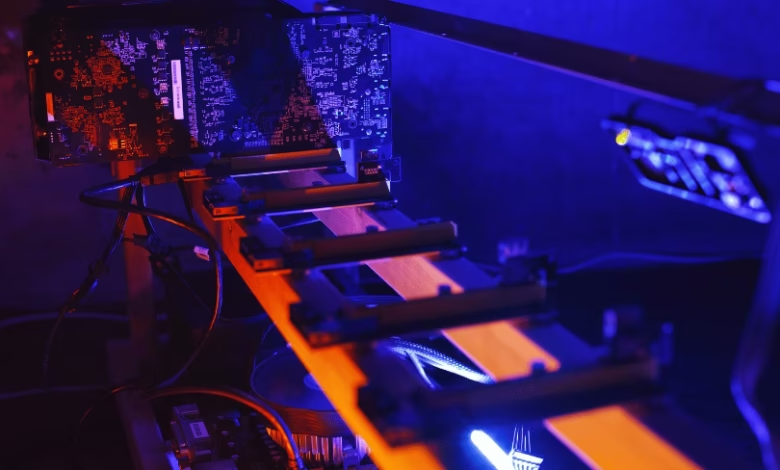
– Nscale operates as a neocloud, leasing GPU compute to AI developers, and its crypto-to-AI transition leveraged existing access to large-scale electrical capacity and GPU-dense operations.
– Portugal offers lower energy costs and gigawatt-scale grid permits, contrasting with Europe’s high electricity prices and regulatory hurdles that have stalled other AI projects.
– Nscale’s model relies on persistent GPU demand outpacing supply, with the company aiming to go public in 2026 and positioning as Europe’s leading AI infrastructure provider.
A crypto mining operation from two years ago has transformed into a $14.6 billion AI infrastructure powerhouse, and its latest move is a massive bet on Portugal. Nscale announced a €695 million ($812 million) investment to expand its partnership with Microsoft, delivering over 66,000 Nvidia Rubin GPUs to the Start Campus site in Sines. This deep-water port town on Portugal’s Atlantic coast hosts a data centre with 1.2 gigawatts of permitted capacity, one of the largest in Southern Europe. The company, now valued at $14.6 billion after a $2 billion Series C in March backed by Nvidia, Lenovo, Dell, Citadel, Jane Street, and Nokia, operates facilities across the UK, Norway, Portugal, Iceland, and the US. Its CEO has confirmed plans for a public listing in 2026. The meteoric rise from cryptocurrency mining to Europe’s leading AI infrastructure firm in just twenty-four months raises a critical question: will Europe’s answer to the compute crisis come not from governments or hyperscalers, but from a new breed of company that barely existed three years ago?
The Portugal deal splits the investment into €230 million for shared infrastructure and €465 million for a second 200-megawatt building at the Start Campus site. Microsoft, which announced a multiyear lease agreement in October 2025 and committed $10 billion to the overall build-out, will use the GPU infrastructure Nscale supplies to serve its cloud customers. This partnership model, where the neocloud provides the hardware layer and the hyperscaler manages the customer relationship, allows Microsoft to overcome computing capacity shortages that have constrained Azure’s AI growth. The 66,000 Nvidia Rubin GPUs, scheduled for delivery from late 2027, represent a substantial allocation of next-generation silicon. Rubin, the successor to Blackwell, entered production in 2026, and demand already exceeds supply. Nscale’s ability to secure this commitment reflects its deep ties with Nvidia, which invested £500 million during the Series C, and the sheer scale of Microsoft’s European compute needs.
The company is already delivering 14 megawatts of sovereign AI capacity in the UK through a partnership with BT and Nvidia, and the Portugal expansion extends this model to a jurisdiction with cheaper energy and fewer grid constraints.
Nscale operates as a neocloud, a cloud provider focused exclusively on leasing GPU compute to AI developers, avoiding the hundreds of ancillary services offered by hyperscalers like AWS, Azure, and Google Cloud. The model is straightforward: acquire GPUs at scale, house them in data centres with sufficient power and cooling, and rent access to AI companies that cannot secure hardware directly from Nvidia. Execution requires enormous capital, long-term offtake agreements with creditworthy customers, and the ability to build capacity faster than hyperscalers. CoreWeave, the US category leader, went public in 2025 with over $50 billion in contracts with OpenAI, Meta, and Anthropic. Nscale pursues the same model with a geographic thesis: Europe needs its own compute layer, and the company that builds it first will own a structural position in the continent’s AI economy. The crypto-to-AI transition is not incidental; it is foundational. Nscale spun out of Arkon Energy, a cryptocurrency mining infrastructure provider, in early 2024.
Crypto miners already possessed the two assets AI infrastructure requires: access to large-scale electrical capacity and experience operating GPU-dense computing environments in power-constrained facilities. When AI demand made GPU compute vastly more profitable per megawatt than mining Bitcoin, the economics of the pivot became obvious. Morgan Stanley reclassified the entire crypto mining sector as an energy infrastructure play for the AI economy in February 2026. Nscale simply executed the transition faster and at larger scale than any competitor, raising $3.1 billion across three rounds in less than eighteen months.
The fragility of Europe’s position in the global compute race was highlighted when OpenAI paused its Stargate UK data centre project in April, citing electricity prices four times higher than in the US and unresolved copyright regulation. Portugal offers a different proposition. Its electricity costs are lower than Britain’s, it has abundant renewable energy, its Atlantic location provides connectivity to submarine cable networks linking Europe to the Americas and Africa, and the Sines campus already has grid connections permitted for gigawatt-scale power delivery. The EU has awarded €180 million in sovereign cloud contracts as part of its effort to reduce dependence on American hyperscalers, which currently control roughly 70 per cent of European cloud infrastructure revenue. But €180 million is a fraction of what a single data centre campus costs. Nscale’s €695 million Portugal investment and Microsoft’s $10 billion commitment to the same site dwarf the EU’s public spending on sovereign compute. The European sovereign AI thesis is being funded not by governments but by private capital following the economics of GPU demand.
Nscale’s Europe-first strategy, with major sites in the UK, Norway, and Portugal, is assembling the physical infrastructure that European AI sovereignty requires, funded by partnerships with the same American hyperscaler the EU is trying to reduce dependence on.
Microsoft has committed $16 billion to Australia, $30 billion to the UK, $10 billion to Portugal, and billions more across Asia and the Middle East. The company added 1 gigawatt of data centre capacity in the March quarter alone and plans to double its total capacity within two years. Azure AI revenue is growing faster than the company can build infrastructure to serve it, and Microsoft’s CEO told analysts the business is “compute constrained in the near term.” The Nscale partnership solves a specific problem: it lets Microsoft bring capacity online faster than it could by building and operating sites itself, because Nscale handles GPU procurement, installation, and facility management while Microsoft focuses on software and customer layers. The 200-megawatt second building at Sines will represent a substantial addition to Portugal’s data centre footprint. For context, Denmark’s entire installed data centre capacity was 398 megawatts at the start of 2026, and Energinet paused new grid connections after demand overwhelmed the system.
Portugal’s advantage is that Start Campus secured its grid permissions early, before the queue of data centre projects across Europe grew to the point where regulators intervened. The 1.2-gigawatt permit at Sines is a head start that may prove more valuable than the site’s other attributes, because the constraint on AI infrastructure expansion in Europe is increasingly not capital, not demand, and not GPU supply, but grid access.
Verda raised $117 million to expand its GPU cloud platform, joining a growing cohort of European neoclouds building compute infrastructure for the continent’s AI companies. But the scale difference is instructive. Verda raised $117 million. Nscale has raised $3.1 billion and is investing €695 million in a single site expansion. The neocloud market is stratifying rapidly into companies operating at hyperscale and those that will remain niche providers for specific geographies or workloads. Nscale’s partnerships with Microsoft, its Nvidia investment, its CoreWeave-scale ambitions, and its planned IPO position it as the category leader in Europe. The Portugal expansion is the largest single infrastructure commitment it has made outside the UK. Whether the neocloud model survives long-term depends on whether the compute shortage persists. If GPU supply catches up with demand and hyperscalers build enough capacity to serve every customer directly, the neocloud layer becomes unnecessary.
If demand continues to outstrip supply, which every current forecast projects through at least 2028, then companies like Nscale that can deliver capacity faster than hyperscalers can build it will retain pricing power and strategic relevance. Nscale’s trajectory from crypto miner to $14.6 billion AI infrastructure company is the fastest value creation story in European tech history. The Portugal investment is the bet that the conditions which made that trajectory possible, insatiable demand for compute, constrained GPU supply, and Europe’s urgent need for sovereign AI infrastructure, will persist long enough for the neocloud model to become permanent rather than transitional. A crypto mining company became Europe’s most valuable AI startup by recognising, before anyone else, that the AI industry’s real bottleneck is not algorithms but electricity and silicon. Twenty-four months and $3.1 billion later, it is still building.
(Source: The Next Web)