Meet the most outrageous gaming laptop ever made
▼ Summary
– The Asus ROG Zephyrus Duo reviewed costs $5,500 and features two full-size 16-inch OLED screens, an Nvidia RTX 5090 Laptop GPU, and an Intel Panther Lake chip.
– The laptop is described as a multitasking champion, allowing users to snap multiple windows across its dual displays, but it is nearly an inch thick and weighs 6.17 pounds.
– Gaming performance is strong, maintaining 60-90 fps on high settings in titles like Marathon and Battlefield 6, but the RTX 5090 GPU is throttled to 135W TGP, making cheaper laptops outperform it.
– The reviewer notes no one needs this laptop, calling it illogical and expensive, but praises it as a unique and fun portable battlestation for those who prioritize desire over necessity.
– Battery life in clamshell mode is 11 hours, and the removable keyboard offers over six hours of wireless use, while the speakers and webcam receive poor ratings.
The Asus ROG Zephyrus Duo is back, and it’s more outrageous than ever. This dual-screen gaming laptop was one of the most talked-about devices at CES, and now that it’s finally here, I can confirm it delivers on its wild promise. Our review unit rings up at a staggering $5,500, making it one of the most expensive gaming laptops on the market. Yes, that price tag is as eye-watering as you’d expect.
Let’s break down what you’re getting for that kind of cash: two full-size 16-inch OLED displays, a top-tier Nvidia RTX 5090 Laptop GPU, a powerful 16-core Intel Panther Lake processor, a generous selection of ports (including an SD card slot), and a detachable keyboard and trackpad that work wirelessly via Bluetooth. The 32GB of soldered RAM and 1TB SSD are welcome, but they’re just the icing on an already very expensive cake.
So, who exactly is this machine for? The honest answer is: almost nobody. I once spotted a previous-gen Zephyrus Duo in the wild at a retro gaming convention, and the owner was just browsing eBay. It felt like seeing a unicorn. This laptop defies practicality. It’s not about need; it’s about want. Toss out any notions of necessity and just appreciate the sheer ambition of this portable battlestation.
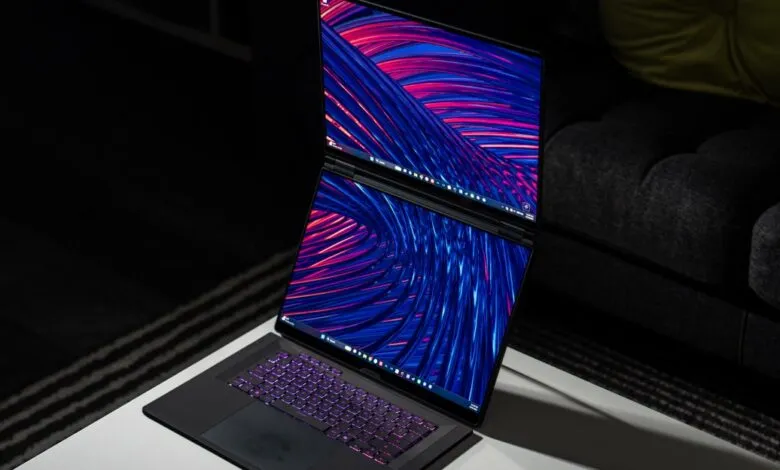
Visually, the Zephyrus Duo looks like a thicker, heavier version of the ROG Zephyrus G16. But lift the keyboard from its pogo pins, and the magic begins. Both displays are 16-inch 2880 x 1800 OLED touchscreens with a 120Hz refresh rate and up to 1,100 nits of peak brightness. They’re stunning, with crisp details and deep, inky blacks. This is a massive upgrade from previous Duo models, which paired a large main screen with a narrow secondary strip. Now, you’re carrying two perfectly matched, full-size OLEDs. The tradeoff? The laptop is nearly an inch thick and weighs a hefty 6.17 pounds.
As a multitasking tool, the Zephyrus Duo is a dream. Snapping windows across both screens is effortless, and I love having all that real estate for work. The landscape mode, with side-by-side vertical screens, is my favorite for writing. However, the dual-screen design comes with compromises. The speakers are only okay, lacking bass due to their hinge and under-chassis placement. The 1080p webcam sits at eye level in tall mode but looks grainy in anything less than perfect lighting. On the plus side, the detachable keyboard retains deep 1.7mm key travel and a satisfying tactile feel, while the large mechanical trackpad has a pleasant dampened click.
In clamshell mode, the keyboard and trackpad work wirelessly for over six hours before the low-battery light appears. The laptop’s own battery life, however, is less impressive. With a 90Wh battery (10% less than the Zenbook Duo’s), a power-hungry discrete GPU, and larger screens, it lasted 11 hours in our single-screen test, compared to the Zenbook Duo’s 14 hours.
But the Zephyrus Duo’s real purpose is gaming. It packs Nvidia’s flagship mobile GPU, and it delivers. I played Marathon at a solid 60fps on High settings at 2880 x 1800 with DLSS on Performance. Switching to Turbo mode pushed it past 70fps, peaking at 80. The fans get loud in Turbo, but they’re manageable with headphones or turned-up game volume. Battlefield 6 ran even better, maintaining around 90fps on High preset at native resolution. With DLSS 4.5 in quality mode, it hit 100 to 110fps.
The real magic, though, is having that second screen. While gaming, I kept Discord, Signal, and Chrome tabs open on the bottom display. It’s like having a dual-monitor desktop setup that you can take anywhere. I played from my couch with a lap desk, mechanical keyboard, and mouse, all while my spouse watched TV. It was glorious.
However, there’s a catch. The RTX 5090 in our review unit is throttled to 135W TGP, below the chip’s 150W maximum. That means cheaper, lighter 5090 laptops like the Razer Blade 16 and the 2025 ROG Zephyrus G16 actually outperform it. Even Asus’ own ROG Strix Scar 16 with a lesser RTX 5080 beats the Duo, thanks to better cooling and power delivery. Those laptops undercut the Duo by $1,000 to $2,200. An entry-level Duo with an RTX 5070 Ti costs $4,500 but would struggle to keep up in performance.
This isn’t new for the ROG Zephyrus line. Models like the G14 and G16 have always traded raw performance for thinner designs and better battery life. But the Duo’s price is simply absurd. You could buy a Razer Blade 16 with the same specs, add a $350 Alienware QD-OLED monitor, and still save $650. The only thing you’d miss is the dual-screen experience.
There’s nothing logical about the Zephyrus Duo. It feels like a flex for r/battlestations. But I love it. It’s special. If money were no object, I’d buy one. But money is very much an object. Even with disposable income, I’d probably talk myself into a ROG Strix Scar 16 with an RTX 5080 for gaming and a 14-inch M5 MacBook Pro for creative work. That combo costs $500 less than the 5090 Duo.
If you want to join the exclusive dual-screen gaming laptop club, you have to lead with your heart, not your brain. And your wallet. A very, very full wallet.
(Source: The Verge)