Sony’s Ping-Pong Robot Defeats Top Players
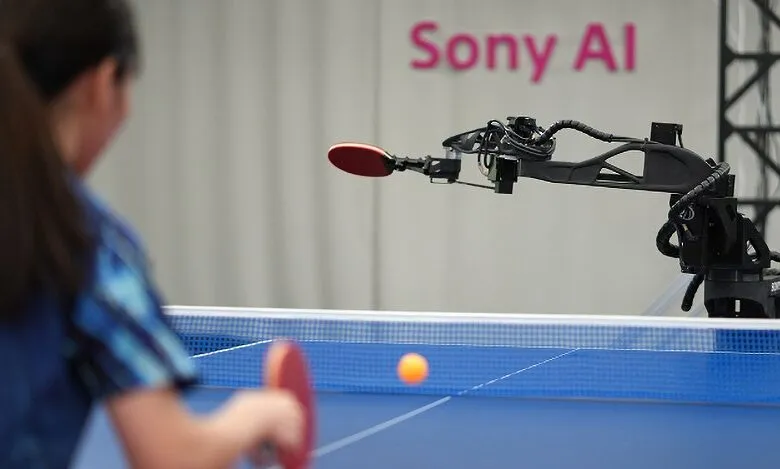
▼ Summary
– Sony’s AI division has developed a table tennis robot named Ace, which is the first to competitively play against and occasionally beat top-ranked human players under official ITTF rules.
– Unlike AI that masters board games, physical games like table tennis require a robot engineered for speed and responsiveness to match human physicality.
– The robot uses an eight-joint system to control its paddle’s position, orientation, and power, enabling it to handle the game’s high-speed, spinning ball.
– Ace employs a complex vision system with nine cameras and three gaze control systems to track the ball’s 3D position, spin, and trajectory.
– In documented tests, Ace won three of five matches against elite players in April 2025 and later defeated professional players in December 2025.
The long-standing goal of creating a table tennis robot capable of competing at the highest human level has been achieved. Sony’s AI division has developed a system named Ace, which distinguishes itself by not only playing against elite opponents but also securing victories under official International Table Tennis Federation rules. This marks a significant leap beyond previous robots designed primarily for demonstration or amateur play.
Mastering a fast-paced physical sport like table tennis presents a far greater engineering challenge than conquering board games like Chess or Go. The task requires a machine to perceive, calculate, and physically react in real-time to a small, spinning ball traveling at high speeds. To meet this demand, Sony’s researchers built a robotic arm with eight distinct joints. This sophisticated articulation allows for precise control, with two joints managing the paddle’s position, two adjusting its angle, and three others generating the power necessary for competitive shots.
This mechanical prowess is guided by an advanced vision system. Nine standard cameras positioned around the court create a three-dimensional map to track the ball’s location. This data is supplemented by three specialized gaze control systems that measure the ball’s spin and angular velocity, enabling Ace to accurately predict its trajectory and plan a return.
Documented research in the journal Nature details the robot’s competitive milestones. During tests in April 2025, Ace won three out of five matches against elite players, each with over a decade of training. It lost the remaining two matches to active professionals. Building on that foundation, Sony reports that by December 2025 and into earlier this year, the system progressed to defeating those professional-level players in subsequent matches. This evolution from challenging top competitors to consistently beating them underscores a rapid advancement in robotic skill and adaptability.
(Source: The Verge)