How Chef Robotics Succeeded in Automated Cooking
▼ Summary
– The food automation industry has a history of startup failures, such as Chowbotics and Zume.
– Chef Robotics pivoted from restaurants to food manufacturing, now serving large-scale clients like Amy’s Kitchen and school lunch providers.
– The company has reached a milestone of 100 million “servings,” defined as one robot-deposited food component per meal tray.
– Chef plans to expand into “smaller kitchens,” including airline caterers, ghost kitchens, and eventually fast casual restaurants, stadiums, and prisons.
– Data from these servings trains its AI models to better handle food’s unpredictable nature, aiming to improve robot performance and business scalability.
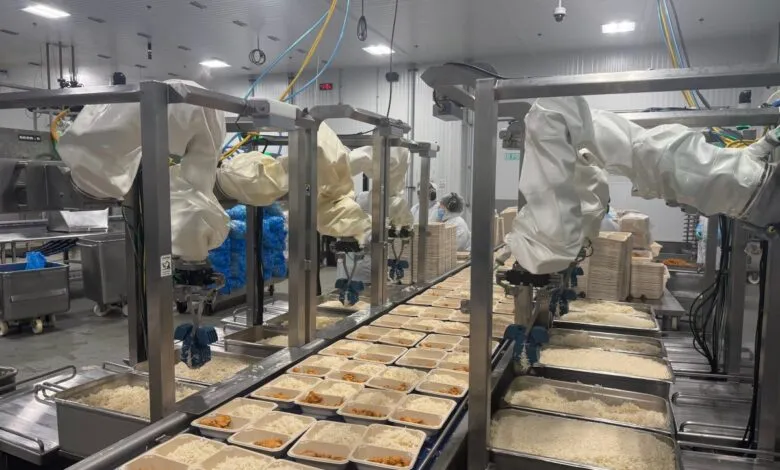
The path to automating commercial food preparation is famously littered with failed ventures, a point Chef Robotics CEO Rajat Bhageria readily acknowledges. From shuttered salad robots to a high-profile pizza delivery collapse, replacing human dexterity and judgment in the kitchen has proven a formidable challenge. Bhageria believes his company has discovered a viable formula for success, focusing on AI-powered robotic arms designed to handle repetitive tasks in high-volume environments.
Initially targeting fast-casual restaurants, Chef Robotics quickly pivoted its strategy. The company found its true niche in large-scale food manufacturing, securing enterprise clients like Amy’s Kitchen and Chef Bombay. It also partners with a major national provider of school lunches. This shift toward institutional production has driven significant volume, with the company recently announcing a milestone of 100 million robotic servings completed. A serving is defined as one portion of food deposited by a robot into a meal tray, representing a single component of a larger meal.
With this foundation in industrial kitchens, Chef Robotics is now targeting what it terms “smaller kitchen” environments. This classification includes surprisingly large operations, such as a recently signed contract with one of the world’s biggest airline catering companies. The company also plans to move into ghost kitchen facilities that prepare food exclusively for delivery services. Future expansion goals include fast-casual restaurants, stadium concessions, and correctional facilities.
A critical advantage stems from the data generated by those 100 million servings. This information continuously trains the company’s proprietary AI models for food handling and packaging. Bhageria notes that the inconsistent, slippery nature of many food items makes them uniquely difficult for machines to manage. By feeding operational data back into its systems, Chef aims to create increasingly capable and efficient robots, using machine learning for continuous improvement to enhance reliability and support further business scaling.
(Source: TechCrunch)