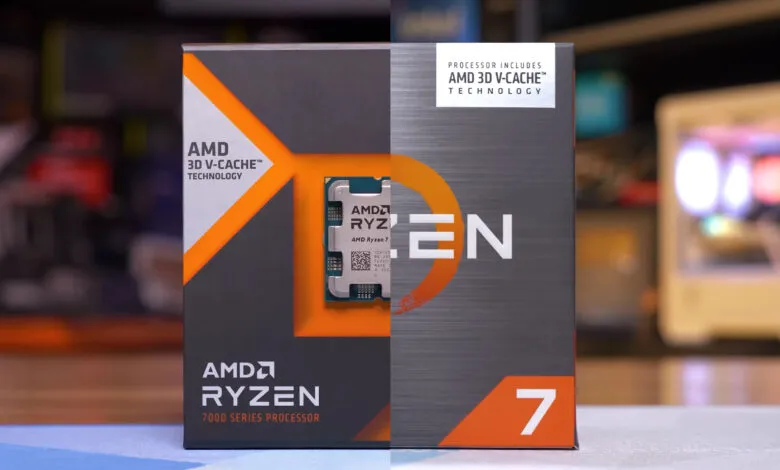
Ryzen 5 & 7 X3D CPUs Tested: 5800X3D to 9800X3D
▼ Summary
– The review tests nine different AMD Ryzen X3D CPUs across two different processor platforms.
– It directly compares all current Ryzen 5 and Ryzen 7 models with 3D V-Cache technology.
– A core goal is to measure performance gains since the original 5800X3D processor.
– The analysis determines in which specific scenarios the improved performance is most significant.
– The testing methodology involves benchmarking 14 different games for performance data.
The performance journey of AMD’s X3D processors, from the groundbreaking 5800X3D to the latest 9800X3D, reveals a compelling story of targeted innovation. By testing nine different X3D CPUs across two distinct platforms and 14 demanding games, we can clearly see where these chips deliver tangible benefits and where the generational leaps are most pronounced. The core question is not just about raw speed increases, but about identifying the specific scenarios where the 3D V-Cache technology makes a decisive difference for gamers.
Starting with the Ryzen 7 5800X3D, this processor redefined expectations for gaming performance on the AM4 platform. Its introduction of a large, stacked L3 cache directly addressed a key bottleneck in many game engines, providing a significant boost in minimum frame rates and overall smoothness. This established a new paradigm for AMD, creating a product line dedicated to maximizing gaming efficiency. The legacy of this chip is evident in every successor.
Moving to the current AM5 generation, the progression from the Ryzen 7 7800X3D to the newer Ryzen 7 9800X3D shows refinements in both architecture and cache integration. Benchmark results across a wide suite of titles indicate that the performance gains are not uniform. In many modern, cache-sensitive games, the advantage of the X3D variants is substantial, often outpacing even higher-clocked non-X3D counterparts. The improvements are particularly noticeable in simulation titles, massive strategy games, and certain open-world engines where data access latency is critical.
However, the testing also highlights an important nuance. In less cache-dependent applications or games that are primarily limited by GPU power, the performance delta between generations narrows. The Ryzen 5 X3D models, like the 7600X3D, offer a fascinating value proposition, bringing a large portion of the gaming performance uplift to a more accessible price point. This creates clear segmentation for builders who prioritize game frame rates above all else.
The data underscores that the evolution of these processors is about intelligent specialization. Each new X3D release builds upon the foundational cache technology, pairing it with improved core architectures and more efficient manufacturing processes. For gamers playing the latest, most demanding titles, the leap from the original 5800X3D to a current-generation model is significant, especially in terms of 1% low frame rates that affect perceived smoothness. For those on older platforms or playing less demanding games, the upgrade path requires more careful consideration of the specific performance gains in their favorite applications.
(Source: TechSpot)