Antigravity A1 Review: The Ultimate (But Pricey) 360 Drone
▼ Summary
– The Antigravity A1 is a unique, sub-250g drone with a built-in 360-degree camera, offering an immersive flying experience via FPV goggles and a motion controller.
– It is an expensive and niche product, with its high cost largely due to the included goggles and controller, and it currently has no direct rivals in the market.
– The drone’s image quality for reframed 360 videos matches that of 360-degree cameras, which is generally lower than the quality from standard camera drones like the DJI Mini 5 Pro.
– A significant drawback is the requirement for a visual observer or spotter during flight for safety and legality, as the pilot’s view is confined to the goggles.
– Its innovative “fly-first, frame-later” workflow provides creative flexibility for reframing shots after flight, but the system adds complexity compared to standard drones.
The Antigravity A1 redefines aerial photography by merging a full 360-degree camera system into a compact, sub-250-gram drone. This innovative device offers a uniquely immersive flying experience through its included FPV goggles and motion controller, though this approach significantly increases the cost and introduces operational complexities not found with traditional models. For creators fascinated by spherical content and a “fly first, frame later” workflow, the A1 stands alone in the market, despite its premium price tag and niche appeal.
This drone represents the culmination of a long-standing concept. The idea of a 360-degree drone isn’t new, and Antigravity’s lineage as an offshoot of Insta360 provides relevant context. Previous experiments, like attaching a 360 camera to existing drones, proved cumbersome. The A1 solves this by integrating the dual-lens camera directly into the aircraft’s body, creating a seamless system designed from the ground up for spherical capture.
Launched in December 2025, the drone is offered in three distinct bundles. The pricing reflects the high-end goggles and specialized controller included in every kit. The entry-level Standard Bundle includes the drone, controller, goggles, and a single battery. The better-value Explorer Bundle adds two extra batteries, a charging hub, a shoulder bag, and spare propellers. For maximum flight time, the Infinity Bundle swaps in higher-capacity batteries, though this pushes the total weight over the 250-gram threshold. Most users will find the Explorer Bundle represents the best balance of equipment and value.
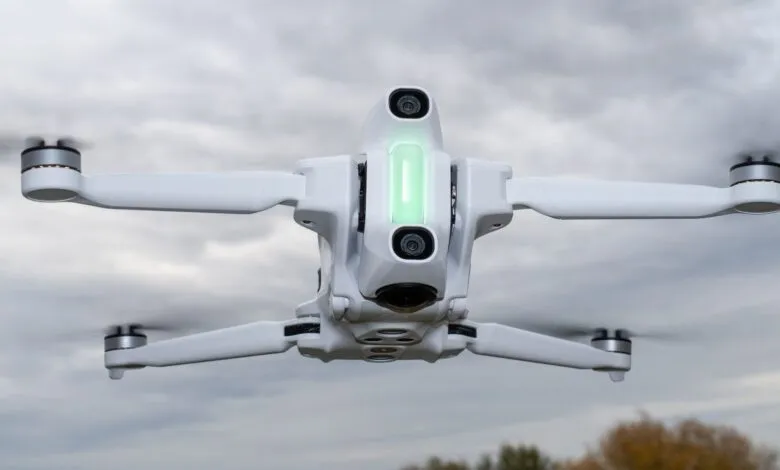
In terms of design, the A1 features a familiar folding silhouette but with a distinctive look. The two cameras required for the 360-degree view are positioned on the top and bottom of the front section. A clever retractable landing gear system lifts the lower camera off the ground when parked, helping maintain a clean, “invisible” stitch in the final footage. The included Vision Goggles are central to the experience, featuring high-resolution Micro-OLED screens in an unusual square aspect ratio that works perfectly for the spherical view. They are comfortable, include diopter adjustments for glasses wearers, and feature intuitive head-tracking.
However, the goggle-based control system has a major drawback: it legally requires a visual observer or spotter during flight. This makes spontaneous flights less convenient compared to using a standard controller with a phone screen. The drone offers two battery options, with flight times ranging from approximately 16 minutes with the standard pack to significantly longer with the optional high-capacity battery.
Performance is solid and stable, tailored to its role as a camera platform rather than a high-speed FPV racer. Pilots can choose between FreeMotion Mode, which uses the controller’s orientation for direction, and FPV Mode, which allows for smoother, sweeping turns. Standard flight modes like Cinematic, Normal, and Sport are available, with even Sport mode being relatively sedate. The automated “Sky Genie” flight patterns, such as Orbit and Spiral Ascend, are genuinely useful for capturing dynamic shots effortlessly. Subject tracking, powered by Insta360’s Deep Track technology, is also reliable and effective.
When it comes to image quality, the A1 performs on par with high-end 360-degree cameras, not traditional camera drones. The dual 1/1.28-inch sensors capture stills up to 55MP and video up to 8K resolution for the full spherical field of view. The magic happens in post-production using the Antigravity Studio software (a rebadged version of Insta360 Studio), where creators can reframe their aerial footage into standard videos long after the flight is over. This “invisible drone” technology eliminates the aircraft from the stitched footage, much like an invisible selfie stick. While the reframed output is impressive, those seeking the absolute highest image quality from a sub-250g drone might still prefer a model like the DJI Mini 5 Pro, which uses a larger sensor for a traditional, non-spherical field of view.
In summary, the Antigravity A1 is a groundbreaking and highly specialized tool. It is ideal for immersive content creators who value its unique workflow and are willing to manage its operational requirements and cost. For those prioritizing simplicity, the highest possible image quality, or a more budget-friendly option, a standard camera drone remains a more practical choice.
(Source: TechRadar)