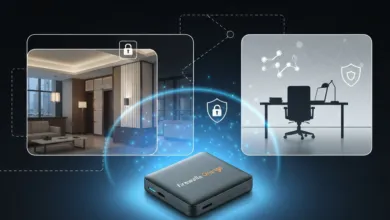
Firewalla’s Zero Trust Fix for Flat Home Networks

▼ Summary
– Firewalla offers a method to modernize large, flat home networks for better security and performance without requiring IP renumbering or reconfiguring many devices.
– Flat home networks, where all devices can communicate, pose security risks and hinder the adoption of newer technologies like WPA3 and Wi-Fi 7.
– The solution uses segmentation to create purpose-built network sections while keeping devices on the same IP network, preserving existing addresses and avoiding IoT compatibility issues.
– During migration, users can reuse their existing Wi-Fi credentials, allowing legacy IoT devices to reconnect automatically and be secured immediately with microsegmentation.
– Firewalla supports multiple segmentation strategies, allowing users to group devices by type or user and apply specific security policies, including support for WPA3 Enterprise.
Modernizing a large, flat home network no longer requires a complete overhaul of IP addresses or reconfiguring every connected gadget. Firewalla introduces a streamlined method to enhance security, scalability, and overall performance by applying zero trust principles and microsegmentation through its AP7 and Orange devices. This approach allows homeowners to quickly segment their outdated Wi-Fi setups into organized, secure networks.
Most residential networks evolve into a flat structure over the years. As smart speakers, cameras, phones, and laptops accumulate, they all typically share the same network space. In this environment, every device can communicate with every other device, older Wi-Fi encryption like WPA2 often remains active, and adopting newer standards such as WPA3 or Wi-Fi 7 becomes challenging. The consequences include heightened security vulnerabilities, constrained performance, and increasing management complexity.
Firewalla’s new strategy shows users how to remodel these networks by creating smaller, purpose-specific segments while keeping all devices on the same underlying IP network. This preserves existing IP addresses, prevents compatibility problems with older IoT gadgets, and removes the need for complicated relay setups for services like SSDP or mDNS.
During the migration to a Firewalla Wi-Fi system, users can keep their current network name and password. Older smart home devices reconnect on their own, sparing homeowners the tedious task of manually entering new credentials on dozens of items. Once connected, Firewalla’s VqLAN microsegmentation and device isolation features instantly restrict unnecessary device-to-device traffic, significantly shrinking the network’s attack surface.
Homeowners can define segments based on device type, security needs, or user roles, applying customized rules for Wi-Fi encryption, device isolation, and trusted time synchronization.
Firewalla supports several practical segmentation strategies:
Legacy IoT devices: Older gadgets can remain on WPA/WPA2 using the familiar network name, while being protected through microsegmentation and isolation from other network parts.
Newer IoT devices: Establish separate network names with WPA2/WPA3 encryption for devices that support more robust security protocols.
Advanced IoT Grouping: Further separate items like security cameras, sensors, and smart lights into distinct groups using multiple network names or personal access keys.
Personal devices: Isolate phones, laptops, and tablets from IoT traffic using Mixed Personal Security, which enables modern features like WPA3 and 6 GHz bands where hardware allows.
User-based segmentation: Assign devices to specific household members using Firewalla Users, personal keys, or WPA3 Enterprise for the strongest combination of security and performance.
For users working with sensitive information or those needing top-tier performance with Wi-Fi 7 and 6 GHz bands, Firewalla also accommodates WPA3 Enterprise. This provides user-specific authentication and powerful encryption under a single network identifier.
A Firewalla co-founder noted that network segmentation should not introduce unnecessary complication. With the right tools, users can progressively secure and upgrade their networks without disrupting existing devices or redesigning their entire IP framework from scratch.
(Source: NewsAPI Cybersecurity & Enterprise)