Fujifilm’s New Retro Camera Has a Super-8 Design and a Catch
▼ Summary
– Fujifilm announced the Instax Mini Evo Cinema, a hybrid digital-instant camera that is the first Instax model capable of shooting video.
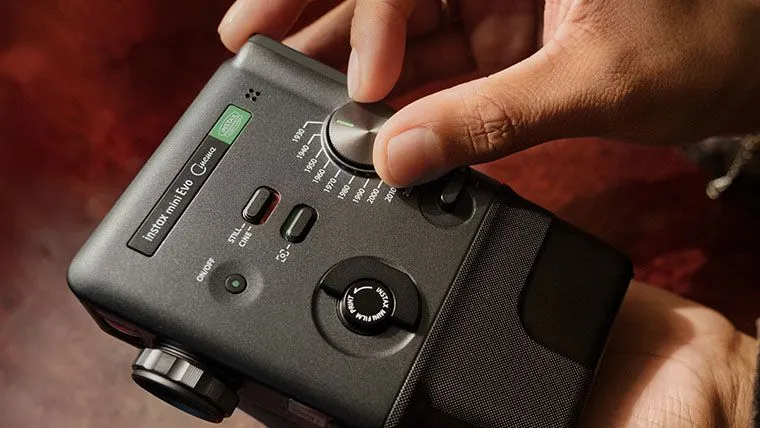
– The camera is modeled after vintage Super 8 cine cameras and features a unique “Eras Dial” to replicate film and photo styles from different decades.
– It can record 15-second videos and shoot still photos, printing them as Instax prints, and can also function as a printer for smartphone photos.
– The camera’s availability is currently limited, as it was announced in Japan with no confirmation of a wider international release.
– Key specifications like price and sensor details remain unknown, and optional accessories like a viewfinder attachment will be available.
Fujifilm has unveiled a novel hybrid camera that blends instant film printing with digital video capture, wrapped in a nostalgic Super 8 design. The Instax Mini Evo Cinema introduces a first for the Instax line: the ability to record short video clips. This device merges the tactile joy of instant photography with modern digital features, all housed in a body that pays homage to classic cine cameras. While initially announced for the Japanese market, its unique capabilities have sparked interest worldwide.
The camera’s design is a significant departure from previous Instax Mini Evo models. It adopts a vertical orientation inspired by Fujifilm’s own Fujica Single-8 film cameras from the 1960s. A prominent trigger-style button on the front is used to record videos, which are limited to 15 seconds in length. This design choice firmly roots the device in a retro aesthetic while providing a familiar, tactile shooting experience.
Perhaps the most intriguing feature is what Fujifilm calls the “Eras Dial.” This control allows users to select a decade, from the 1930s up to the 2020s, applying a specific visual and audio filter to mimic the photographic styles of that period. For instance, the 1960s setting replicates the look of classic Super 8 film, while the 1980s option emulates 35mm color negatives. A separate dial around the lens adjusts the intensity of these effects. Notably, the Eras Dial also alters the video’s audio, adding period-appropriate sounds like the whir of a film reel.
Despite its focus on video, the Evo Cinema remains a fully functional instant camera. A switch on the side toggles between video and still photo modes. Instax Mini film prints are produced from a slot on the top of the camera. For videos, the camera generates a QR code on a print; scanning this code links to the digital video file, creating a physical “print” of the motion clip. A satisfying lever on the side controls the printing mechanism.
The rear of the camera features a small monitor for framing shots. Fujifilm Japan has indicated that an optional viewfinder attachment will be available to convert this screen into an electronic viewfinder, along with accessories like a larger grip and a dedicated carrying case. The camera is equipped with Wi-Fi and Bluetooth, enabling it to double as a printer for photos taken on a smartphone.
While other digital cameras, like the Camp Snap CS-8, have explored the Super 8 aesthetic, the Evo Cinema distinguishes itself with its compact form factor and its integrated instant printing capability. The combination of video recording, stylistic era filters, and physical photo output appears to be unique in the current market.
As of now, availability is confirmed only for Japan, with shipping set to begin on January 30. Fujifilm has not announced plans for a global release or provided details on pricing and full technical specifications, leaving several questions about the camera’s sensor and final cost unanswered.
(Source: Digital Camera World)

