Farewell to 2025’s Most Missed Tech
▼ Summary
– AOL discontinued its dial-up internet service in 2025, ending a 34-year era and impacting rural customers who still relied on it.
– The Humane AI pin wearable device was discontinued after roughly a year, as its single-function design was outmatched by multifunctional smartphones.
– Apple discontinued the last iPhone with a physical home button, the iPhone SE, replacing it with a model reliant on gesture controls.
– Microsoft replaced the iconic “blue screen of death” with a simpler black-screen error display in its October 2025 Windows update.
– Amazon shut down its general Android App Store to focus solely on apps for its own Fire devices, and Microsoft folded Skype into its Teams application.
Looking back at the year in technology, 2025 may seem quiet on the surface, but it still marked the end for several significant products and services. These departures, while perhaps less flashy than in previous years, signal important shifts in the industry and often leave a nostalgic void for longtime users. From the final disconnection of a dial-up pioneer to the quiet retirement of familiar hardware interfaces, these changes reflect broader trends toward consolidation, specialization, and the relentless push of technological progress.
The familiar screech of an AOL dial-up modem is now a relic of the past. After thirty-four years, the service that once defined internet access for millions officially disconnected in September. This move left a notable gap, particularly for rural customers who relied on it, underscoring how foundational technologies can fade even while their impact endures.
The Humane AI pin arrived with considerable fanfare but departed just as quickly. This wearable AI device struggled to justify its existence in a world where powerful smartphones already reside in our pockets. While the company’s assets were acquired, a revival of the hardware itself seems improbable, serving as a cautionary tale for single-function gadgets in a multifunctional era.
Apple quietly retired a classic feature with the last iPhone model featuring a dedicated home button. The iPhone SE’s replacement in February means navigating iOS now relies entirely on gestures and software controls. For many, the tactile reassurance of that physical button is deeply missed, especially when touchscreen commands prove finicky.
In the memory market, Micron’s decision to pivot away from consumer DRAM like its Crucial brand sent ripples through the PC building community. With manufacturers chasing the lucrative high-bandwidth memory demanded by AI data centers, the move signals potential challenges ahead for affordable and available upgrades for personal computers.
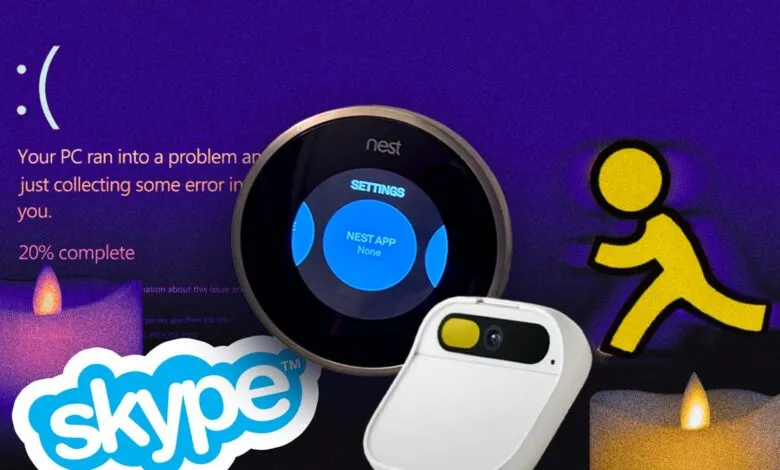
A visual icon of computing frustration received a makeover. Microsoft replaced the classic Blue Screen of Death with a new black-screen error display in its late 2025 OS update. While the backend crash reporting was improved, the shift marks the end of an era for that infamous blue backdrop and its accompanying frown emoticon, a sight that will likely persist on outdated systems in public spaces.
Amazon closed its general Android Appstore to the public in August, refocusing it exclusively on apps for its Fire devices. After fourteen years, this strategic retreat highlights the company’s intensified focus on its own ecosystem, making it harder for users of other Android devices to access Amazon’s curated app selection.
Another communications pioneer faded into the background as Microsoft announced the retirement of the standalone Skype app, folding its functionality into the free version of Teams. Once revolutionary for cheap international calls, Skype’s journey from mainstream staple to integrated feature illustrates the competitive evolution of voice and video chat platforms.
Owners of early Nest Learning Thermostats received a harsh lesson in planned obsolescence. Google ended app support for the first- and second-generation models, stripping them of remote control, notifications, and security updates. The hardware still works on the wall, but the disconnection effectively downgrades these once-smart devices, pushing users toward newer products.
Even hardware from defunct services reached its final chapter. Google ceased offering firmware upgrades to convert its Stadia controllers to standard Bluetooth use by the end of 2025. Without this update, the well-designed controllers become decorative bricks, a tangible reminder of the cloud gaming service that shut down years prior.
Finally, regulatory action reshaped the drone market. A U.S. import ban on foreign-made drones that took effect in December has made products from leading manufacturer DJI much harder to acquire domestically. While existing drones can still be flown, the ban significantly complicates purchasing new ones, altering the landscape for hobbyists and professionals alike.
(Source: CNET)