Asus Announces Dream OLED Xbox Ally X
▼ Summary
– The ROG Xbox Ally X20 upgrades from a 7-inch IPS to a 7.4-inch 120Hz OLED display with 600 nits SDR and 1400 nits HDR peak brightness, supporting Dolby Vision.
– It features improved variable refresh rate down to 30Hz, drift-resistant Gulikit TMR joysticks, a transforming D-pad, and a new “Action” button for screenshots and recordings.
– The handheld is slightly larger (9mm wider, half a millimeter thicker, 41g heavier) and includes a faster microSD Express card slot.
– Asus will only sell the Ally X20 as a bundle with Xreal R1 glasses, likely to cushion its high price, though the bundle price is not yet announced.
– The original Xbox Ally X remains at $1,000 with no announced price increase, and Asus has not confirmed a way to remap its Library button.
If you asked me what I’d change about the Xbox Ally X handheld, aside from fixing Windows, I’d have two clear requests. First, give it a bigger, better screen , something a little larger to reduce that claustrophobic feel and shrink the unsightly bezels. Second, kill the “Library” button. I’m tired of accidentally hitting it, getting booted out of my game, and struggling to find a quick way back.
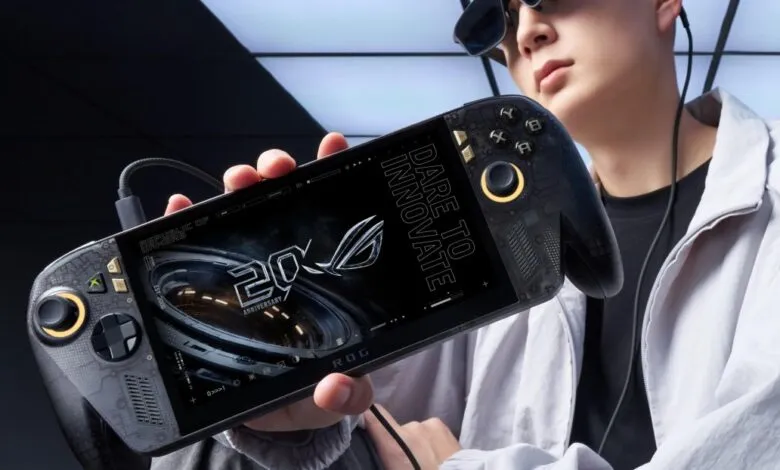
With the newly announced ROG Xbox Ally X20, Asus has addressed both of those wishes , and then some. This refreshed device arrives in a striking translucent design, featuring drift-resistant Gulikit TMR joysticks, a transforming D-pad that shifts from 8-way to 4-way by dropping its corners when rotated, along with refined buttons, improved haptic feedback, and tweaked fans. Most notably, it may now boast the best screen on a handheld yet.
The display upgrade is substantial: the Xbox Ally X20 moves from a 7-inch IPS panel to a 7.4-inch 120Hz OLED at the same performance-friendly 1080p resolution. The screen delivers 600 nits in SDR and HDR peaks of 1400 nits, even surpassing the Lenovo Legion Go 2, though both are certified VESA DisplayHDR TrueBlack 1000. It also supports Dolby Vision.
Like the Legion Go 2, the Ally X20 features an improved variable refresh rate (VRR) that now drops to 30Hz, rather than the 48Hz floor on the original Ally. This could make gameplay feel smoother when the AMD Z2 Extreme chip struggles to maintain 48fps. The chipset remains unchanged from the original Xbox Ally X: the AMD Z2 Extreme, paired with 24GB of 8000MT/sec RAM and 1TB of storage.
To accommodate these upgrades, the handheld is slightly larger , 9mm wider, half a millimeter thicker, and 41 grams heavier.
The dreaded “Library” button is gone, replaced by a new “Action” button that feels genuinely useful. A single press takes a screenshot, while a long press starts a recording , much like modern console controllers.
The ABXY buttons now sit flush against the casing when pressed. The bumper switches have been relocated, offering a longer, quieter throw for better tactile feedback. Asus spokesperson Anthony Spence tells me the fans have been redesigned to channel more fresh air through the chassis, lowering touchscreen temperatures. The Xbox button now glows green, which just looks cool, and the device includes a faster microSD Express card slot, similar to the Nintendo Switch 2.
Not everything about this launch is ideal, though. Asus won’t let you buy the handheld on its own. This holiday, the Xbox Ally X20 will only be available as part of a bundle with Asus and Xreal’s pricey R1 glasses, which cost $849 , nearly as much as the $1,000 handheld itself. Asus hasn’t announced the bundle’s final price, but it seems the glasses are more about offsetting the handheld’s high cost than offering a discount on eyewear.
I can see the appeal of Xreal glasses for enhancing a smaller screen, but if I’m buying a new Ally specifically for a better display, do I really need the glasses too? I’ll keep dreaming. For now, Spence says there are no plans to increase the price of the original Xbox Ally X, which remains at $1,000. I’ve also asked whether Asus will offer a way to remap that original handheld’s Library button.
(Source: The Verge)