The Game Awards Statue Hints at a Single Major Reveal
▼ Summary
– In 2005, Microsoft held an extravagant, Burning Man-inspired launch event in the Mojave Desert for the Xbox 360, representing a bygone era of lavish gaming promotions.
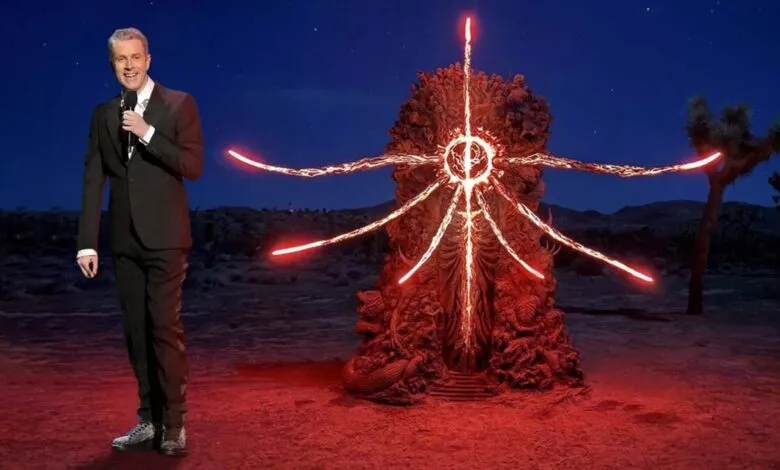
– A mysterious, demonic statue recently appeared in the Colorado desert, placed by The Game Awards host Geoff Keighley as a viral marketing stunt to generate buzz for the show.
– The ambiguous statue has sparked widespread online speculation about which upcoming game it might be teasing, successfully driving engagement and viewership for The Game Awards.
– Unlike past complex alternate reality games (ARGs) for promotions, this statue relies on simple, shareable mystery to fuel modern algorithmic virality on platforms like TikTok and Reddit.
– The article suggests the traditional AAA gaming marketing model is declining, as big-budget events feel less impactful while surprise indie hits often capture attention without massive campaigns.
Back in 2005, the Mojave Desert briefly lit up with an eerie green glow. This was the scene for Microsoft’s launch of the Xbox 360, an extravagant affair held in a desert hangar meant to evoke the spirit of Burning Man. Described by one executive as an “Xbox 360 oasis,” it was a blend of press event and fan party, complete with beanbag chairs, gaming stations, and drinks served from domed structures. That era of lavish, location-based marketing spectacles for games and hardware has largely faded. Yet, two decades later, a strange relic echoing that time has surfaced in the Colorado desert: a demonic statue covered in etched, screaming figures, sparking intense speculation about its purpose.
This mysterious installation is linked to The Game Awards host Geoff Keighley, who shared a geotagged photo pointing to a spot near Joshua Tree National Park. At night, the statue emits a red glow from its tendrils, illuminating the skeletal forms of humans and monsters carved into its sides. Visitors report it emits hellish ambient sounds, with one Reddit user describing it as feeling like a doorway to a demonic cavern. A security guard is even posted nearby, adding to the intrigue. While it could be mistaken for a piece of desert art or something more sinister, Keighley’s involvement signals it’s a deliberate marketing stunt for the annual awards show.
The statue’s ambiguous, infernal design has become a blank canvas for fan theories. Is it a clue for Half-Life 3, given its Yucca Mesa Road location? Do the demonic symbols point to Diablo 4 or the next God of War? Perhaps it’s a portal for a new Doom title. The speculation itself is the point, fueling online buzz and ensuring people will tune into The Game Awards for the reveal. Even a prominent journalist hinted the statue is teasing “a good one,” while playfully dismissing some of the popular guesses. This campaign is far less complex than past alternate reality games (ARGs) that involved years-long puzzles or sending game copies into space. Instead, it leverages the modern hype cycle: a bizarre, photogenic object in a remote location, perfectly suited for sharing on TikTok and Reddit to generate viral curiosity.
This approach is a new twist on a familiar industry tactic. Major publishers have long created physical installations to promote big games, from giant Overwatch action figures to a massive God of War axe in London. The key difference here is the intentional mystery. The danger is that the eventual reveal might not live up to the expansive speculation, potentially leaving audiences disappointed. The Game Awards itself is a platform built for marketing AAA blockbusters, filled with world premiere trailers for titles like The Witcher 4 or Marvel’s Wolverine. Yet, breakout hits often emerge from smaller studios without these massive campaigns, leading some to question the old model of high-stakes, high-budget reveals.
Regardless of what the statue ultimately promotes, the strategy is effective for Keighley. The conversation and mystery directly drive viewership to his show. People may forget the specific game it advertised, but they will remember the strange hell portal in the desert and tune in to solve the puzzle. In an age where capturing attention is paramount, the spectacle itself is the victory, proving that even a single, well-placed enigmatic object can command the spotlight far from the glitzy stages of past launch events.
(Source: Kotaku)