ChargePoint Partners with Powers Parts for Transit EV Bus Charging
▼ Summary
– ChargePoint and Powers Parts have partnered to sell charging hardware, software, and fleet telematics to transit agencies operating PhoenixEV electric buses, targeting operators left with service gaps after Proterra’s 2023 bankruptcy.
– The partnership provides a single procurement path through Powers Parts’ distribution network for ChargePoint’s DC fast charging and telematics, which integrates with all vehicle types and charging stations via OCPP compliance.
– Proterra’s 2023 bankruptcy fragmented service support for its E2 and ZX5 buses, leaving agencies without adequate parts, software updates, or charging infrastructure, which PhoenixEV’s bus acquisition did not fully resolve.
– US transit electrification faces operational challenges like reduced battery range in extreme weather and thin aftermarket supply, despite $5.6 billion in federal funding from 2022 to 2026.
– For ChargePoint, this distribution deal expands its fleet and transit charging business, offering agencies a practical solution to the patchwork of support left after Proterra’s collapse.
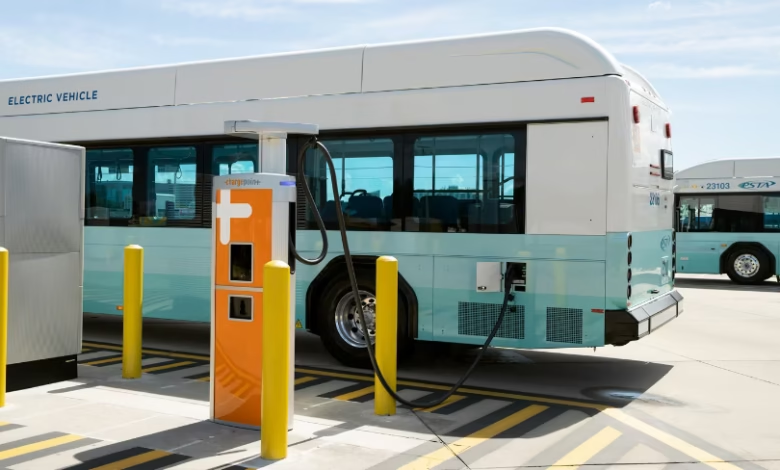
ChargePoint and Powers Parts have joined forces to supply EV charging hardware, fleet management software, and telematics to transit agencies operating PhoenixEV electric buses. The collaboration is designed to help operators still grappling with service disruptions that followed Proterra’s 2023 bankruptcy by routing ChargePoint’s platform through Powers Parts’ established distribution network.
Powers Parts, a national distributor of EV components and fleet replacement parts, will now offer ChargePoint’s DC fast charging stations, fleet software, and telematics services directly to transit agencies across North America. The focus is on agencies running the E2 and ZX5 electric buses built by PhoenixEV, the company that acquired Proterra’s transit bus assets out of bankruptcy in early 2024 for $3.5 million.
The partnership solves a specific problem. Many transit agencies that purchased Proterra’s E2 and ZX5 buses before the company’s collapse now operate those vehicles without reliable service, charging support, or fleet management tools. Powers Parts already built its business around supplying replacement components to these exact operators. Adding ChargePoint’s charging infrastructure and telematics to that distribution channel gives transit agencies a single procurement path for both parts and charging.
What the deal includes
Through the agreement, transit operators can purchase ChargePoint’s charging stations, fleet management software, and telematics services via Powers Parts’ existing distribution network. ChargePoint’s telematics platform integrates with all vehicle types and charging stations regardless of manufacturer, offering real-time visibility into battery health, route efficiency, and total cost of ownership. The software is OCPP compliant, meaning it can manage third-party charging hardware as well as ChargePoint’s own stations.
The telematics system also works with mixed-fuel fleets, a critical feature since most transit agencies are electrifying gradually rather than replacing entire fleets at once. An agency running a mix of diesel, compressed natural gas, and electric buses can manage all three through a single interface.
The Proterra aftermath
Proterra filed for Chapter 11 bankruptcy in August 2023 after years of losses, despite being one of the most prominent U. S. electric bus manufacturers. Its transit bus division was sold to Phoenix Motorcars, now PhoenixEV, for just $3.5 million. Volvo acquired Proterra’s battery and powertrain division for approximately $223 million, while the charging infrastructure business was sold separately.
The bankruptcy left transit agencies that had invested in Proterra buses in a difficult position. Replacement parts, software updates, and charging infrastructure support, once handled by a single integrated provider, were suddenly fragmented across multiple companies or simply unavailable. PhoenixEV inherited the bus platform and manufacturing rights, but the broader service ecosystem had to be rebuilt from scratch.
Transit electrification under pressure
The partnership arrives at a challenging moment for U. S. transit electrification. The Federal Transit Administration’s Low or No Emission Vehicle Program has allocated $5.6 billion over five years from 2022 to 2026, driving hundreds of agencies to order electric buses. But the transition has exposed real operational challenges, including shorter-than-advertised battery range in extreme weather, lengthy charging times that disrupt scheduling, and a thin aftermarket parts supply chain.
California, which leads the country in electric bus adoption, has already delayed some of its zero-emission transit mandates to give the market time to stabilise. Agencies in colder climates have reported range reductions of 30% or more in winter, requiring more buses to cover the same routes.
ChargePoint’s fleet play
For ChargePoint, the partnership extends a push into fleet and transit charging that complements its larger consumer and commercial business. The company reported full fiscal year 2026 revenue of $411 million and operates more than 1.37 million public and private charging ports worldwide. Electric buses represent a growing share of that network, as transit agencies electrify under federal mandates and funding incentives.
CEO Rick Wilmer described transit as “critical to the broader electrification of transportation” and said the Powers Parts partnership expands ChargePoint’s reach across the transit ecosystem. The deal is a distribution agreement, not a technology breakthrough, but for agencies struggling with the aftermath of Proterra’s collapse, having a single channel for parts, charging, and fleet software is a practical improvement over the current patchwork.
(Source: The Next Web)