H&M Partners with Startup to Turn CO2 Into Clothing
▼ Summary
– The fashion industry has a severe waste and pollution problem, discarding a garbage truck of textiles every second and generating more carbon emissions than international flights and shipping combined.
– Startup Rubi is developing a technology to produce cellulose for materials like lyocell and viscose by using enzymes to capture and process carbon dioxide, avoiding fossil fuels and trees.
– Rubi recently raised $7.5 million to scale its system and has secured over $60 million in non-binding agreements, testing materials with major partners like H&M, Patagonia, and Walmart.
– The company’s enzyme-based approach differs from other methods, using AI to enhance efficiency, and aims to enable local, textile-grade cellulose production in regions like the U.S.
– While initially targeting apparel, Rubi envisions its technology as a low-cost platform to produce various chemicals and materials across the economy from captured CO2.
The fashion industry faces a significant environmental challenge, with vast amounts of textile waste and substantial carbon emissions. Innovative solutions are emerging to address this dual crisis, including new technologies that transform waste into wearable materials. One promising approach comes from startup Rubi, which has developed a system to create the building blocks for fabrics like lyocell and viscose directly from captured carbon dioxide. This process could fundamentally reshape material supply chains, offering a sustainable alternative to traditional forestry-based cellulose production.
Rubi recently secured $7.5 million in funding to build a demonstration-scale production system. This system is designed to produce tens of tons of material using CO2 as its primary ingredient. The investment round was led by AP Ventures and FH One Investments, with notable participation from CMPC Ventures, H&M Group, Talis Capital, and Understorey Ventures. The startup has also reported securing over $60 million in non-binding purchase agreements with several partners and has tested its material with 15 pilot companies, including major brands like H&M, Patagonia, and Walmart.
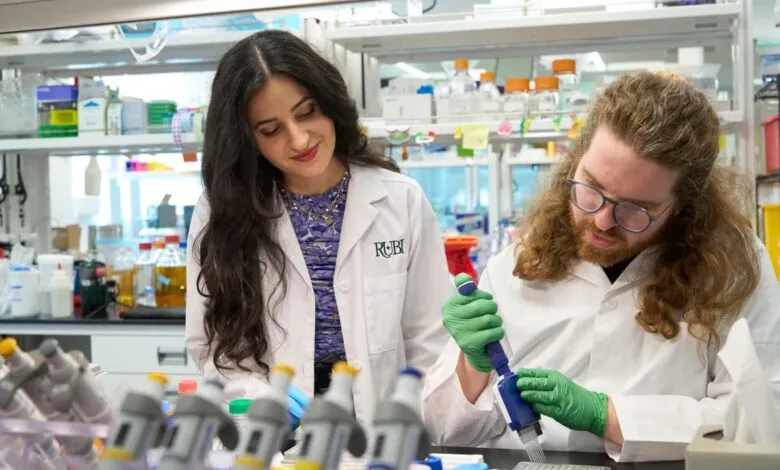
The company’s method centers on using enzymes to convert carbon dioxide into cellulose, the essential polymer for many textiles. This approach differs from other technologies that might rely on engineered bacteria or chemical catalysts. By leveraging enzymatic processes, Rubi taps into an existing, scalable, and cost-effective industrial infrastructure commonly used in sectors like food production and wastewater treatment. The founders, Neeka and Leila Mashouf, focused on enzymes after evaluating various technological pathways, recognizing their potential for efficiency and stability.
In Rubi’s current setup, enzymes in a water-based solution process waste carbon dioxide, resulting in the formation of white cellulose within minutes inside a reactor. These reactors are modular, designed to fit within standard shipping container dimensions. The company utilizes artificial intelligence and machine learning to enhance the performance and durability of its enzymatic “cascade.” While the present batch process is effective, Rubi aims to evolve toward a continuous production model to increase output and efficiency.
Initially targeting the apparel sector, Rubi envisions its technology as a broad platform. The goal is to supply cellulose not just for textiles but for any industry that utilizes it, from packaging to other consumer goods. This represents a strategic shift toward producing essential chemicals and materials across the economy in a sustainable, low-cost manner. By creating textile-grade cellulose pulp domestically, such as in the United States where it isn’t currently manufactured, Rubi could shorten lengthy global supply chains and reduce reliance on wood pulp from forests.
(Source: TechCrunch)