Rivian’s $4,500 Electric Bike: Inside the Bold Bet

▼ Summary
– Rivian’s founder RJ Scaringe initially considered pedal-powered microcars before launching the EV company, but pivoted to focus on sustainable mobility through the new venture Also.
– Also, a Rivian spin-off, has launched its first products including a modular e-bike, a pedal-assisted four-wheeler, and an innovative helmet designed to reduce head injury risk by over 60%.
– The flagship TM-B e-bike features a unique modular frame, tool-free seat removal, and a pedal-by-wire “Dream Ride” system that eliminates mechanical drivetrain connections for customizable riding experiences.
– Despite Rivian facing financial challenges with unprofitable quarters and a declining EV market, Also is well-capitalized with $105 million in funding and aims to transform micromobility into a serious industry.
– The TM-B e-bike will launch in 2026 starting at $4,500, targeting premium buyers with advanced features like phone integration, adaptive riding modes, and high torque for demanding terrain.
Rivian’s $4,500 electric bike represents a bold expansion into micromobility, emerging from founder RJ Scaringe’s long-standing vision for sustainable transportation solutions beyond traditional automobiles. Years before establishing the adventure-focused electric vehicle manufacturer, Scaringe contemplated pedal-powered hybrid microcars and alternative transport forms. Though he ultimately shelved that specific concept due to perceived market limitations, the underlying philosophy of creating versatile, eco-friendly mobility options persisted.
Approximately four years ago, Scaringe initiated discussions with Specialized’s then-chief technology officer Chris Yu about establishing an independent division to explore pedal-powered innovations. This collaboration has now materialized as Also, a separate company introducing its inaugural product lineup: a modular e-bike, pedal-assisted four-wheeler, and advanced safety helmet.
The timing appears counterintuitive given Rivian’s current challenges. The automaker anticipates significant EV sales declines following the expiration of federal tax credits while preparing for next year’s crucial R2 vehicle launch. Despite never recording a profitable quarter and facing industry-wide contraction, Rivian is pushing forward with this micromobility venture.
Also enters the market with substantial advantages, having secured $105 million from Eclipse Ventures and assembled talent from leading technology and mobility companies. The startup maintains vertical integration similar to its parent company, potentially offering cost efficiencies. Scaringe describes the venture’s mission as “pursuing a variety of form factors that are all sub-car,” with the bicycle serving as a foundational platform for broader mobility solutions.
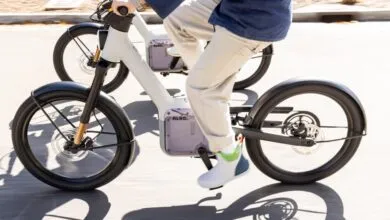
The flagship TM-B e-bike defies conventional categorization with its modular top frame that enables riders to switch between a standard saddle, utility seat with integrated rack, or motorbike-style bench seating. This innovative design allows frame swapping in approximately three seconds without tools through electronic detachment controlled via the display interface.
Perhaps the most revolutionary aspect is the Dream Ride mid-drive system, which completely reimagines bicycle propulsion. This pedal-by-wire technology eliminates mechanical connections between pedaling and wheel movement. Instead, pedaling activates a generator motor that replenishes the battery, while a separate traction motor at the rear wheel provides propulsion through software-controlled Gates Carbon belt drive.
Yu explains that traditional drivetrains have remained fundamentally unchanged for over a century, even with electrification. Also’s system offers both simplicity for novices and sophisticated performance for enthusiasts. The bike provides adaptive assistance matching preferred cadence with minimal rider input, while delivering exceptional torque output that surpasses even high-performance electric mountain bikes.
The system accommodates various riding preferences through software customization. Trail mode simulates traditional geared bicycles with perfectly timed ratio changes, while automatic grade detection adjusts assistance for hill climbing. Regenerative braking handles most deceleration, reducing mechanical wear and extending range.
Power comes from two battery options: a 538Wh unit providing 60-mile range with two-hour charging, and an 808Wh extended battery offering 100-mile range. Both feature USB-C Power Delivery ports and energy-efficient E Ink charge indicators.
The TM-B incorporates zonal architecture mirroring Rivian’s automotive approach, enabling smartphone integration for keyless access and personalized settings. When paired phones approach, the bike recognizes users by name and automatically configures preferences. An integrated anti-theft system immobilizes the bike when owners walk away.
A circular 5-inch touchscreen called the Portal displays essential information, while handlebar controls manage audio playback from connected devices. As a Class 3 e-bike, it reaches 28mph with pedal assistance and includes thumb throttle capability where permitted. Full suspension with inverted fork design provides stability across varied terrain.
Also’s debut extends beyond the TM-B to include the TM-Q pedal-assisted four-wheeler, available in commercial and personal configurations. The consumer version resembles an open-air golf cart, targeting the growing market for neighborhood electric vehicles at competitive pricing.
Completing the launch lineup is the Alpha Wave Helmet, incorporating Release Layer System technology to reduce rotational impact forces. Independent testing suggests this design may decrease traumatic brain injury risk by over 60%. Integrated lighting, microphones, and speakers enable hands-free functionality.
The premium pricing strategy positions the TM-B launch edition at $4,500 for spring 2026 delivery, with a base model under $4,000 following later that year. This places Also’s offerings significantly above popular $1,000 e-bikes dominating the American market, raising questions about market reception given recent bankruptcies of premium e-mobility brands.
Scaringe remains optimistic about the venture’s potential to transform micromobility from fragmented experiments into substantial business category. He compares the experience to Rivian’s automotive approach, emphasizing comprehensive design integration that might convince consumers they’ve discovered a product they hadn’t previously considered.
(Source: The Verge)