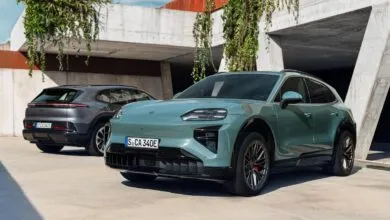
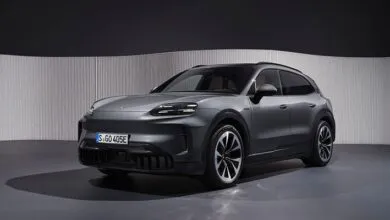
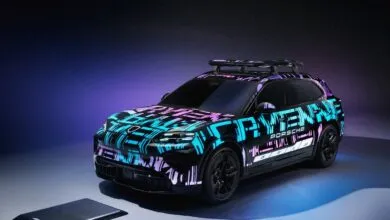
Porsche Cayenne Coupe Turbo: A threat to 911 drivers
▼ Summary
– Porsche’s Cayenne and Macan SUVs accounted for 62 percent of all Porsche sales last year, and the new electric Cayenne Turbo Coupe is the most powerful Porsche ever, with 1,139 horsepower.
– The electric Cayenne accelerates from 0 to 60 mph in an estimated 2.2 seconds and covers a quarter-mile in 9.9 seconds, outperforming many supercars.
– It features a 400-kilowatt peak charging capability, allowing a 10-to-80 percent battery charge in under 16 minutes.
– The Cayenne uses a rear electric motor with oil-cooled technology directly transferred from Porsche’s Formula E team, enabling 600-kilowatt regenerative braking.
– The electric Cayenne is built on a dedicated platform with a stretched wheelbase, offers up to 416 miles of range (WLTP), and starts at $116,150 for the base model.
Back in 2002, Porsche purists howled in protest when the Cayenne debuted at the Paris Motor Show. More than two decades later, the company sells more SUVs than anything else. Last year, the Macan and Cayenne combined for 62 percent of all Porsche sales. Now, these SUVs are taunting traditionalists in an entirely new way. They’ve gone electric, with a Cayenne Electric joining a smaller plug-in Macan. And the Cayenne Coupe Turbo is so quick that even 911 owners might start feeling nervous.
Even the most die-hard Porsche enthusiasts, the ones who gather at vintage festivals to celebrate air-cooled engines, have to respect the Turbo Coupe Electric. This new Cayenne makes a legitimate case as the most powerful Porsche ever built, delivering a staggering 1,139 horsepower and 1,106 pound-feet of torque. Not from a 911 or a seven-figure hypercar like the 918 Spyder. Instead, it comes from a suburban-friendly, lacrosse-gear-hauling SUV.
This electric Cayenne treats physics like a punchline. It accelerates faster than many supercars and carves through corners like, well, a Porsche. That includes effortless runs to its 261 kph top speed (162 mph for Americans) on unrestricted stretches of the German Autobahn.
The Turbo Coupe settles into a relaxed 110 mph cruise, gliding on standard air springs, optional rear-axle steering, and the Active Ride suspension. That clever system uses sensors, electric motors, and hydraulic dampers to counteract body motion. Each damper can generate up to 2,250 pounds of proactive force at individual wheels, independent of road bumps. In Comfort mode, the active system lets the Cayenne “helicopter,” hovering oddly but effectively over the road with almost no body lean.
That ridiculous speed extends to charging. Electric Cayennes can peak at a blistering 400 kilowatts, matching the Lucid Gravity SUV. They maintain a wide enough charging curve to refill the 108 kilowatt-hour battery from 10 to 80 percent in under 16 minutes.
Porsche claims the Coupe Turbo hits 60 mph in 2.4 seconds. Based on my brain-squeezing launches in the Bavarian countryside, I’d say it’s closer to 2.2 seconds. That time shames many supercars, past and present. Despite a curb weight of nearly 5,900 pounds, the Coupe Turbo dashes from 0 to 124 mph (200 kph) in a ridiculous 7.4 seconds. It covers the quarter-mile in 9.9 seconds, nearly a full second quicker than a Ferrari 12Cilindri. That pace comes with a surprisingly charming synthesized sound that recalls a German V-8 filtered through Trent Reznor. Drivers can dial down or shut off the fake engine noise when they prefer an EV whisper.
Turbo versions make 845 horsepower in normal operation, reserving the full 1,139 horses for automated launches. An F1-style “push-to-pass” feature summons 173-horsepower bursts of electric overboost whenever you press a steering-wheel button. Those nitrous-like surges are limited to 10-second intervals, compared to 20 seconds in a 911 GTS hybrid, to keep temperatures under control.
One squeeze of the slim, ergonomically ideal GT steering wheel reminds you this is still a Porsche. Like the Taycan sedan, the steering feels brilliantly agile and natural, with a tactile road connection that too many EVs lack.
Automakers often spin dubious links between their racecars and street cars. Here, a muscular rear electric motor claims a direct, legitimate tech transfer from Porsche’s championship-winning Formula E team. The motor’s internal stator and live copper windings are bathed in a Mobil-designed oil that doesn’t conduct electricity. That provides a huge cooling advantage over external water jackets that typically surround a motor’s case. The ingenious design lets the Porsche regenerate braking electricity at a torrential 600-kilowatt pace, matching its Formula E cars, without overheating internal components.
Porsche stubbornly refuses to include a one-pedal EV driving mode, preferring to coast like familiar ICE cars when you lift off the throttle. Yet give the brake pedal a squeeze, and Porsche claims 97 percent of real-world stops will be handled entirely by the electric motors. Press the pedal deeper, and the Cayenne engages its mega-powered physical brakes, including optional ceramic-composite units. The transition to friction braking is so seamless I couldn’t spot it on a bet.
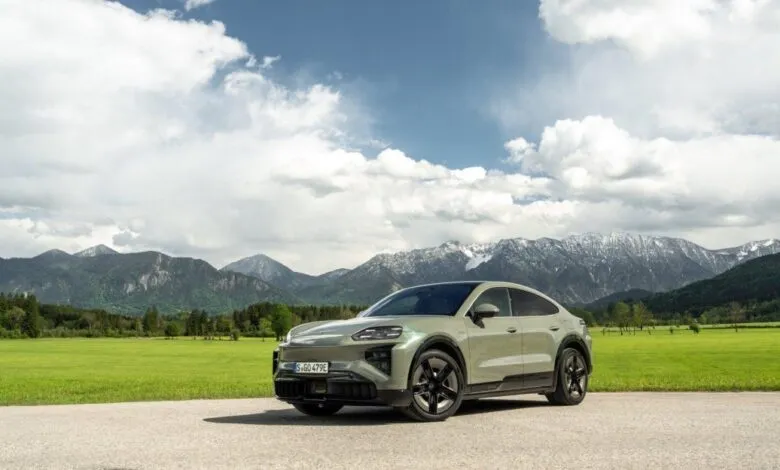
Compared to a standard, square-backed Cayenne, these Coupes are defined by their sloping rooflines, a “flyline” silhouette inspired by the 911. It’s a sportier, less family-oriented body style that 40 percent of American buyers chose in 2025, despite a modest cargo space penalty.
Offered in either body style, these first-ever electric Cayennes leap ahead of Porsche’s internal-combustion versions, whose aging current generation dates to 2019. They’re built on a dedicated electric platform, sharing almost no components with gasoline models. A nearly five-inch wheelbase stretch delivers welcome rear legroom gains. A 3.2 cubic-foot frunk fits a pair of backpacks, but no more.
A shapely snout integrates active front cooling flaps, with signature gym-pumped rear shoulders and an active rear spoiler. On the Turbo, a pair of motorized “aeroblades” emerge near the rear bumper. The Coupe’s fastback shape delivers a slippery 0.23 coefficient of drag, versus 0.25 for a standard model. That should squeeze out 10 or 11 more miles of driving range.
Porsche says the Coupes, offered in three strengths, should range between 356 and 416 miles. Those estimates are based on generous global WLTP test procedures. The EPA has yet to weigh in. But based on my drives and calculations, these Coupes should all top 340 miles easily. Porsche’s superlative Taycan is already known to exceed EPA range figures.
It’s ironic that the most powerful Porsche ever is designed to tempt newcomers who may care more about luxury EV features than German performance. Porsche’s great leap forward in tech and infotainment may rank among its biggest selling points as it tries to attract first-time buyers.
The lavish cockpit centers on a vertical, 14.25-inch OLED “flow screen” that bends toward the console like a giant flip phone. Drivers are welcomed with a large greeting animation showing a Cayenne in the exact body color of their car, which they can twirl with their fingers. Cute. A leather hand rest is a stroke of genius, making it easy to control the screen while in motion. Blessedly, old-school analog switches manage regularly used controls, such as a volume knob and temperature toggles.
An optional passenger screen blows away previous shotgun screens from Ferrari and others, with comprehensive functions and video streaming that’s digitally shielded from the driver’s view. There’s a lot going on here. But somehow it all works, from a Porsche that decades ago used to slap in an AM/FM Blaupunkt radio and call it a day. Unlike Mercedes’ stadium-sized “Hyperscreen,” the system doesn’t suck up all the cabin’s design oxygen or overwhelm its occupants.
One misstep is an AR heads-up display that takes up too much real estate in the driver’s view. Floating navigation arrows become intrusive motes in your eye. Screen-based vent controls are another trend Porsche might have skipped, though they’re easier to operate than Rivian’s or Lucid’s vents.
The Turbo Coupe starts from $170,350, and my options-laden test model hit $233,000. A standard Coupe Electric will ask $116,150 when these Porsches arrive in late summer. The “starter” model offers a perfectly adequate 402 horsepower, 435 from a launch, and a 4.5-second run to 60 mph. The Cayenne S Electric I drove feels like the sweet spot in the lineup, with 536 horsepower, 657 horses of max overboost, and a wicked 3.7-second sprint to 60 mph. That’s as quick as a BMW X6M Competition SUV with a 617-horsepower V-8.
That S model starts from $133,550. Stuffed with options, it reaches $201,150. Seems we were just getting used to Porsches being $100,000 cars, and now they’re $200,000 cars.
EV fans ready to splurge might consider Porsche’s wireless inductive charging system. At a lunch stop, I rolled the Cayenne atop a magnetic ground pad that owners can install in a garage or outdoor driveway. A screen display guided me into docking position by joining a pair of animated green circles, one representing the moving car, the other the pad below. The Cayenne began to charge like a three-ton smartphone, absorbing 11 kilowatts of AC juice with no awkward cord or plug required. Don’t worry about stray cats or kids: The Porsche stops charging if it senses motion around the pad.
Inductive transfer is strong enough to charge the Cayenne’s hefty battery from 10 to 80 percent in less than nine hours. Skip a few superficial options in favor of this pioneering home system, and you may rarely touch a grubby plug again. In other charging news, these Cayennes are the first Porsches with an onboard Tesla-style NACS connector.
Versus the old SUVs-off-my-lawn debates, these electric Cayennes bear genuine issues on their broad shoulders: a tariff regime that heavily taxes these pricey European-built machines, a slowdown in EV adoption, and a Chinese market that currently prefers its own EVs. In an ironic upside, a war in Iran is providing an unforeseen opening for energy-efficient models, despite the Trump administration’s attempts to strangle EVs in their crib. And as with the controversial Ferrari Luce, the jury is still out on whether Porsche can convince enough people to switch to an electric performance car.
That’s a lot of baggage for these Porsches to haul when they arrive, fresh off the boat from a factory in Bratislava, Slovakia. One thing is certain: America’s Cayenne buyers will be casting a progressive vote, with fattened wallets, for the unstoppable progress of EVs.
(Source: The Verge)