Google Launches Its Own Visual Studio Code Alternative
▼ Summary
– Google Antigravity is a new agent-first IDE that works with the Gemini 3 Pro model, using a chatbot to handle complex, multi-step development tasks.
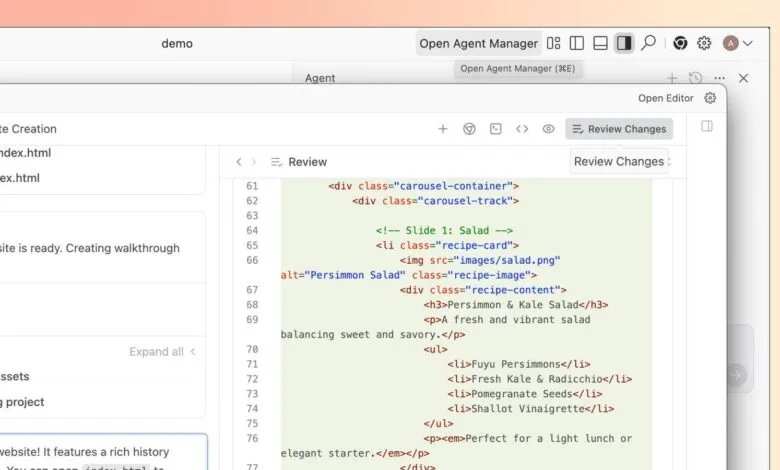
– The platform’s interface resembles Microsoft’s Visual Studio Code and includes a unique Manager view for controlling multiple autonomous agents simultaneously.
– Agents produce “Artifacts” like task summaries and browser recordings to document their work, and users can provide feedback directly on these without interrupting the agent.
– Antigravity supports third-party models like Claude Sonnet 4.5 and GPT-OSS, offering developers flexibility and avoiding immediate vendor lock-in.
– The tool is in free public preview for major operating systems, but users have reported issues like sign-in problems and quickly hitting usage quotas.
Google has officially launched Antigravity, a new agent-first development platform that functions as a sophisticated integrated development environment. Announced in conjunction with the Gemini 3 Pro model, this platform introduces a chatbot designed to take the lead on intricate, multi-step programming tasks. The interface bears a striking resemblance to Microsoft’s Visual Studio Code, with nearly identical icons and layout, positioning it as Google’s direct competitor to other AI-driven IDEs such as Cursor and GitHub Copilot.
The fundamental concept behind Antigravity is that developers act as architects, delegating complex, end-to-end software projects to intelligent agents. These agents operate seamlessly across the editor, terminal, and even web browsers. Leveraging a familiar VS Code-like foundation is a strategic move that significantly lowers the learning curve, allowing developers who are already comfortable with that environment to adapt quickly.
By default, Antigravity opens in the standard Editor view, where the AI agent resides in a side panel similar to competing tools. However, the platform’s standout feature is the Manager view, which is specifically engineered for overseeing multiple agents at once. This view enables these agents to work autonomously and in parallel across various workspaces, a capability Google describes as a “mission control” for coordinating a team of specialized assistants.
As agents complete their assignments, they generate “Artifacts.” These are not merely logs of every action performed but are meaningful summaries that include task lists, project plans, screenshots, and browser recordings. These Artifacts serve to verify completed work and outline the agent’s next steps. A particularly useful feature is the ability to leave direct feedback on specific Artifacts. The agent can incorporate this input without interrupting its current workflow, addressing a recurring frustration users have experienced with tools like Gemini and NotebookLM.
Another significant advancement is the agent’s capacity to learn from previous work. It retains essential code snippets and procedural steps for recurring tasks, which helps break the cycle of repeated errors, a common issue that has plagued other AI coding assistants. This learning mechanism aims to create a more reliable and efficient development experience over time.
Antigravity is built around the Gemini 3 Pro model, which Google states is particularly adept at handling agentic workflows and complex coding assignments. This supports what the company refers to as “vibe coding,” where developers can transform high-level ideas or natural language prompts into functional code using a large language model.
Notably, the platform is not restricted to Google’s own AI models. While it prominently features Gemini 3 Pro, it also supports third-party models including Anthropic’s Claude Sonnet 4.5 and OpenAI’s GPT-OSS. This open approach is highly beneficial for developers, as it provides flexibility and helps prevent immediate vendor lock-in.
Despite its promising features, Antigravity appears to have some early technical issues. Some users, including those with active AI subscriptions, have reported difficulties signing into the platform. Social media responses indicate that this login problem is not an isolated incident.
Currently available as a public preview for Windows, macOS, and Linux, Antigravity is being offered free of charge during this initial phase. Google has implemented what it describes as “generous rate limits” for Gemini 3 Pro, though some users have commented that they reached their usage quota surprisingly quickly, in some cases, after just three prompts.
(Source: HowToGeek)