Cipher Digital raises $810M in junk bonds for Texas data centre
▼ Summary
– Cipher Digital is raising $810 million through a junk-bond sale at a 6.25% yield to fund the Stingray data centre in West Texas, which Amazon will lease for 15 years.
– The bond’s amortisation schedule is tied to the project’s cash flow after completion, differing from fixed repayment schedules typical in high-yield data centre financings.
– Cipher Digital, formerly a cryptocurrency miner, now holds about 600 megawatts of contracted HPC capacity with Amazon Web Services, Google, and Fluidstack, citing roughly $11.4 billion in contracted revenue.
– The Stingray offering is Cipher’s third high-yield bond sale in four months, following a $2 billion deal in February for its Black Pearl subsidiary that attracted over $13 billion in orders.
– The deal highlights a two-track AI infrastructure debt market, where hyperscalers borrow at investment-grade rates while smaller developers tap junk markets, with hyperscaler lease commitments underpinning the creditworthiness of junk-rated issuers like Cipher.
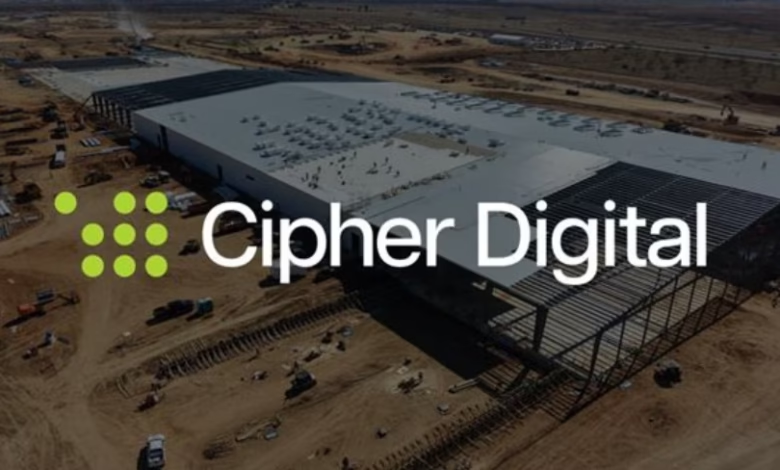
Cipher Digital is raising $810 million through a junk-bond sale to finance a data centre in West Texas that Amazon will lease for 15 years, according to Bloomberg. The offering, priced at a yield of roughly 6.25%, will cover the remaining construction costs for the company’s Stingray Facility, a 100-megawatt computing campus in Andrews County. Morgan Stanley, Goldman Sachs, Wells Fargo, Banco Santander, and SMBC Nikko Securities are managing the deal.
This bond carries an unusual structural feature. Instead of requiring Cipher to pay a fixed annual principal amount, the amortisation schedule is linked to the cash the project generates after completion. Most high-yield data centre financings rely on fixed repayment plans, making this transaction more akin to project finance than traditional corporate junk debt.
Cipher Digital, formerly known as Cipher Mining, started as a cryptocurrency miner before shifting focus to high-performance computing infrastructure. The company shut down its bitcoin mining operations in February and now holds about 600 megawatts of contracted HPC capacity with Amazon Web Services, Google, and Fluidstack. Management reports roughly $11.4 billion in contracted revenue across its portfolio.
The Stingray offering marks Cipher’s third high-yield bond sale in four months. In February, its Black Pearl Compute subsidiary raised $2 billion in a deal that drew more than $13 billion in orders, a 6.5-to-one oversubscription ratio that highlighted how aggressively fixed-income investors are chasing AI infrastructure exposure. Black Pearl is another Amazon-leased data centre campus in Texas, backed by a 15-year, 300-megawatt AWS lease that Cipher says will generate roughly $5.5 billion in contracted revenue.
The timing is significant. The $810 million offering landed on the same day Amazon launched a C$14 billion ($10 billion) investment-grade bond sale in Canadian dollars, the largest corporate bond offering on record in that currency. Together, these deals illustrate the two-track debt market emerging around AI infrastructure: hyperscalers borrow at investment-grade rates in global currencies, while smaller firms building their data centres tap the junk market at yields between 6% and 8%.
That two-track structure has become a defining feature of AI financing in 2026. By signing long-term leases on facilities developed by smaller companies, tech giants like Amazon and Alphabet have effectively turned their creditworthiness into collateral for high-yield borrowers. The hyperscaler’s lease commitment makes a junk-rated issuer like Cipher investable, and investors have responded accordingly. Combined 2026 AI capex across the five largest hyperscalers is now on track to exceed $650 billion, with debt markets absorbing much of the downstream financing.
Cipher is not alone in riding this wave. CoreWeave, the GPU cloud provider that went public earlier this year, has raised billions in high-yield and asset-backed debt secured against its Nvidia GPU inventory. A $5.7 billion junk-bond offering backed by Google-leased data centres priced at 6.25% earlier this year. Cambridge Associates noted in a recent report that AI-related high-yield issuance has grown faster than any other sector in the credit markets.
The risk profile of these instruments differs from traditional junk bonds. The underlying revenue is contracted, often for a decade or more, with investment-grade counterparties guaranteeing the cash flows. Cipher’s Amazon leases are structured as triple-net agreements with no termination-for-convenience clauses, meaning Amazon is committed to paying rent for the full term regardless of whether it needs the capacity. That structure is closer to infrastructure finance than to the speculative-grade corporate debt the “junk” label implies.
The broader market context reinforces the trend. UBS credit strategists have estimated that the hyperscaler sector may need to borrow between $230 billion and $240 billion this year alone. Morgan Stanley and JPMorgan have projected the sector could require as much as $1.5 trillion of additional debt over the coming years to sustain the AI build-out at its current pace. Data centre development is also encountering growing community opposition, which could constrain supply and make existing permitted sites like Cipher’s more valuable.
Cipher’s stock has reflected the transformation. The company’s shares have surged since it announced the AWS lease and completed the Black Pearl bond, as investors have reclassified it from a volatile crypto miner into a contracted infrastructure landlord. Whether the junk-bond market’s enthusiasm for AI infrastructure proves durable will depend on whether the hyperscalers’ demand for compute continues to grow at the pace their capital spending implies. For now, the orders keep coming.
(Source: The Next Web)