Google Search Now Uses AI to Generate Headlines
▼ Summary
– Google is experimenting with replacing original news headlines in its traditional “10 blue links” search results with AI-generated or altered versions, sometimes changing their meaning.
– The author provides examples where Google significantly shortened or rewrote their headlines, creating misleading impressions about the articles’ content.
– Google describes this as a “small” and “narrow” experiment using generative AI, but states any future launch would not use a generative model, without explaining how.
– The author argues this practice undermines journalistic integrity and editorial control, comparing it to a bookstore changing book titles on display.
– While Google frames this as a normal test to improve titles, the author emphasizes it is unprecedented and erodes trust in the search results they previously relied upon.
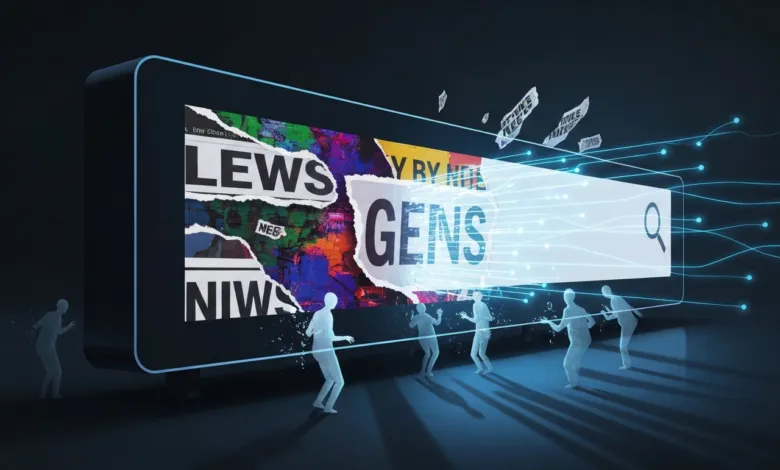
For over two decades, Google Search has functioned as the internet’s primary gateway, built on a foundation of user trust. The familiar “10 blue links” represented a straightforward promise: clicking a result would take you directly to the publisher’s intended content. That foundational trust is now being tested as Google begins a quiet experiment, using artificial intelligence to rewrite and replace the original headlines created by news publishers in its core search results.
This move follows similar AI headline generation in the Google Discover feed. Multiple instances have been documented where Google’s systems have swapped a publisher’s carefully crafted headline for an AI-generated alternative, occasionally altering the story’s meaning in the process. In one case, a detailed headline about an AI tool that failed to help with cheating was reduced to a mere five words that could mistakenly imply an endorsement. Google spokespeople describe this as a “small” and “narrow” experiment not yet approved for a full launch, but declined to specify its scale. The changes affect not just news sites but other websites as well, with no indication to users that the headline has been altered.
This practice fundamentally disrupts the relationship between publishers and their audience. It’s akin to a bookstore removing a book’s original cover and slapping on a new title of its own devising. Publishers invest significant effort into writing headlines that are accurate, engaging, and respectful of the reader, avoiding cheap clickbait. Google’s experiment suggests the company believes it has a right to repackage that work for its own purposes, without the publisher’s consent.
Currently, these altered headlines appear infrequently and are less egregious than some of the misleading examples previously seen in Google Discover. However, they represent a significant shift in principle. Past experience suggests caution; Google initially labeled its AI headlines in Discover as an experiment, only to later declare them a permanent feature due to positive user feedback. The concern is that what starts as a limited test in core search could quickly become standard practice.
Google’s stated rationale is to better match titles to user queries and facilitate engagement. The company confirms the test uses generative AI but paradoxically claims any future launch would not rely on a generative model, without explaining how headline replacement would then occur. Their responses aim to normalize the idea, framing it as just one of thousands of ongoing tests and noting that Google has tweaked webpage titles for years.
But this is not a normal or minor tweak. Industry veterans with deep SEO experience note that historical adjustments were far more limited. Typically, Google might truncate an overly long headline or choose between a publisher’s “search” and “on-page” headline fields. Replacing a publisher’s headline entirely with one of Google’s own creation is an unprecedented step. It risks eroding the credibility of journalism at a precarious time, when trust in media is under constant assault and news organizations face severe financial pressures.
While warnings have long existed about Google prioritizing AI over traditional web results, many users relied on the “blue links” as a haven for direct access to source material. This new experiment casts doubt on that assumption, suggesting that even the sanctity of the link title is no longer guaranteed. The integrity of search, and the trust it requires, may be quietly changing.
(Source: The Verge)