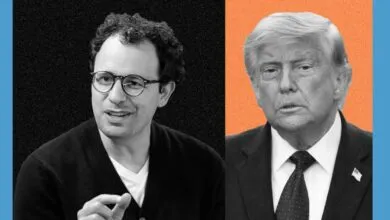
Reid Hoffman Urges Silicon Valley to Oppose Trump

▼ Summary
– Reid Hoffman is a prominent Silicon Valley figure known for co-founding LinkedIn and early investments in companies like Meta and Airbnb.
– He is a leading public advocate for artificial intelligence, arguing in his book that AI amplifies rather than diminishes human capability.
– Hoffman is an outspoken critic of former President Trump, a rare stance in tech, and has faced political threats as a consequence.
– He criticizes his Silicon Valley peers for political neutrality and urges the tech industry to engage more openly in political discourse.
– Hoffman personally uses AI for creative projects, such as generating an ironic, AI-composed Christmas album as a holiday gift for friends.
Reid Hoffman is a figure who embodies the full spectrum of modern Silicon Valley influence, from pioneering professional networking with LinkedIn to becoming a vocal advocate for artificial intelligence and a staunch political critic. His latest work argues that AI will enhance human potential, a view he passionately defends. Yet, beyond his tech evangelism, Hoffman has carved out a distinct and risky role as one of the industry’s few prominent voices openly opposing former President Donald Trump, urging his peers to abandon the false comfort of neutrality.
During a recent conversation, Hoffman displayed his characteristic blend of visionary optimism and blunt pragmatism. He enthusiastically detailed using AI to create a custom, humorous Christmas album for friends, pressed onto vinyl records, showcasing his belief in the technology’s creative potential. This personal project reflects his broader argument that AI serves as a powerful tool for amplification, whether for professional research or personal expression.
However, the discussion quickly turned to weightier matters. Hoffman did not hesitate to criticize the Trump administration for what he sees as the degradation of American governance. He expressed frustration with fellow technology leaders who remain quiet, suggesting that silence in the current political climate is complicity. His outspoken stance has drawn direct threats, including public calls for investigations into his past, yet he continues to argue that the tech community has a profound responsibility to engage.
The interview began with rapid-fire questions, revealing glimpses of his personality. He prefers text messages over voice memos, cooperative games over competitive ones, and humorously cited “sanity” as the key difference between himself and Elon Musk. When pressed on the hardest lesson he’s learned, he pointed to knowing when to give up. This pragmatic admission underscores the calculated risks that define his career, from startup investing to political advocacy.
Hoffman’s call to action is clear. He believes Silicon Valley must stop pretending that neutrality is a virtue in the face of political challenges that threaten democratic institutions. While many in his position opt for discretion, he champions the need for principled opposition, framing it not as a partisan issue but as a necessary defense of functional government. His stance serves as a rare public challenge to the industry’s often cautious political culture, highlighting a significant divide between the immense power tech leaders wield and their willingness to use it for political engagement.
(Source: Wired)