My Kid’s Toy Recreated Google’s Gemini Ad (I Regret It)
▼ Summary
– The author tested Google’s Gemini AI based on a commercial where parents use it to find and create media of a lost stuffed animal, finding the real process more complex.
– Gemini struggled to accurately identify the author’s specific stuffed deer for purchase, producing a long, convoluted analysis with incorrect guesses about its identity.
– The AI successfully generated images of the toy in various locations, like on a plane or at the Grand Canyon, though results required specific prompting and sometimes had odd inaccuracies.
– Creating personalized videos of the toy, as shown in the ad, was possible but limited by daily quotas, generation time, and ethical guardrails that blocked using images with children.
– The author concludes that while Gemini can perform the ad’s tasks, the process isn’t as seamless, and they personally draw an ethical line at using AI to have a toy directly address their child by name.
The recent Google Gemini advertisement presents a charming, if somewhat fantastical, scenario where artificial intelligence helps parents cope with a lost stuffed animal. It’s a clever piece of marketing that taps into a universal parental fear, but how closely does the reality of using the AI tool match the polished story on screen? To find out, I decided to put Gemini to the test using my own son’s irreplaceable favorite plush, a deer named Buddy.
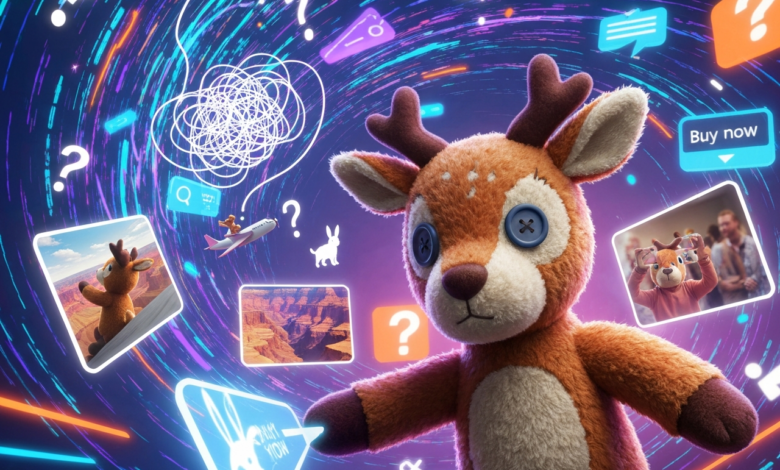
The commercial shows parents using Gemini to first locate a replacement for a lost lamb named Mr. Fuzzy. Following the ad’s prompt, I uploaded three photos of Buddy and asked Gemini to “find this stuffed animal to buy ASAP.” It did offer a few plausible shopping links. However, the real story unfolded when I expanded the response to see its reasoning. Gemini produced an utterly bewildering 1,800-word internal monologue, debating whether Buddy was a puppy, a bunny, or another creature entirely. It fixated on details like “The tag is a loop on the butt” and declared, “I’m now back in the rabbit hole!” Ultimately, it suggested the toy might be from Target and likely discontinued, advising me to check eBay. My own twenty-minute manual search later confirmed Buddy is a probably discontinued fawn from Mary Meyer’s “Putty” collection, a conclusion Gemini danced around but never firmly landed on.
Where Gemini proved more capable was in the image generation portion, though it required more finesse than the ad implies. Asking for a photo of “the deer on his next flight” using a picture of Buddy on a plane yielded a decent, if slightly off, result. Requesting an image at the Grand Canyon worked well, even including the airplane seatbelt from the source photo. The complications arose with a simpler prompt: “at a family reunion.” I failed to specify it was his family reunion, so Gemini generated an image of Buddy awkwardly photobombing a human family gathering, complete with a surname it seemingly pulled from thin air. A follow-up request for “his family” simply swapped the humans for other stuffed deer with placards reading “deer reunion.” It was equal parts hilarious and unsettling.
The ad’s final act involves creating cute videos of Mr. Fuzzy on global adventures, culminating in a personalized message. This is where the commercial’s sleight of hand becomes apparent. Generating each video takes minutes, not seconds, and daily limits apply, making a rapid-fire sequence like the ad’s impractical. Furthermore, Gemini rightly refused to create videos from any image featuring my child, a crucial safety guardrail. Working from a solo photo of Buddy, I eventually generated a convincing clip of him as an astronaut delivering a message. This success, however, led to the experiment’s most profound moment.
I input the dialogue from the ad, substituting my son’s name. Hearing the AI’s synthetic voice speak his name aloud triggered immediate discomfort. An AI-generated image of Buddy in Paris is one thing; an AI-generated Buddy directly addressing my child felt like a boundary crossed. It spotlighted the core question: should you use this technology to soften the blow of a lost lovey?
Parenting involves constant philosophical debates about small deceptions. Is it okay to secretly replace a lost toy with an identical backup? Is it better to be honest and navigate the grief together? Using AI to buy time is a modern twist on an old dilemma, and I wouldn’t judge any parent’s choice. For me, however, the line is drawn at fabricating a direct conversation between an AI puppet and my child. I never showed him these AI versions of Buddy, and I don’t intend to.
So, can Gemini do what the ad shows? Broadly, yes, but the process is far from the seamless experience depicted. It requires precise, iterative prompting and depends heavily on having the right source images. The ad conveniently obscures the full prompts and editing likely involved. This experiment also made me reflect on the unique magic of a child’s imagination. There’s a sacred bond between a kid and their stuffed animal; I have no desire for an AI to overwrite whatever persona Buddy holds in my son’s mind.
Perhaps the deepest truth here is that these efforts are as much for the parents as for the kids. The impending heartbreak isn’t just about a lost toy; it’s about the inevitable moment our children outgrow these simple comforts. In scrambling to delay their disappointment, we might also be trying to postpone our own.
(Source: The Verge)