Kindle’s best feature: Amazon’s short story collections
▼ Summary
– The author has mostly returned to physical media for a deeper sense of ownership but still uses a Kindle for Amazon’s Original Stories imprint.
– The latest collection, “Magic and Mystery,” features fantasy authors writing puzzle box mystery stories, often involving murder.
– The collection includes varied stories with unique worldbuilding, such as Travis Baldree’s detective in enchanted armor and Robert Jackson Bennett’s bizarre murder weapon.
– A key benefit is the freedom to buy individual short stories cheaply, allowing an episodic, choose-your-own reading experience.
– The main drawback is that these shorts are largely exclusive to Amazon, requiring a Kindle or app to access.
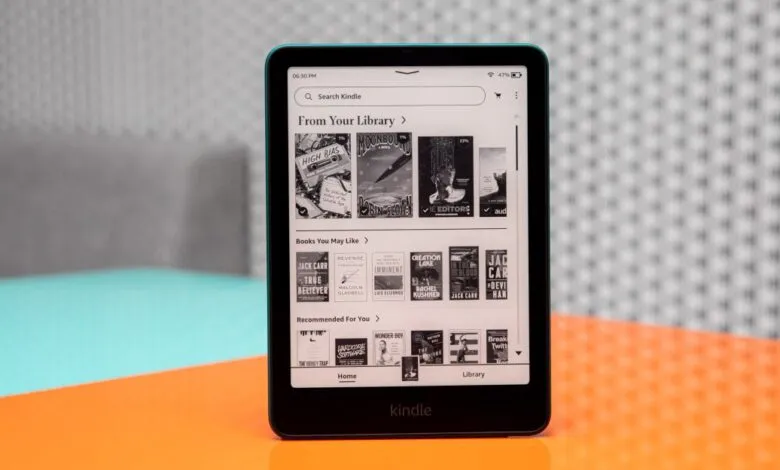
For years now, I’ve been steadily moving away from ebooks. It’s part of a broader return to physical media, driven by a desire for a more tangible connection to the art I love. A Kindle is undeniably convenient: it’s compact, stores thousands of titles, and lets you buy a new book in seconds. But much like collecting retro video games, there’s a deeper satisfaction in pulling a worn paperback from a dusty shelf at a used bookstore than simply scrolling through a digital menu for the next entry in a series. Still, I haven’t abandoned my Kindle entirely. And the reason is surprisingly small , actually, there are many small reasons.
Amazon’s Original Stories publishing imprint has quietly built an impressive library of short story collections, often featuring major authors and catering especially well to fans of genre fiction. The latest release, Magic and Mystery, dropped this week and brings together a roster of fantasy writers tasked with crafting puzzle box mysteries, most involving a murder of some kind.
Like previous collections , which have covered everything from deep-space sci-fi to straight horror , the stories here are wildly diverse, each tackling the central theme from a unique angle. Take Travis Baldree’s Miss Gentle and the Case of the Very Flat Monk, which introduces a detective I desperately want to see again: an elderly woman clad in full armor covered in enchanted human body parts, her face never revealed. Then there’s Robert Jackson Bennett’s The Lion’s Tusk, a gruesome murder at a royal wedding solved with a weapon so bizarre and clever it feels entirely original.
Some entries are masterclasses in compression, packing entire worlds into a single sitting. Heather Fawcett’s A Labyrinth of Honeybees builds a fantasy realm rich with gods and competing religions, while Scott Lynch’s The Wizard Who Kept Himself Suspicious presents an ancient order of mages who have been friends for centuries, meeting every 13 years to show off their skills.
These collections offer two major draws. First, the stories themselves are excellent. I’d recommend all seven in Magic and Mystery, and past collections have featured authors like Min Jin Lee (Pachinko), Lauren Beukes (The Shining Girls), N. K. Jemisin (The Inheritance Trilogy), and Jeff VanderMeer (Southern Reach). There’s even an original six-part story from Guillermo del Toro and Chuck Hogan that Netflix is adapting into a film. Short stories remain an underappreciated form, letting readers discover new voices while giving established writers room to experiment. Often, that freedom produces some of their most memorable work. Arthur C. Clarke wrote many novels, but nothing haunts me like his short story The Star.
The second advantage is the flexibility Amazon’s platform offers. Traditionally, short stories appeared in magazines or hefty anthologies. But on the Kindle, you control how you consume them. Each story in Magic and Mystery is available individually, giving the collection an episodic feel , like watching Black Mirror, where you decide after each episode whether to continue. And at a dollar or two each, they’re easy impulse buys.
The downside? These shorts are almost entirely exclusive to Amazon. There’s at least one exception , del Toro’s The Boy in the Iron Box is getting a physical release , but otherwise, diving into these collections means owning a Kindle or using the app. For me, that’s reason enough to keep my e-reader charged, even as my shelves overflow with paperbacks.
(Source: The Verge)