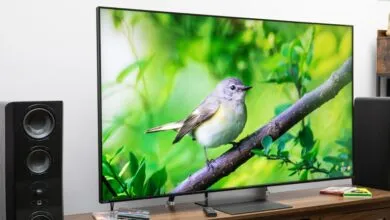
Vizio inadvertently created the top non-smart TV available
▼ Summary
– The Vizio Mini LED Quantum TV is notable not just for its low price, but because it can be used as a “dumb TV” by declining all data-sharing agreements during setup.
– During setup, users can skip creating a Walmart account and decline the activity data policy, which disables the smart TV features and prevents data collection.
– As a dumb TV, the 65-inch model offers good picture quality for its price, with bright images in Calibrated mode, though it has a glossy screen and limited black levels.
– The TV has only three HDMI 2.0 ports and a plastic build, with cost-cutting evident in its limited connectivity and cheap-feeling components.
– Walmart’s acquisition of Vizio aims to use viewing data for targeted ads, but users can bypass this by using an external streaming device and disconnecting the TV from Wi-Fi.
When I first started testing Vizio’s 65-inch Mini LED Quantum TV, I assumed the headline was obvious: Vizio had returned with a quantum-dot television for under $398, making it the cheapest such set on the market. The company had been quiet since Walmart acquired it in 2024, so launching a TV with quantum dots , which boost brightness and color accuracy , at a budget price felt like a powerful comeback.
But that’s not the real story. While those details are compelling, the true revelation about the Mini LED Quantum TV is that Vizio accidentally created the best dumb TV currently available.
Walmart bought Vizio primarily for its advertising business. Since Vizio’s ad division generated all of the company’s profits at the time of the sale, maintaining that revenue stream is clearly the priority, and Vizio’s TV operating system is the vehicle for it.
You now need a Walmart account to use certain features on a Vizio TV. And you cannot access any streaming apps on the Mini LED Quantum without agreeing to its activity data policy, which allows Walmart to collect all your usage data. That’s frustrating, but not unusual. Smart TVs routinely collect information on what you watch and how you watch it to serve targeted recommendations and ads. (Vizio was even caught doing this without consent back in 2017.)
The potential for Walmart , much like Amazon with its Fire TVs , is that your viewing habits can inform your shopping experience. If you’ve been watching Star Wars movies with your family, the next time you log into the Walmart app, you might see a recommendation for a Luke’s Red Five X-wing Lego set. That might sound convenient to some, but to me, the tight link between a TV OS and a retailer feels unsettling.
However, there is a way around it , and it’s more thorough than on other platforms. As with any TV, you can add an external streaming device and set the Vizio to power on to the last used input, bypassing the OS entirely. But even with an external device, Vizio and Walmart are still scanning the HDMI port and collecting data on what you’re watching. The key difference here is that by making specific choices during setup, you can keep the OS from ever becoming active , and presumably stop it from gathering your viewing information. I’ve never seen that option on other televisions.
During setup, the TV asks you to sign in or create a Walmart account. If you choose to skip, it warns that “you will not be able to manage payments and subscriptions or link your Vizio devices.” For most people, that’s no loss, since they already manage subscriptions through each streaming service. After agreeing to Vizio’s terms of service and privacy policy, you’re asked to accept the activity data policy, which enables the TV’s smart features. Declining brings up another warning , this one actually says “Whoops!” , informing you that “skipping this step means missing out on all your Vizio smart TV features, including apps like Netflix, YouTube, and other apps.”
Decline one last time, and the Vizio becomes the dumb TV many people are looking for: no OS, just three HDMI ports waiting for a signal. To ensure Walmart gets no data at all, you can disconnect the TV from the internet entirely by forgetting your Wi-Fi settings. (You can also skip connecting to Wi-Fi at the start of setup, which immediately switches the TV to HDMI, though you may miss firmware updates.)
In Calibrated mode, the Vizio delivers a nice, bright image, though its black level isn’t very deep and the screen is reflective. For a $400 dumb TV , or even a $400 smart TV , the 65-inch Mini LED Quantum performs remarkably well. I watched multiple World Cup matches using an OTA antenna and weekly shows like Last Week Tonight through an Apple TV, and everything looked solid. Among its picture modes, Calibrated and Calibrated Dark are the most accurate, though both lean slightly blue. Calibrated Dark is best for color accuracy in a dark, light-controlled room. With SDR, the TV tops out at 309 nits of brightness, while HDR reaches 579 nits on small highlights. Calibrated mode hits 936 nits, which is incredible for a budget TV, making highlights and overall picture hold up well in ambient light. The glossy screen can be distracting with nearby lamps, especially during dark scenes.
There’s some motion blur with fast action, noticeable during the Austrian Grand Prix, especially with the quick drone shots. The Mini LED Quantum also uses an IPS panel instead of VA, so black levels aren’t as deep as pricier TVs, and blooming appears around bright highlights in dark scenes. Still, most people will be more than satisfied with its performance. Even I set aside my videophile expectations and simply enjoyed watching. For a 65-inch TV under $400 , or an 85-inch for just $768 , it’s easy to overlook those flaws.
The build reflects cost-cutting. The back is all plastic, and the cable management channel on each foot only fits a single cable. Connections are limited: three HDMI 2.0 ports, USB 2.0, an antenna input, and digital audio out. The remote is small and cheap but functional. The feet are widely set and have only one height option.
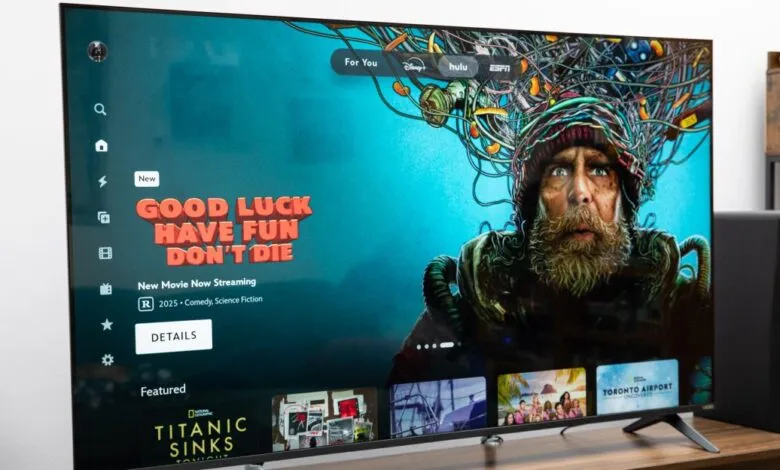
If you do use the Vizio OS, you can limit Walmart’s data collection by turning off Viewing Data in the privacy menu and unchecking personalized ads on your Vizio account page. The OS is easy to navigate, if a bit sluggish at times. It supports all major apps, plus AirPlay and Google Cast. Selecting inputs is easy via the OS or the remote’s input button. After a few minutes of inactivity, the TV enters a screensaver mode that shows what looks like AI-generated scenes with music from one of the WatchFree+ channels. But since these are actual channels, ads interrupt the experience every so often , not the most relaxing screensaver.
Of course, none of that matters if you use the Mini LED Quantum as a dumb TV. That’s not what Walmart hopes you’ll do, but it’s absolutely what you should. If you want streaming apps, plug in a cheap device like the Fire TV Stick 4K Select for $40. Just keep in mind that if you use a connected device with the Vizio OS active, your viewing data will still be shared with Walmart.
My main concern is that this dumb TV functionality appears to be an accident. A software update could remove it in the future, requiring you to accept all data collection. If that happens, recommending the TV becomes harder. For now, though, the Mini LED Quantum offers great performance for the price. If you’ve been searching for a large, inexpensive TV that lets you escape constant data tracking, this is it. At least for now.
(Source: The Verge)