Google’s SynthID watermarking adopted by OpenAI, Nvidia, and more
▼ Summary
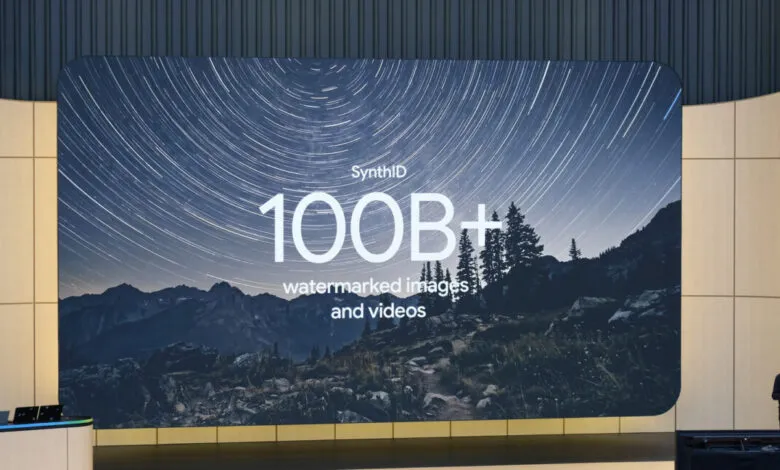
– Google’s SynthID has labeled 100 billion images and videos and 60,000 years of audio, and is now expanding beyond Google.
– Google uses the C2PA standard to tag content with metadata describing its creation, which it began using more prominently with Pixel 10 smartphones.
– Pixel 10 photos include metadata on processing, with AI tags for zoomed images containing generative elements, and this feature is coming to videos on Pixel 8, 9, and 10.
– Google is adding C2PA scanning to Gemini, Chrome, and Search to allow users to check a file’s provenance via content labeling.
– SynthID is a digital watermark embedded in pixels and waveforms that is designed to be much harder to remove than metadata, even after compression, cropping, or rotation.
In just a few years, the telltale signs of AI-generated content have shifted from extra fingers and distorted faces to images and videos so lifelike they blur the line between real and fabricated. So how do we separate fact from fiction in this new landscape? Google’s answer is SynthID, a digital watermarking system first unveiled three years ago. The company reports that SynthID has already been used to label 100 billion images and videos, along with the equivalent of 60,000 years of audio. And with SynthID now expanding beyond Google’s own ecosystem, those numbers are set to climb even higher.
SynthID is just one piece of Google’s broader strategy for AI transparency. The tech giant is also committed to the C2PA standard, which embeds metadata into content to detail how it was created. Google stepped up its use of C2PA with the launch of the Pixel 10 smartphones. Photos captured on these devices now include metadata that explains how each image was processed. If a heavily zoomed shot incorporates generative AI elements, the system automatically tags it as AI-enhanced.
That capability is coming to videos as well. Google announced that Pixel 8, 9, and 10 users will receive an update in the coming weeks that adds C2PA tagging to video recordings. In addition, the company is integrating C2PA scanning into Gemini, its AI chatbot. This will let Gemini analyze a file’s provenance by reading its content labels. Within a few months, the same feature will roll out to Chrome and Google Search.
Metadata, however, can be stripped or altered. That’s where SynthID’s deeper integration makes a difference. Unlike metadata, SynthID is woven directly into the pixels of images and videos, as well as the waveform of AI-generated songs and audio from products like NotebookLM. According to Pushmeet Kohli, a scientist at Google DeepMind, the team prioritized making SynthID resilient against tampering. Even if someone compresses, crops, or rotates the content, the watermark remains intact.
“A technology like this will always be attacked,” Kohli said. “There was a lot of research that we did in making SynthID robust to different kinds of transformations.”
(Source: Ars Technica)