This Desk Gadget Fixed My Posture
▼ Summary
– Isa is a desk device from German startup Deep Care that tracks posture, hydration, light, sound, and movement without using a camera or internet connection.
– It uses a Time-of-Flight 3D depth sensor to monitor posture and movement from 0.15 to 1.8 meters, displaying a posture ring and hydration widget on its 5.5-inch screen.
– The device vibrates to alert users of poor posture, suggests guided exercises after periods of inactivity, and resets movement tracking after breaks.
– Privacy-focused sensor-only design has trade-offs, such as objects or pets triggering false readings, but it effectively encourages better posture and activity habits.
– Isa costs €299 with subscription plans (€4.99–€7.99/month), offering core features like posture tracking and exercise library, with plans for future mental health tracking via sensor data.
Working from a home desk comes with its own set of challenges. Between demanding pets, persistent back pain from sitting too long, and the tendency to forget to move, it’s easy to fall into poor habits. While apps exist to nudge you toward better posture or remind you to stand, they’re all too easy to ignore or dismiss.
After nearly a decade refining my home office setup with gaming chairs, lumbar supports, and various ergonomic accessories, I learned that none of these guarantees good posture. Then I discovered Isa, a desk device from German startup Deep Care that takes an entirely different approach. It tracks posture, hydration, light, sound, and movement, all without a camera or internet connection. In an age of constant surveillance, that privacy focus is a meaningful differentiator.
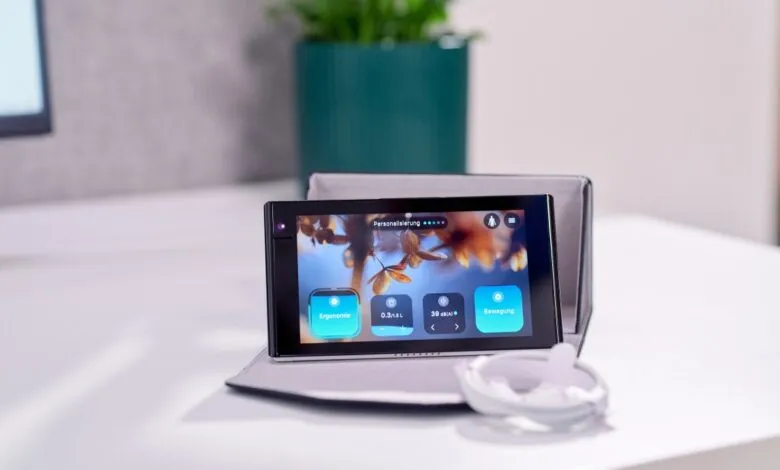
Here’s how Isa works. The device features a 5.5-inch IPS HD screen and resembles a table clock. It is powered by USB-C; Deep Care supplies a power unit, but you can use any existing charger since it consumes roughly 2.45W. The core sensor is a Time-of-Flight (ToF) 3D depth sensor on the front, the same technology used in facial recognition and some smartphone cameras, which tracks posture and movement. This sensor also enables beta features, like counting how many times you’ve had water or other liquids. The company says it works within a range of 0.15 meters to 1.8 meters, meaning it can track you even when you stand up and move around your desk. Additional sensors include a ToF 1D sensor, gyroscope, barometer, light sensor, sound level sensor, CO₂/VoC sensor, and a temperature and humidity sensor.
Setup is straightforward , the device asks for a few details about you and your work routine. I found it odd that there was no option to set the device to India time or any other Asian time zone. Deep Care said Isa currently supports only EU and US time zones. That’s fair for now, but broader time zone support or even a simple world clock feels like a basic expectation for a desk device.
On the screen, Isa displays your posture with a squircle (rounded square) ring that fills or empties based on how well you’re sitting, while a water-tank-style widget tracks your drinking. If your posture is poor, the indicator turns yellow. This Apple Watch-style ring is surprisingly effective , when I see yellow or red, I straighten up almost instinctively. The device also vibrates to alert you if you’ve been slouching too long, and I’m okay with that mild shaming. It also alerts you if you’re leaning too far forward or back, helping you correct your stance.
A similar widget tracks movement. If you’ve been stationary for a while, Isa suggests you get up and offers on-device guided exercises to follow. When you return to your desk after a break, the movement tracker resets.
Deep Care chose not to include a camera, which helps with privacy, but it comes with trade-offs. If a bottle or other object sits between you and the sensor, it may read that as a person and log you as stationary. Pets or housemates passing by can also trigger the sensor. Isa usually figures out that you’ve stepped away and switches to a digital clock display, but I would have liked a manual button to tell it I’m not at the desk so it stops tracking. Because of the sensor-only approach, the device occasionally told me I’d been stationary too long when I’d been sitting for under half an hour. These are minor inconveniences. On balance, the device made me check my posture more often than I used to, and the exercise suggestions are truly useful.
To process all these features, Isa uses a quad-core 2 GHz processor. It can connect to Wi-Fi for software updates, but you can turn it off at any time.
Deep Care was founded by three former Bosch employees and initially sold Isa directly to businesses. It recently expanded to consumers, a shift that signals confidence in the retail market for workplace wellness hardware and tests whether a subscription model layered onto premium hardware can find a mainstream audience.
Isa is priced at €299 ($354) with two subscription tiers. The core plan (€4.99 per month) gives you access to posture tracking, healthy sitting habit tracking, drinking habit detection, and its exercise library. The Pro plan (€7.99 per month) lets you track light, noise, and CO2 levels for a healthy working environment.
The company plans to use Isa’s sensor suite to venture into mental health-related tracking. By using signals like posture, head movement, and chest movement, the device can measure breathing patterns. Paired with environmental data like noise, light levels, and CO2 level, Deep Care wants to introduce a stress-related score.
Even if you skip the mental health features, Isa is a solid device for anyone serious about posture and movement. It isn’t cheap, and the subscription adds to the long-term cost. But if you or someone you know works from home and has been meaning to improve their desk habits, it’s one of the more thoughtful options available.
(Source: TechCrunch)