Replit CEO on Cursor deal, Apple rivalry, and staying independent

▼ Summary
– Replit’s revenue grew from $2.8 million in 2024 to a projected billion-dollar annual run rate, with net revenue retention reaching 300% in some cases.
– CEO Amjad Masad stated Replit aims to stay independent, citing positive gross margins for over a year, unlike rival Cursor which reportedly operates at negative 23% margins.
– Replit targets non-technical users with an end-to-end platform that handles deployment, security, and databases, winning enterprise deals on product and security.
– Masad accused Apple of lying about why it blocked Replit’s app updates, claiming the real reason is that Replit enables iOS app creation, and said he would prove it in court if needed.
– Replit is considering investing in its own customers for equity, noting that some startups built on its platform, like Magic School, have generated significant revenue.
Amjad Masad has spent a decade building Replit, but the past year and a half has been a transformative period unlike any other. The AI-powered coding platform skyrocketed from just $2.8 million in total revenue in 2024 to what Masad now describes as a trajectory toward a billion-dollar annual run rate.
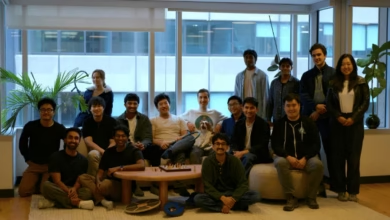
At TechCrunch’s sold-out StrictlyVC event in San Francisco on Thursday night, the conversation was wide-ranging and rapid-fire. It started with the industry’s most pressing question: with rival Cursor reportedly in acquisition talks with SpaceX for a staggering $60 billion, is Replit also on the block? From there, the discussion moved to Replit’s net revenue retention, which Masad says can hit an eye-popping 300%, his readiness to take Apple to court over what he calls outright falsehoods in its App Store dispute with Replit, and the potential for the company to start investing directly in its own customers.
Regarding independence, Masad was clear. Unlike Cursor, which he claims has been operating at negative 23% gross margins, he believes Replit has the financial fundamentals to stay independent, even if he didn’t completely close the door on a sale.
The following has been edited for length and clarity.
TechCrunch: Cursor’s reported deal with SpaceX dominated headlines last week. What’s your take?
Amjad Masad: It’s tough being an independent, smaller AI company that relies on foundation models, especially if you’re burning through cash. Reports suggest Cursor has negative 23% margins, and if you also want to invest in training models, staying independent becomes incredibly difficult.
For Replit, partly because we serve a different customer base, we’ve been able to run the business more sensibly. We’ve been gross margin positive for over a year. We’re a bit more expensive, but we deliver a lot more. Our audience is mostly non-technical users who previously couldn’t create any software. We offer an end-to-end platform,from the initial prompt all the way to a deployed application that can scale. We handle security, databases, and database migration. We’ve been doing this long enough that those primitives are deeply built into the platform.
Is Replit for sale? I assume you’re constantly in talks with potential acquirers; it’s a fiduciary duty.
Yeah. We have great partners, and they sometimes bring up these topics. But we’re going to try to stay independent. I’d love for us to remain an independent company. We’ve been around for 10 years, before it was even accepted that you could make apps just from ideas. We were talking about creating a billion software creators back in 2018 at YC, and people sometimes actually laughed at that dream. Now that dream is possible, and we kicked off this revolution with our agentic coding experience in September 2024. It feels like we can take it much further.
You work closely with Anthropic, Google, and OpenAI. If you had to rank them,who’s doing it best?
Anthropic is still undefeated on the core agentic loop. They have the best tool calling; the agent can stay coherent much longer. GPT-5 is catching up quickly. Google’s Flash family of models is amazing on price-performance. If you want something fast and cheap, they’re actually beating open source right now. We use all three, and honestly I wouldn’t discount the newer labs either. Reflection AI is coming out with open-source models we’re hearing great things about. And the Chinese models are impressive,Kimi is as good as an Anthropic-generation model from January, so it’s only about three months behind.
When you’re in a bake-off for an enterprise deal, what wins it for you?
Most of our sales are inbound or organic,very product-led. We’ve acquired customers like Zillow and Meta purely through people adopting the product and then raising their hand to buy an enterprise plan. When it does go top-down and there’s a formal bake-off, we usually win on product. But even in cases where we might be missing a feature, once it hits the C-suite and the IT group, Replit wins on security. A lot of vibe-coding tools will generate a website and connect it to an external database,great products, but it makes security much harder, because the database is open to the public and you need to configure row-level security, which is especially difficult for non-technical builders. Replit being full stack, with the database built into the project and not open to the public,that makes the app inherently more secure.
We also spent 10 years battling crypto scammers and hackers, so our cybersecurity function is as good as a dedicated cybersecurity startup. Every time you deploy an app on Replit, we create an entirely new isolated project on Google Cloud. We inherit Google’s security model.
Can we talk about churn? How long do you hold onto customers if the best prototypes eventually get rebuilt into a company’s existing stack?
Churn is very, very low, and net retention is incredibly high,300% in some cases. What we actually hear from customers is that when engineers get nervous and try to rebuild an app into their own stack, they often make it worse. Once enterprises get comfortable with the full Replit stack,especially when we set up a single-tenant environment for them,they keep the apps on Replit. Bain & Company, for example, replaced Tableau and Power BI with Replit and Databricks.
There’s a growing concern about AI bloat,non-technical users generate far more code and burn through far more tokens. That’s good for you [given your usage-based fees]. What about your customers?
We don’t have a lot of regrettable spend. Enterprises are very ROI conscious, and they tell us about the returns they’re getting. For the most part they feel the investment is totally worth it,often one, two, three orders of magnitude. If they spend $100,000 a month with Replit, they’re usually generating $2 million, $3 million, $10 million in some kind of return.
Let’s talk about Apple. Another rival, Lovable, just got an app-building app approved by the App Store this week. Replit has been in App Store purgatory, with Apple blocking your updates for months. How much does that hurt you?
It’s not life or death,we could lose the app and it wouldn’t do anything meaningful to our business. But it’s an app people genuinely love. We’ve been on the App Store for four years. Kids in underprivileged communities learn to code on Replit on their Android devices. Executives use it in meetings.
The reason Replit got blocked when others weren’t, we believe, is that Replit makes iOS apps. When we launched that capability in December, there were charts going around showing how many apps were getting into the App Store through us. We think Apple feels threatened by that.
Apple’s stated reason is that you’re downloading new code to the device [after the approval process], which violates their guidelines.
That’s a lie. And we can prove it in court if we have to.
Is that going to happen?
I hope not. I’m a fan of Apple, and I’d love to collaborate and build something great together. We’re happy to send customers to Xcode [Apple’s own development environment]. But you can’t run a marketplace that a billion people have access to and make decisions that are discriminatory or based on whims.
Just wondering if, like Nvidia, OpenAI and others, you’re thinking about investing in your own customers in exchange for equity.
We’ve thought a lot about it, and it is a consideration. I’ve personally invested in a few startups that started on Replit before they made any money. Some of them, like Magic School,a teacher decided to take his time during COVID to learn a little bit of vibe coding and built an AI app for other teachers. He found this problem that in America, we burn out a lot of teachers. He wanted to use AI to reduce the workload. He did that, and he made $20 million in the first year. Other companies that started on Replit, I think, are valued at half a billion dollars. The entrepreneurship happening on Replit right now is genuinely exciting. We integrated with Stripe a few months ago, and the transactions flowing through Replit are growing triple digits month over month. Pretty soon, our customers will be making more revenue than we are.
(Source: TechCrunch)