How Companies Train Millions Amid Nonstop Product Shipping

▼ Summary
– 85% of companies plan to prioritize upskilling through 2030, yet 63% still cite skills gaps as the top barrier to business transformation due to slow learning content production.
– ServiceNow’s Chief Learning Officer reduced course production time by ten times using AI-generated video, producing over 5,000 videos in 18 months.
– 87% of learning professionals now use AI, with 72% expecting future gains in personalized learning delivered at the moment of need.
– AI frees learning leaders to focus on which skills drive performance, how to measure behavior change, and how to connect L&D to business outcomes.
– Closing the skills gap requires combining faster, more relevant learning with psychological safety, moving beyond 2016-era training models.
The statistics on workforce development present a clear paradox. While 85% of companies plan to prioritize upskilling their workforce through 2030, a staggering 63% of employers still cite skills gaps as the primary obstacle to business transformation. The disconnect stems from a fundamental flaw: the traditional learning and development (L&D) model was built for a slower era and has failed to keep pace with modern business velocity. Content creation once required scripting, review, localization, and publication, a process that can take weeks even at well-resourced organizations. By the time training reaches an employee, the product it explains has already shipped two updates, the compliance process has been revised, and the sales motion has been adapted by the field team.
Most of us have endured mandated corporate training that felt more like a compliance checkbox than a genuine learning experience. To make L&D more relevant, companies are now rethinking both the format and the speed of delivery.
The Chief Learning Officer’s new mandate
Jayney Howson, Chief Learning Officer at ServiceNow, is redefining what an effective model looks like. Her initiative, ServiceNow University, aims to upskill more than three million people by the end of 2027. Recently rebuilt to be AI-native, the program tackles a challenge familiar to L&D leaders: a business shipping AI products on a continuous cycle, a global workforce needing constant updates, and a content production process that couldn’t keep up.
Howson’s solution was to rebuild the infrastructure around AI, including AI-generated video, which reduced course production time by roughly tenfold. Her team used Synthesia to produce over 5,000 videos in 18 months, enabling programs like Sales Academy for the global sales team and partner enablement to run consistently worldwide. Learning content now reflects what the business is doing today, not what it was months ago.
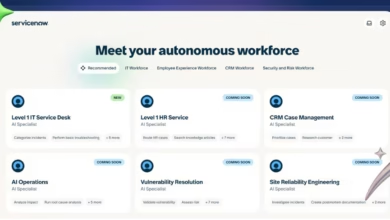
According to Howson, “It feels like a Netflix experience, where it serves up personalized recommendations for each employee. But it can also see that for the job I’m doing right now, the proficiency level I’ve got on a skill is a one and it needs to be a four. So it serves me up that training, too.”
Production is no longer the constraint
ServiceNow’s transformation mirrors a broader shift in enterprise L&D. Research shows that 87% of learning professionals are already using AI in their workflows, and 72% believe the biggest future gain from AI will be more personalized learning delivered closer to the moment of need, not just cheaper production. These two goals have always been linked. Personalization at scale was the holy grail of corporate learning for years, but it remained elusive because building individualized learning paths for thousands of employees is impractical when a single course takes weeks to produce.
When video content can be created, updated, and translated in hours, everything changes. Programs can now be tailored for specific roles, regions, and career stages, rather than being averaged across an entire workforce and useful to no one.
What changes for learning leaders
Organizations that solve the production capacity problem through AI free up their learning function to focus on deeper questions. Which skills truly drive business performance? What does success look like in a specific role, and how do you build toward it? How do you measure whether learning changed behavior, rather than just which employees clicked through a module?
These are the questions that connect L&D to business outcomes in a way that completion rates never could. The organizations making real progress on the skills gap are those where learning leaders have permission to rethink the operating model, and where AI is used to close the gap between when knowledge is needed and when it actually arrives.
For Howson, the infrastructure changes matter, but so does the environment. She describes her goal for ServiceNow University in terms that go beyond output to ensuring the learning experience feels like a safe space for risk-taking.
“We all can remember being a kid and feeling like we were safe,” she said. “This needs to feel like you’re safe to push yourself and not get it right the first time.”
That combination of learning that’s faster, more relevant, and psychologically safe is what separates the organizations closing the skills gap from those still trying to solve a 2026 problem with a 2016 model.
(Source: The Next Web)