Founder’s bet on ‘old school web’ starts paying off
▼ Summary
– Craig Campbell, a former Meta engineer, founded Past Maps, a website that overlays historical maps onto modern-day maps, instead of starting an AI company despite VC offers.
– Past Maps grew to over 300,000 monthly active users in three years, primarily through organic Google search traffic, and sustains Campbell and his wife financially.
– The site generates revenue through subscriptions ($9 weekly or $52 annually) rather than display advertising, protecting it from ad tech industry fluctuations.
– Campbell uses AI tools to automate customer service, reducing his daily time spent from 1–2 hours to about 10 minutes, including handling refunds and cancellations.
– He is developing an AI-powered OCR tool for historical maps, emphasizing the need for human creativity and experimentation to complement the technology.
Craig Campbell had every reason to chase the AI gold rush. As a former Meta engineer and a seasoned tech founder who sold his Shopify-focused e-commerce tool in 2022 , right when the AI boom was taking off , he could have easily launched another venture backed by eager investors. “I had my prior VC investors breathing down my neck, going ‘start something else. We’ll write you a blank check,’” he recalls. Instead, he turned away from that river of capital to build something decidedly less trendy: a website.
In an era where the so-called Google Zero event horizon looms and few are eager to enter the web publishing space, Campbell’s bet on the old school web is quietly paying off. His creation, Past Maps, has grown into a sustainable business, thriving through an increasingly rare channel: organic search.
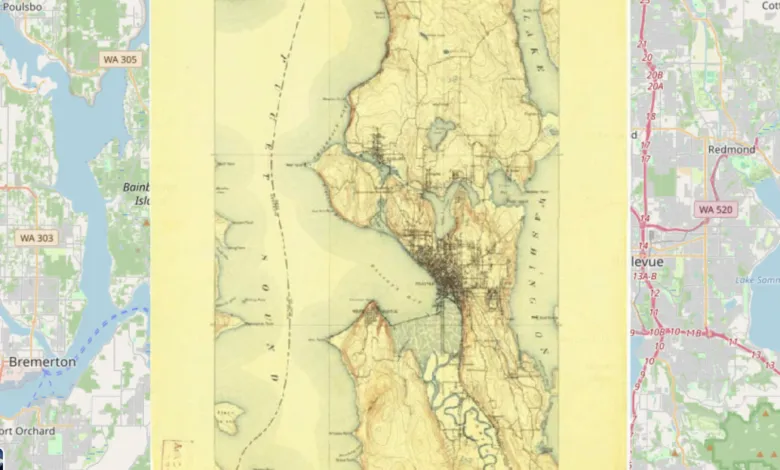
Past Maps does exactly what its name suggests. It lets users overlay historical maps onto modern-day views of any region, adjusting opacity to fade between past and present. The underlying map data comes from public sources like the US Geological Survey, but Campbell built the tools that make this exploration possible. What started as a side project to aid his metal detection hobby , helping him pinpoint old structures and trails to find artifacts , quickly gained traction. After sharing his map tooling on Reddit with fellow enthusiasts, demand surged. That was the spark for his newest venture.
You don’t need to be hunting for buried treasure to find value here. For the curious, Past Maps is a treasure trove of local history. I’ve used it to understand how the Duwamish River looked before it was straightened for shipping. Campbell’s customers span a wide range of uses , from genealogy research to mapping old oil wells. It’s a research tool, but it’s also genuinely fun.
The growth has been steady. Campbell reports that monthly active users have climbed from an average of 20,000 to over 300,000 in just three years. The income now supports him and his wife, who helps run the business. Still, he occasionally wonders what might have been if he’d taken that VC money for AI. “I’m making the same as when I was like, an E4 at Facebook, which is like a mid-level engineer.”
Google Search is Past Maps’ primary traffic driver. Early on, Campbell noticed the site climbing search rankings when people looked for historical details about specific locations , a grandmother’s church or abandoned mines in a particular county. By tagging his maps and pages in a way Google understands, a virtuous cycle emerged. “As I started exploding out this data and making it finally available to Google and giving it a place on the web, traffic just started to build.”
“This is how the web is supposed to work. This is actually the old school web,” Campbell says. “It is alive and well, but only in these really, really small niches.”
A web publisher from a decade ago would have relied on display ads for revenue. Past Maps takes a different approach: a free tier for dabbling, then a $9 weekly pass or $52 annual subscription for deeper access. This subscription model insulates Campbell from the volatility of ad budgets and an ad tech industry that the DOJ ruled an illegal monopoly in 2025.
Despite AI’s reputation for eating the open web, Campbell has fully embraced AI tools to run his business. He used to spend one or two hours a day handling every customer service request himself, writing lengthy emails. Now, a local agent model on his desktop handles front-line triage. It runs once an hour , as long as his laptop is on , and has access to his Gmail. It filters spam, identifies tasks needing his attention, and drafts responses. This has cut his customer service time to about 10 minutes a day.
“I do sometimes have angry customers,” Campbell says. “If they ask me for a refund, it cues up the refund and subscription cancellation request with Stripe. It does the whole thing, then it pings me.” He then reviews the request, approves or denies it, and checks the message before sending.
Campbell is also using AI to build an OCR tool , Optical Character Recognition , tailored for old maps. “Cartographers are assholes,” he jokes. Historical maps present unique challenges: labels curve along rivers, use inconsistent spacing, and often crowd together. Off-the-shelf OCR systems fail. He’s found more success with modern LLMs using reasoning, but it’s not a simple prompt. “You have to still bring that human spark into the mix.”
By combining human experimentation with the LLM’s capabilities, rather than relying solely on the tool, he’s found a workable solution. “It still doesn’t bring like that human-level reasoning spark, and creativity, and being able to stitch together decades of using tools like this,” he says. “You have to still bring that human spark into the mix.”
Campbell may have passed on the AI gold rush, but in doing so, he’s crafted a blueprint for success in the age of Claude Code and AI summaries. Start with something you’re passionate about, build something useful, and share it with others like you. That foundation has proven resilient. His day-to-day operations look nothing like running a website a decade ago, but the qualities that made his business work are thoroughly human.
(Source: The Verge)