Custom Visuals Boosted Organic Traffic by 110%
▼ Summary
– A six-month experiment on a high-traffic accounting website tested custom featured images, infographics, and video across 47 articles to measure their impact on organic traffic.
– Infographics were the most reliable asset, producing an average 110% increase in organic traffic across tested articles.
– Custom featured images on 39 existing pages yielded a 13% average traffic boost, with the strongest results on pages that already had search demand.
– Video had high potential but inconsistent results; one video boosted traffic by 292%, while others had minimal impact despite YouTube views.
– Custom visuals amplified strong content but failed to revive declining pages or create interest where search demand was absent.
After six months of testing custom visual assets across 47 articles on a high-traffic accounting education site, we uncovered which design investments truly drive SEO performance and which ones waste time and budget. The experiment spanned featured images, infographics, and video across both new and existing content, with a clear focus on the ROI of bespoke design rather than proving that any image helps,basic visuals are already table stakes.
The standout winner was infographics. Across the articles tested, adding infographics produced an average 110% increase in organic traffic. However, the broader lesson was just as critical: custom visuals amplified strong content but couldn’t revive declining pages or create demand where none existed.
The experiment was structured around two content groups. First, 41 existing articles received only a custom featured image as a refresh. Second, six brand-new articles launched with featured images, infographics, and videos added at different stages, allowing us to test whether timing affected performance.
Success was measured by comparing monthly organic traffic before and after each design element was added. We compared the month before implementation against the average of the implementation month and the following month to account for late-month additions.
In Phase 1, adding custom featured images to 39 existing pages yielded an average 13% organic traffic boost. Some pages saw dramatic jumps: QuickBooks ProAdvisor Academy rose 379%, the CAS page climbed 100%, and Build a CAS team gained 73%. The pattern was clear,pages with existing search demand responded best.
Phase 2 focused on six new articles. Since content and visuals were published together, there was no pre-design baseline, but we could still analyze performance. 63% of all design additions had a positive impact on organic traffic. Featured images acted as a baseline enhancer, supporting credibility but not driving growth alone.
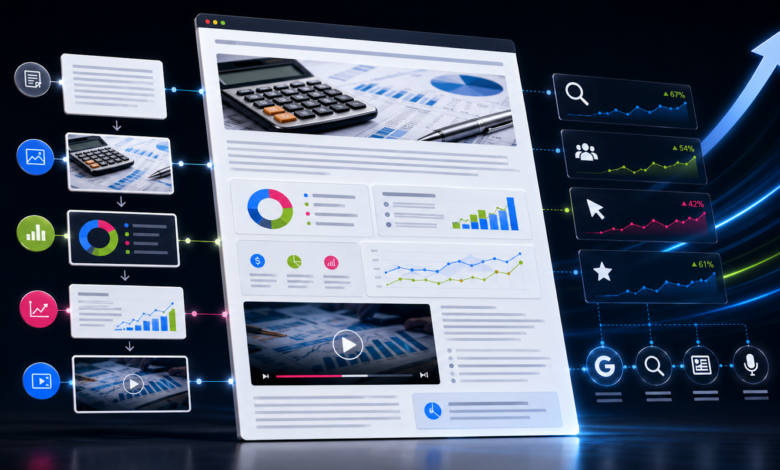
Infographics were the clear champion. Five out of six additions produced a strong positive lift, averaging 110% more page visits. They improved clarity, broke up dense educational content, increased time on page, and encouraged sharing. For evergreen educational content, infographics should be the first priority.
Video showed the biggest potential but was resource-intensive. One video drove a 292% increase in organic page visits, while two others had minimal on-site impact despite roughly 500 YouTube views each. The standout AI financial modeling video ranked in Google’s video results and reached the first page of YouTube for “AI financial modeling.” Video works best when the topic has strong search demand and clear alignment with video consumption intent.
Key takeaways across all 47 pages: Infographics are the most reliable growth tool. Layering visuals amplifies performance where demand already exists. Evergreen educational content, especially how-to guides and advisory pages, responded particularly well. Adding custom visuals to pages with existing traffic made strong pages even stronger.
This context matters more than ever, with Google AI Overviews reducing organic search clicks by as much as 42%. Static articles alone are no longer enough. That’s why interactive calculators built with vibe coding have become part of the strategy for this client, giving users a reason to engage and convert in ways AI-generated answers can’t replicate.
What didn’t work was equally important. Design didn’t revive declining content. If search demand was decreasing, visuals alone couldn’t reverse the trend. Overinvesting in low-demand topics was a mistake because no visual asset can manufacture interest where none exists. The lesson: design supports performance, it doesn’t replace strong content and demand.
Moving forward, our cheat sheet is clear. For new content, start with a mandatory custom featured image to establish early credibility, prioritize infographics as the primary growth lever, and layer video selectively for high-demand topics. For existing content, focus design enhancements on pages with established organic traffic, lead with infographics on high-performing pages, and avoid adding visuals to declining pages until underlying content issues are resolved first.
The biggest takeaway from the experiment was simple: custom visuals work best where demand already exists and can amplify it further.
(Source: Search Engine Land)