Your Website Is Now Local AI Search’s Source of Truth
▼ Summary
– AI generates business recommendations by pulling from online sources, making a company’s own website a critical input for controlling its narrative.
– While AI provides informational answers that reduce website clicks, the commercial and transactional queries that drive revenue still lead customers to visit sites for validation.
– AI systems cross-reference a business’s website with other online profiles to build confidence, meaning a clear, consistent site acts as a primary source document.
– AI is vastly more selective than traditional search, with visibility heavily dependent on accurate, structured website content and strong online consistency.
– A business’s website is the only platform it fully controls, allowing it to structure content with clear headings, FAQs, and schema markup to directly feed AI the intended narrative.
The next time you ask an AI assistant for a local business recommendation, notice where it gets its information. The answer is likely built from the business’s own website. This reveals a fundamental shift: your website is no longer just a brochure but a primary source document for artificial intelligence. If your site is incomplete or unclear, AI will assemble its answer from other, less reliable scraps of data, meaning you surrender control over how your business is presented online. This reality forces a critical question for every business owner about who ultimately defines their brand in the digital age.
Many marketers observe a trend of steady impressions but declining clicks, leading some to prematurely declare websites obsolete. This interpretation misses the mark. Fewer clicks do not equate to diminished importance; they reflect a change in the nature of the click itself. An analysis of over 46 million keywords that trigger an AI Overview shows that nearly 99% are informational queries where a user seeks a quick fact. These were never high-intent visits. The clicks that truly drive revenue, tied to bookings and purchases, originate from commercial and transactional queries. These are the moments when a potential customer, having received an AI recommendation, is ready to validate their choice, and they almost always turn to your website to do it.
Consider what happens after an AI suggests your business. A customer doesn’t immediately book an appointment. They perform their own research, which typically involves a Google search, reading reviews, and critically, checking your website to confirm services, pricing, and credibility. The AI provides an introduction, but your website is what secures the final decision. This validation phase is where trust is built and conversions happen.
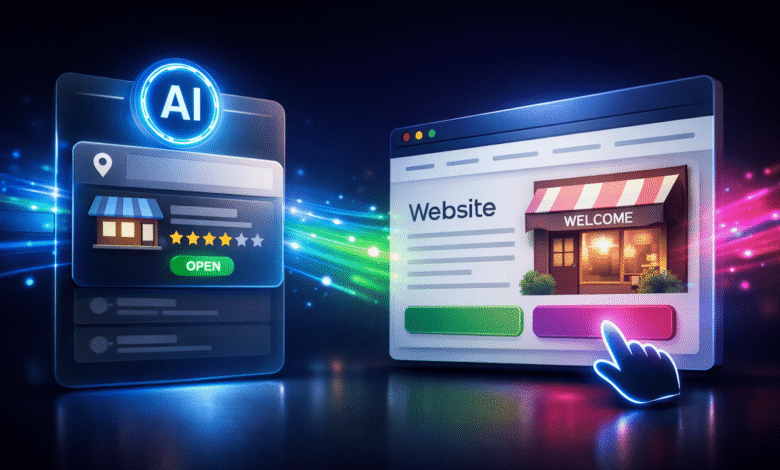
Paradoxically, AI is increasing your website’s value. These systems are constantly reading your content to understand what you do, cross-referencing it with your Google Business Profile and other listings to ensure consistency. When your information is clear and aligned across platforms, AI gains confidence in recommending you. When discrepancies exist, you risk being overlooked. Your site must serve as the definitive source of truth, or AI will fill informational gaps with potentially outdated third-party content like old Yelp reviews or incorrect directory listings.
The selectivity of AI is staggering. Research indicates that AI systems can be up to 30 times more selective than traditional local search. Strong performance in a standard local pack does not guarantee AI visibility. The brands that consistently earn AI recommendations are those with accurate, consistent information everywhere, strong reviews, and, crucially, well-structured website content. This last element is where many businesses leave significant opportunity unused.
Your website remains the only platform you fully control. Every other channel, from social media to AI summaries, is subject to algorithms and public opinion. On your own site, you decide the narrative, highlight differentiators, and address customer objections directly. More importantly, you feed AI the narrative you want it to use. Well-structured service pages, detailed FAQs, and content that answers real customer questions provide the raw material AI draws from. If your site is generic, you forfeit this power.
Addressing this shift doesn’t require a full rebuild, but it does demand more intentional structure and content. First, treat your website as a primary source. Replace vague marketing claims with specific, factual information about your services, clientele, and results. Ensure every detail, from hours to pricing approach, matches your other online profiles exactly.
Second, structure content so AI can read it effectively. Schema markup, particularly for LocalBusiness, FAQPage, and Service, acts as a cheat sheet for AI. Use clear headings and concise sentences; research suggests pages with sentences averaging 11 to 14 words have a higher likelihood of being cited. Incorporate an FAQ section built from real customer questions, and create individual pages for each major service, backing up claims with concrete details.
Finally, write for your customer’s actual questions, not industry jargon. People search for phrases like “how long does the repair take?” or “do you take my insurance?”. Answer these questions directly on your site by reviewing sources like your Google Business Profile Q&A and customer service emails. To identify gaps, conduct an AI audit: ask various assistants contextual questions about your business and note what they cite. Is the information coming from your website, a current review, or an outdated directory? This exercise reveals exactly where to focus your efforts.
The risk of inaction is clear. A stale or poorly structured website allows AI to define your business using potentially inaccurate or unflattering third-party information. Beyond factual errors, you lose the ability to position your unique value. AI might get your name in front of someone, but it is the trust built through your own digital hub that transforms a simple recommendation into a booked appointment or a completed sale.
(Source: Search Engine Land)