CRM: The New Backbone of Customer Engagement

▼ Summary
– CRM has evolved from a simple campaign tool for storing customer data into a central system that guides customer understanding and decision-making.
– Traditional CRM systems became limited due to fragmented martech stacks, where customer data is siloed across separate tools, causing operational problems and inconsistent experiences.
– Modern CRM now integrates commerce, loyalty, and messaging data, using AI to analyze signals and coordinate engagement across channels.
– Organizations must shift CRM from a siloed marketing function to a shared decision layer across departments, aligning around common customer signals and identity frameworks.
– CRM’s future success is defined by its ability to help businesses make better decisions, linking marketing activity to business outcomes like lifetime value and profitability.
The marketing world has long viewed Customer Relationship Management platforms as little more than digital filing cabinets. They were the trusted notebooks for storing contact details, purchase histories, engagement signals, and past interactions. Sales and marketing teams relied on them to recognize customers and reach out at the right moment in the funnel. But that narrow definition is rapidly becoming obsolete.
Today, CRM is evolving into the central nervous system of customer engagement. It now guides how organizations understand their audiences and make critical business decisions. This transformation didn’t happen overnight. It was driven by a series of technological shifts that exposed the limits of traditional systems. As companies matured digitally, their customer interactions became scattered across fragmented martech stacks. Different tools now hold separate pieces of customer data. According to Scott Brinker at Chiefmartec, the average marketing team now uses more than 120 martech tools, making it increasingly difficult to maintain a unified view of the customer.
Simultaneously, executives began demanding clear proof that marketing activities drove real business outcomes, not just vanity metrics like click-through rates. These industry pressures exposed the cracks in traditional CRM systems and pushed their roles far beyond simple record-keeping and messaging.
Now, CRM is central to how marketing teams operate. By connecting first-party data, identity systems, and engagement channels, it has evolved to create a single source of truth that helps teams decide when to engage, what to offer, and which channels to use. Instead of simply executing campaigns, CRM is becoming the framework that interprets customer signals and acts on them to drive growth.
Why CRM breaks when it’s siloed
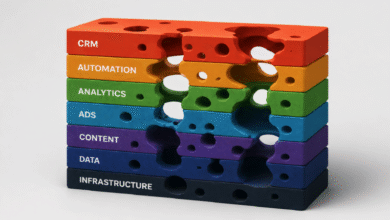
The problem was never CRM itself. It was how it was implemented. Most systems were originally designed to store records and power lifecycle campaigns. They helped marketers segment audiences and deliver messages via email, SMS, and push notifications. But they were rarely connected to the systems that actually captured customer behavior.
Commerce platforms held transaction data. Loyalty programs tracked engagement and preferences. Media platforms executed paid messaging. Each system contained valuable customer signals, but they operated independently. This data siloing left CRM functioning without a complete picture of the customer.
This disconnect created operational headaches. Marketing teams made decisions based on partial information. Messages were triggered without awareness of recent purchases or interactions in other channels. Personalization efforts stalled because the necessary data lived on different platforms. Roughly 75% of marketing challenges stem from data issues rather than tools, reinforcing that fragmentation, not technology, is the core problem.
Customer experiences became inconsistent. Teams moved slowly because insights required piecing together across systems. Marketing activity became too difficult to connect to real business outcomes. CRM could store information and send messages, but it could not guide decisions.
CRM as the backbone of commerce, loyalty, and messaging
Advancements in data infrastructure, identity resolution, and artificial intelligence have allowed CRM systems to evolve beyond campaign execution tools. Instead of operating primarily as storage systems, modern CRM platforms now analyze signals across the business and guide how brands engage customers.
Commerce platforms generate some of the strongest customer behavior signals. They reveal what people buy, how often they purchase, and when their behavior changes. When this data flows into the CRM, AI can analyze purchasing patterns and behavioral signals to help teams recognize changes in intent, such as when a customer is ready to purchase, upgrade, or replenish.
Loyalty is evolving as well. Traditional programs focused on points and perks designed to drive repeat purchases. Today, loyalty is increasingly defined by trust and value exchange. CRM systems can analyze engagement signals, feedback, and the first- and zero-party data customers intentionally share. This helps organizations better understand the strength of customer relationships and identify opportunities to deepen them.
Messaging is no longer static. Instead of simply deciding what to say, CRM increasingly helps determine when, where, and why a brand should engage. AI-driven decisioning can evaluate signals from across the customer journey to coordinate engagement across channels rather than relying on isolated campaigns.
When commerce, loyalty, and messaging connect through CRM, companies can coordinate engagement across teams, channels, and moments. CRM becomes the system that translates customer signals into coordinated decisions that strengthen relationships and drive growth.
The CRM operating model shift brands must make
As CRM becomes the system guiding customer decisions, organizations must rethink how it’s used internally.
CRM can no longer sit in isolation within a single marketing function. It needs to operate as a shared decision layer across marketing, media, customer experience, and growth teams. Each group interacts with customers differently, but they must operate from the same customer signals, identity framework, and shared understanding of the customer journey.
This shift will allow companies to move from disconnected campaigns towards coordinated engagement. Instead of separate teams managing individual channels, CRM can orchestrate how brands show up across commerce platforms, loyalty programs, paid media, and owned messaging environments.
Going forward, organizations need readiness assessments and clear path-to-value frameworks that help teams connect customer data to business outcomes. These frameworks allow teams to align around common signals, such as identity, engagement behavior, and customer value, rather than relying on fragmented metrics across departments.
Most importantly, success depends on ownership across the organization. CRM can’t be a tool used by only one team. It must function across departments, with shared responsibility for how customer signals are understood and how decisions are made. Tools enable the change, but alignment, proper oversight, and collaboration are what ultimately allow CRM to function as a true operating model.
CRM as the operating model for growth
CRM success is no longer defined by the extent of implementation or the number of campaigns it runs. What matters now is whether CRM helps the business make better decisions. Marketing leaders face growing pressure to prove impact while managing tighter budgets, and customers expect seamless experiences across every interaction.
The future of CRM will be shaped by intelligent systems that connect data and help teams quickly act on customer signals. Gartner predicts that AI will influence or automate roughly 50% of business decisions by 2027, accelerating the shift toward more connected, decision-driven operating models.
Within this AI-driven environment, CRM is the foundation for growth. It links marketing activity to metrics, such as lifetime value, acquisition efficiency, and profitability, helping marketing teams demonstrate their contribution to the business.
Brands that treat CRM as an operating model rather than a standalone tool have a structural advantage. Decisions are made faster when based on shared customer signals. They build trust through transparent data exchanges and create coordinated experiences across channels.
CRM is no longer simply where customer data lives. It’s now becoming the system that helps organizations understand customers, make decisions, and grow with them over time.
(Source: MarTech)