Philips & AOC Unveil World’s First 1,000Hz Gaming Monitors
▼ Summary
– Philips and AOC have announced the world’s first 27-inch 1440p gaming monitors with a 500 Hz refresh rate and an alternative 1080p mode at 1,000 Hz.
– The monitors likely use an IPS panel technology, indicated by a 1ms response time and a 2,000:1 contrast ratio, which is higher than conventional IPS.
– These panels have VESA DisplayHDR 400 certification, placing them as entry-level HDR displays without local dimming.
– The 1,000 Hz mode’s image quality will suffer due to the lack of integer scaling when displaying 1080p on the native 1440p panel.
– The actual benefit of a 1,000 Hz refresh rate for most gamers is questionable, as LCD panel limitations prevent full motion clarity gains compared to OLED.
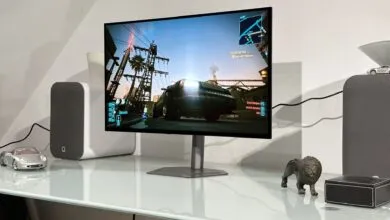
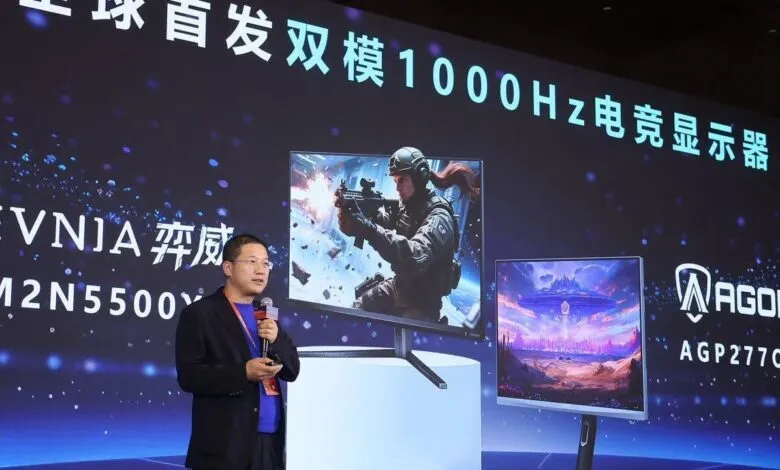
The world of competitive gaming is about to get a significant speed boost with the introduction of the first monitors claiming a 1,000Hz refresh rate. Philips and its sister brand AOC have unveiled two new models, the Philips Evnia 27M2N5500XD and the AOC AGON Pro AGP277QK. These 27-inch displays feature a native 1440p resolution with a 500Hz refresh rate, but they also offer an alternative 1080p mode that pushes the refresh rate to an unprecedented 1,000Hz. While the exact panel technology remains officially unconfirmed, available specifications strongly suggest a form of IPS technology, likely similar to LG’s IPS Black, given the quoted 2,000:1 static contrast ratio, a figure well above conventional IPS panels.
These monitors are reported to carry VESA DisplayHDR 400 certification, placing them in the entry-level tier for high dynamic range content. This means they will not feature local dimming technology. The quoted response time is 1ms GtG (gray-to-gray), which is standard for high-performance IPS panels. However, there are important technical considerations. Running the monitor at 1080p on a 1440p native panel does not allow for integer scaling, which is the optimal method for maintaining image quality when displaying a non-native resolution. Consequently, while the 1,000Hz mode promises incredible speed, visual fidelity in that mode is expected to suffer.
Furthermore, the relationship between the claimed 1ms response time and the 1,000Hz refresh rate raises questions. In an ideal scenario, a 1ms response would perfectly match a 1,000Hz refresh cycle. Yet, in practice, even the fastest IPS panels rarely achieve a true 1ms response across all transitions. This potential mismatch could limit the full motion clarity benefits of such a high refresh rate, especially compared to technologies like OLED with near-instantaneous pixel response. The actual visual experience of 1,000Hz on these LCD panels remains to be seen.
Philips and AOC are not the only companies targeting this extreme refresh rate. Another manufacturer, AntGamer, announced a 1,000Hz monitor last September. That model, however, is a different proposition, featuring a 25-inch screen, TN panel technology, and a native 1080p resolution. This sets the stage for a race to market, making the “world’s first” claim dependent on which product actually becomes available for purchase first.
For the average gamer, the tangible benefits of a 1,000Hz refresh rate are debatable, particularly regarding input latency where diminishing returns set in well before this extreme. For professional esports athletes, however, even a minuscule theoretical advantage can be pursued. The primary potential benefit lies in motion clarity, but this is heavily contingent on having a panel with a response time fast enough to keep up with the refresh cycle. Until these monitors are independently tested, the real-world competitive edge offered by 1,000Hz remains an open and intriguing question for the high-end gaming community.
(Source: PC Gamer)